Most coaches I talk to want to move some part of their business online. Almost none of them actually do it. The reason is almost always the same. They are quietly terrified that the second they stop standing next to their clients, the clients will work out that they did not really need them there in the first place.
I had that fear. I built my coaching business on the gym floor at Olympus Gym in Sydney's south-west under the mentorship of Maurice, who has been at this for longer than most of us have been alive. So when the idea of shifting part of my work online came up, I had the same little voice most coaches have. Clients pay me because I am there. What happens when I am not?
Here is what actually happens, based on doing this with my own roster at Stealth Conditioning. If you handle the transition properly, you do not just keep your clients. You coach them better, and your business gets healthier in every way that matters.
You can also get this badly wrong. Most of what gets posted about the in-person-to-online shift is aspirational nonsense written by people who have never had a real client roster to protect. So here is the actual playbook I used.
Quick answer
To move from in-person to online coaching without losing clients, set up your platform, program library, and check-in cadence before you announce anything. Talk to each client one-on-one about what changes and what stays. Go hybrid first, hold existing pricing steady, then reprice once the model works.
Start With Why You Are Actually Doing This
Before you tell a single client, you need to be dead honest with yourself about why you are making the move. Clients will ask. If you answer it badly, you will lose them before you have even started.
The wrong reasons, in my experience:
- You want to work less.
- You want to charge more for less work.
- You are bored.
- You saw someone on Instagram doing it and it looks like the easy option.
If any of those is your actual driver, do not start. Clients sense it immediately and they opt out.
The right reasons:
- You want to coach more clients without adding more hours to your week.
- You want to coach clients who are not geographically near you.
- You want to deliver a programming and check-in experience that is more thorough, more data-driven, and more consistent than what fits into a 60-minute floor session.
- You want to build a business that is less dependent on you physically being in one room.
The difference matters. The wrong reasons put you at the centre of the transition. The right reasons put the client at the centre. Clients know the difference.
For me, the honest answer was the last two. I wanted to coach people who were not in my local area, and I wanted the programming side of my work to be better than what I could fit into the space between sets. Online does both of those things if you build it properly, and the catchment it opens is bigger than most coaches expect: our report on how global online coaching has become found clients being coached across 152 countries, 42 of them with no local coach at all.
Do Not Tell Anyone Until Your Systems Are Ready
This is the biggest mistake I see coaches make. They announce the move, then spend three months fumbling around trying to figure out what platform to use, what their programs look like, and what they are actually supposed to send a client who is no longer in the room with them. By the time they are ready to deliver, half the client base has quietly moved on.
Do the opposite. Get everything ready first. Then tell people.
Here is what ready actually looks like:
- A platform that handles program delivery, exercise videos, and client feedback. Do not cobble this together with PDFs and WhatsApp. It does not scale and it makes you look amateur. Our guide on moving coaching off spreadsheets and WhatsApp covers the migration order and what the move actually costs in time, and if you want to keep WhatsApp for the relationship while the record moves, the guide to coaching clients on WhatsApp covers the split.
- A library of your core programs built in that platform. Not one program. A library. The programs you run most often, ready to assign.
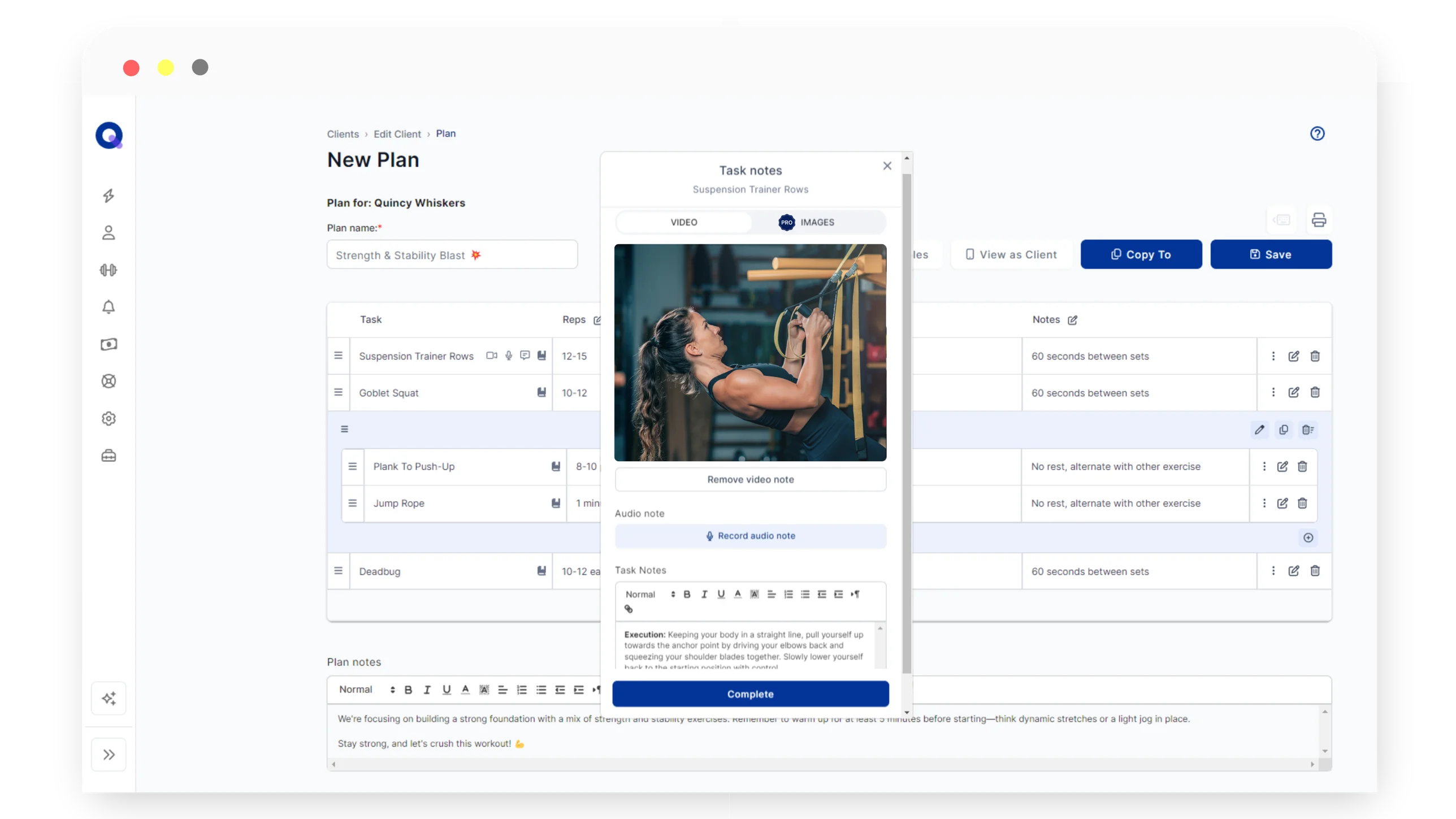
- A video library of the exercises you actually use, linked into your tasks, so clients have demo on tap. These do not need to be your own videos. YouTube is full of excellent demonstrations that will do the job.
- A clear check-in cadence. Weekly, fortnightly, whatever your model is. Set it up so it runs on rails.
- A welcome flow. The first 7 days after a client moves online are make-or-break. What they experience in that window decides whether they stay.
QuickCoach works particularly well for this kind of setup because it handles program delivery, client feedback, and communication in one place, without the bloat of enterprise platforms. If you want the full picture of what's included on the paid tier, the QuickCoach Pro features and pricing breakdown covers it. Not sure where to start? It helps to read up on how to choose coaching software before you commit, and there's a roundup of the best free coaching software for 2026 if you want to start without paying. Whatever you choose, choose one and get good at it before you start telling clients. Tool-hopping mid-transition is the fastest way to lose trust.
The Conversation With Existing Clients
Most coaches agonise over this. In my experience the conversation is not actually that hard if you have the first two steps right.
I spoke to every client individually. Not a group email. Not an Instagram post. A face-to-face conversation at the end of a session, or a phone call if they were already remote.
The structure I used, roughly:
- Here is what I am doing and why. Short. Honest. "I am moving part of my coaching online because I want to deliver better programming and more consistent check-ins than I can fit between sets."
- Here is what it means for you specifically. Not for "my clients". For you. What your training will look like. What the check-ins will look like. What you will get that you are not getting now.
- Here is what stays the same. For my Olympus clients, the answer was often "you still see me on the floor, I am just going to add structured programming and check-ins on top of what we already do".
- Here is the pricing. More on this below.
- Here is what happens next if you are in.
Most clients said yes in the conversation. A couple wanted to think about it. One or two opted out, and in every one of those cases it turned out they had been looking for a reason to step back from coaching anyway. Those clients were not lost to online. They were going to leave regardless.
Hybrid First. Always.
The biggest single thing I got right, and the thing I would push hardest on any coach making this move, is that I did not go 100 percent online overnight. I still coach on the floor at Olympus. Plenty of my clients still want, and get, that in-person piece. What changed is that their programming and their check-ins now happen online, through a platform, with structure and data behind them.
There are things the gym floor does that online genuinely cannot replicate. Real-time cueing. Spotting. The coaching eye. Presence. If you pretend those things do not matter, you are kidding yourself, and you will lose clients who value them.
The smart move is to keep the part of your service that can only happen in-person, and add the part that is actually better when delivered online. Good programming. Consistent check-ins. A record of everything your client has done. Written feedback the client can go back to. Video demos for any exercise you throw at them.
Hybrid gives you the best of both. It also gives your clients the softest possible on-ramp to working with you online, which is exactly what you want when you are trying to hold the existing base together.
If hybrid ends up being where you settle rather than a phase on the way to fully remote, that is completely normal. The QuickCoach guide on running a hybrid personal training model covers how to price the in-person and online tiers separately and keep the admin from doubling once you are running both for the long term.
How I Priced the Transition
Pricing is where a lot of coaches lose people, so I was careful here.
For existing clients, I did not change what they were paying. If someone was on a package with me for in-person sessions, they kept that package. The online programming and check-ins were added on top at no extra cost for the first three months. I treated that window as my investment in getting the transition right, not a revenue opportunity.
After three months, I repriced. By then I had a model that was working, clients had seen the value of structured online programming, and the conversation about restructuring pricing was grounded in something they had actually experienced. Not a hypothetical.
For new clients from that point forward, I priced the online offering properly from day one. If you are starting fresh today, price from day one. Do not discount out the gate just because online feels less tangible to you. The value is real, and the price you set on launch is the price that anchors every conversation going forward.
If you are stuck on what that day-one number should actually be, the QuickCoach guide on how much to charge for online coaching walks through the income-first formula I wish someone had handed me, with worked examples at different roster sizes.
What I Would Do Differently
Three things, if I was starting again tomorrow.
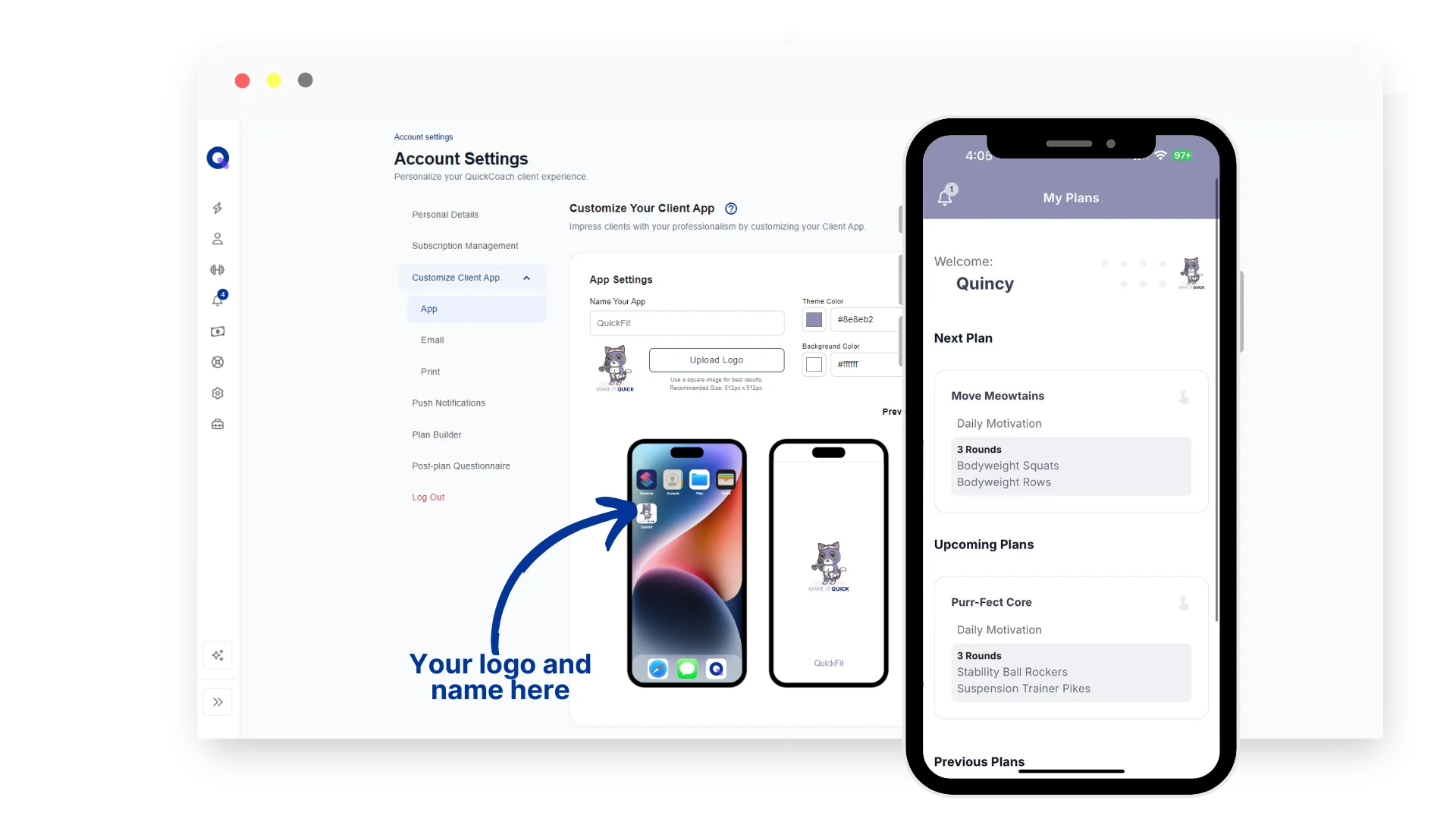
- I would have filmed more of my own exercise demos earlier. I relied heavily on YouTube, which works and is absolutely legitimate, but there is a small brand compounding effect when clients see you in the demos that I underestimated at the time. The same logic applies to anything your clients see, which is why getting your client app branded with your logo and colours early on is worth the 30 minutes it takes.
- I would have set a stricter check-in cadence from day one. I was too flexible in the early months and some clients drifted because nothing felt scheduled. The coaches who retain best are the ones whose clients know exactly when the next touchpoint is.
- I would have told my clients sooner that I was confident about the move. I soft-pedalled it at first because I was still unsure myself. Clients read that hesitation and it made them hesitate too. Confidence in the transition, from day one of the conversation, would have shortened the whole arc.
Why the Business Is Better Now
A few things that matter.
- My client roster is bigger than it was when I was purely in-person, without adding hours to my week.
- Client retention is measurably higher, because the programming and check-in rhythm is more consistent than anything I could sustain on pure floor coaching alone.
- The quality of my coaching has actually gone up. I have more data on every client, I can see patterns over months instead of sessions, and I can adjust programming off evidence rather than instinct.
- The business is less dependent on my physical presence in one postcode, which means it is more resilient and more valuable.
None of that was automatic. All of it came from handling the transition carefully, not quickly.
One side benefit I did not expect: when clients finish a session in the app, they can share the workout straight to their socials with my branding on it. A handful of my online clients now do this regularly, and the new enquiries that come from those posts are warmer than anything paid advertising has produced for me.
A note for coaches reading this without an existing roster to bring across: the playbook changes when you are starting from zero rather than transitioning, and the QuickCoach guide on getting your first 10 online coaching clients covers that version, including a fair bit of what worked for me.
If you are thinking about making this move, my honest advice is do not wait for the perfect moment. Get your systems ready. Have the conversations properly. Go hybrid. Price it right. And back yourself. The clients worth keeping will stay. The ones who leave were leaving anyway. And the coaching you deliver in 12 months will be better than anything you can deliver right now off the floor alone.
Frequently Asked Questions
How do I transition from in-person to online coaching without losing clients?
Get your systems ready before you tell anyone. Have a face-to-face conversation with each existing client about what changes and what stays the same. Go hybrid first rather than fully online. Hold pricing steady for existing clients during the transition window, then reprice once the model is working.
Should I tell clients I'm going online before my systems are ready?
No. Build your platform setup, program library, exercise video library, check-in cadence, and welcome flow first. Announcing too early and then fumbling through setup is the fastest way to lose clients during the transition.
Is hybrid coaching better than going fully online?
For most coaches with an existing in-person client base, hybrid is the safer move. Keep what only works in person, like real-time cueing, spotting, and presence. Add online programming and structured check-ins on top. Hybrid gives clients the softest on-ramp to working with you online.
How should I price the transition to online coaching?
For existing clients, do not change pricing in the first three months. Treat that window as your investment in getting the model right. After three months, reprice based on what's actually working. For new clients, price the online offering properly from day one rather than discounting on launch.
About Nick
Nick Hogan is the founder of Stealth Conditioning and a coach at Olympus Gym in Sydney, Australia. He holds a Bachelor of Sports and Exercise Science from Western Sydney University and specialises in hypertrophy.
Questions about the transition, or about the QuickCoach platform? Reach out at support@quickcoach.fit.