Writing a client programme from scratch every time is like making your coffee by hand-picking the beans each morning. You can do it, but the effort does not scale with the result, and nobody benefits from it being that slow.
The coaches who write programmes fastest are not rushing. They are not cutting corners either. They have built a library of reusable templates, progression blocks, and matching systems that let them work quickly on any new programme because they have already solved most of the underlying problems before. Every programme they write makes the next one faster.
This article is about building that library. Speed is a by-product. The real output is a growing asset that accumulates value every time you use it.
Quick answer
To write client workout programs faster, build five or six base templates matched to your common client types, document progression blocks for the movements you use most, and clone the closest match for each new client instead of starting blank. The speed comes from the system, not from rushing.
Where the time actually goes
Before building a faster process, it is worth knowing where the slow parts are. For most coaches, programme writing time concentrates in three places.
The first is the blank-page problem: starting from nothing on each new client because there is no template that fits them well enough to build from. This is the most common and most fixable.
The second is rebuilding exercise progressions from scratch. Deciding what comes after a goblet squat for a beginner who is ready to load the pattern, or how to bridge from a Romanian deadlift to a conventional pull, is work you should only have to think through carefully once. After that, the answer should be documented somewhere you can reach it.
The third is over-individualisation: writing a fully custom programme for a client whose training age, goals, and movement history are very similar to three other clients you already coach. The programme looks different because the name at the top is different, but the underlying structure is the same.
None of these are solved by working faster. They are solved by working from a better system.
The assessment-to-template match
The fastest route to a first programme is a clear matching rule between a client's assessment findings and the template you build from.
A simple matching framework has three axes: training age, primary goal, and any constraints. An assessment that covers those three axes in ten minutes tells you which of five or six base templates to pull.
| Matching axis | Options to assess | What it determines |
|---|---|---|
| Training age | Beginner, intermediate, experienced | Exercise complexity and starting loads |
| Primary goal | Strength and performance, body composition, general fitness and health | Session structure and rep schemes |
| Constraints | Injuries, equipment limits, time per session | Exercise substitutions and session length |
You do not need dozens of templates. You need five or six that genuinely cover the range of clients you take on, built well enough that cloning and adjusting one takes less time than starting fresh. The goal is not a template for every possible client; it is a template for every common client type, with clear notes on what to change for the exceptions.
Building those templates properly is a one-time investment. Once they exist, matching takes minutes, not decisions.
Progression blocks: the time-saving asset most coaches don't have
A progression block is a planned sequence of exercise variations that advances a movement pattern over time. Instead of deciding what comes after each exercise when a client plateaus or adapts, you have already mapped the sequence and can drop the next variation in without rethinking the programme architecture.
A basic squat progression for a general fitness client might run: goblet squat to box squat to front squat to low-bar back squat, with loading and rep scheme notes at each stage. A pulling progression might run: lat pulldown to assisted pull-up to banded pull-up to strict pull-up to weighted pull-up. The specific path depends on your coaching philosophy and your client population. The point is that you decide it once and document it, rather than redeciding it case by case.
Progression blocks also make programme reviews faster. When a client's eight-week block ends and they have hit their targets, you are not writing a new programme. You are moving them to the next block in the sequence you already built.
Clone and adjust, don't rebuild
Think of your template library the way a solicitor thinks about precedent documents. You do not draft a new contract from scratch for each client. You start from the closest precedent, adjust the specific clauses that need to change, and use the work you have already done as the foundation. The specificity comes from the adjustments, not from the rebuild.
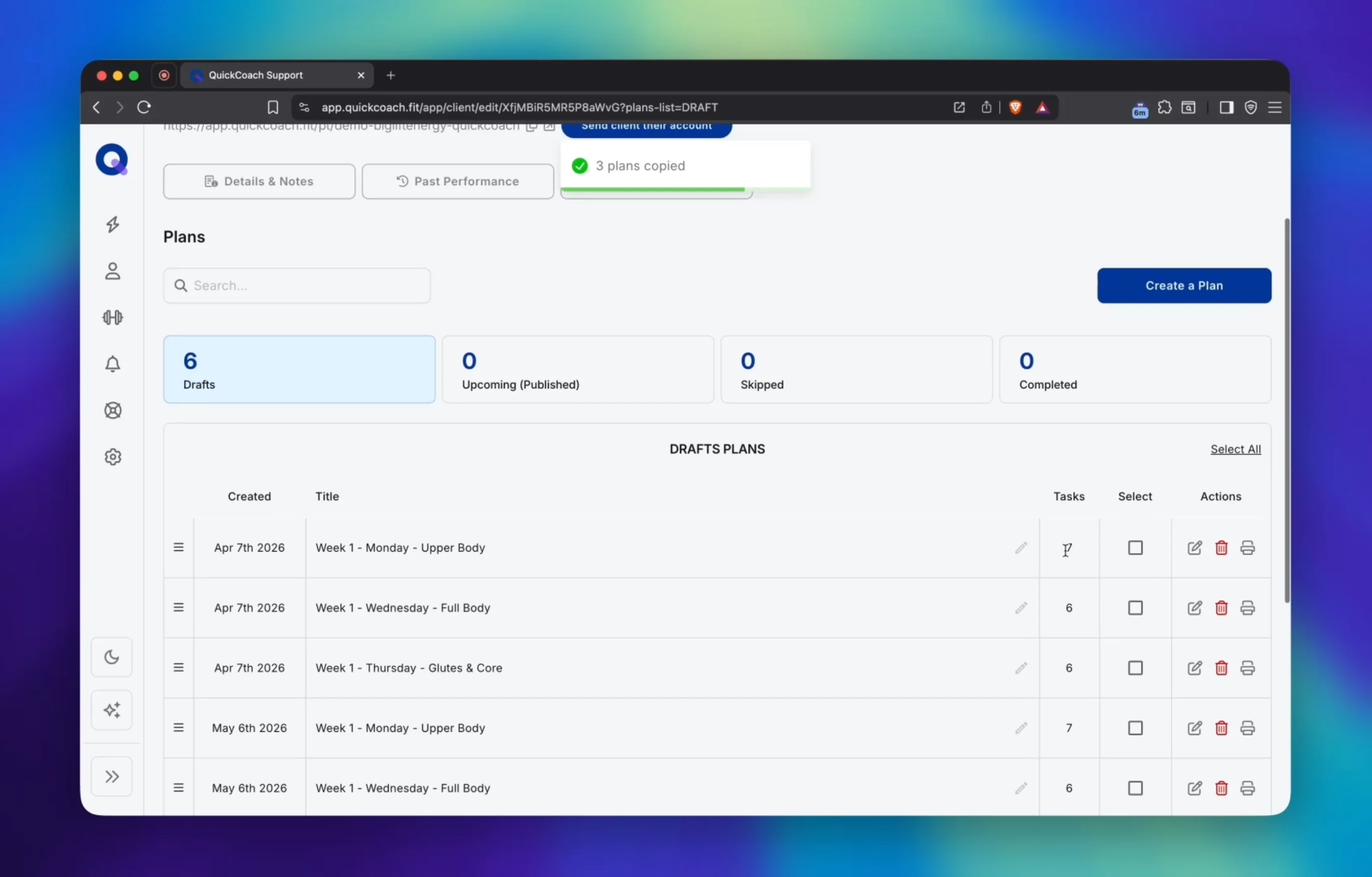
When a new client's profile matches an existing client closely enough, the right move is to clone that client's programme and adjust for the differences. The adjustment should be the work, not the rebuild. The mechanics of doing this inside a coaching app are covered in the QuickTips guide on building repeating workout programs faster, which walks through cloning and templates step by step.
This requires honesty about when programmes are actually different in a way that matters versus different in a way that just makes them look custom. A beginner general fitness client training three days per week with no injuries or equipment constraints probably does not need a programme that looks architecturally different from the last beginner general fitness client you onboarded. The exercises can vary. The structure probably should not.
When individualisation actually matters
There is a real argument for genuine individualisation, and it is worth naming clearly so it does not get lost in the efficiency framing.
Individualisation matters most in four cases: significant movement limitations or injury history that requires exercise substitution at a structural level; clients whose primary goal is performance in a specific sport or activity; clients with sufficiently advanced training age that the marginal gains from specificity are large; and clients whose history with training is complicated in ways that affect adherence as much as programming, where the programme itself is partly a motivational object.
For most general fitness and body composition clients at beginner to intermediate level, the difference between a well-matched template-derived programme and a fully custom one is small, and the difference in outcome for the client is smaller than the difference in your time cost. That time is better spent on check-ins, coaching cues, and the relationship than on programme architecture the client will not notice.
The professional skill is knowing which clients warrant more time at the programme stage and which ones get a well-executed template. That judgement develops with experience, but it is also something you can make explicit rather than leaving it to intuition each time.
Building the library: where to start
If you are starting from no templates at all, the fastest way to build the library is to work backwards from your current client roster.
Take your five most similar clients. Look at what you wrote for them. Extract the common structure: the session layout, the exercise categories, the loading scheme, the progression logic. That common structure is your first template. There is usually more of it than you expect: across the platform, most programs share the same frame of roughly four days a week and six exercises a session, which we break down in the anatomy of an online coaching program. Fill in the variation choices, add progression notes for the exercises you use most, and document the adjustment rules for the things that typically differ.
Repeat for the next group of similar clients. Within a month of normal work, you will have built four or five templates that cover most of what you do, derived from real programmes you have already written rather than constructed theoretically.
The discipline is then to use and improve them rather than defaulting back to blank-page building. Each time you make a meaningful adjustment to a template, either because the client's situation required it or because you spotted a structural improvement, update the template. The library compounds.
The programme-writing workflow, stated simply
Run the assessment. Match the client to a template tier using the three-axis framework. Clone the closest matching template. Adjust for the client's specific constraints, history, and goals. Add exercise notes and any technique cues the client will need for unfamiliar movements. Review the programme as a whole for balance and progression logic. Deliver it.
The total time for a well-matched client with no unusual requirements should be thirty to forty-five minutes for the first programme, dropping to fifteen to twenty minutes once you have coached them through one block and the template is already tuned to their training. A rebuild from scratch for the same client would take longer every time, and would not produce a meaningfully better outcome. The QuickCoach program builder and client app are built around exactly this clone-and-adjust workflow, and both sit on the free tier.
If the time per programme is still high and the template matching feels like the bottleneck, that is usually a signal that the templates need work: either there are not enough of them to cover your client range, or they are under-documented and require too many decisions at the adjustment stage.
The library as a reason to stay
There is a secondary benefit to a well-built template library that is worth naming, because it changes what the library is worth beyond time savings.
A coach whose progression blocks, template structures, and cloning workflow exist inside a coaching platform has built something that does not travel easily. The templates are in the tool. The client history is in the tool. The progression records are in the tool. Switching platforms means rebuilding that accumulated system, which is a significant friction cost. The library is both a professional asset and a structural reason to stay with the platform you have built it on.
That is not a reason to stay on a bad platform. It is a reason to be deliberate about which platform you build on, and to take the template-building seriously once you have made that choice.
If you are thinking about how programme writing fits into your overall capacity, the guide on how many clients an online coach can actually handle covers the full breakdown, including a worksheet you can use to calculate your own ceiling. Rebuilding programmes from scratch is one of the biggest hidden drains on that ceiling, which is exactly what the library fixes.
Frequently Asked Questions
How do I write workout programs for clients faster?
Stop starting from a blank page. Build a small library of five or six base templates that cover your common client types, document progression blocks for the movements you program most, and clone the closest-matching template for each new client instead of rebuilding. The speed comes from the system, not from rushing the work.
How many workout templates does a coach actually need?
Five or six that genuinely cover the range of clients you take on, matched by training age, primary goal, and constraints. You do not need a template for every possible client, just one for every common client type, with clear notes on what to change for the exceptions.
What is a progression block in program design?
A progression block is a planned sequence of exercise variations that advances a movement pattern over time. Instead of deciding what comes next when a client adapts, you map the sequence once (for example goblet squat to box squat to front squat to back squat) and drop the next variation in without rethinking the program architecture.
Does using templates mean clients get a generic program?
No, if you match and adjust properly. For most beginner to intermediate general fitness and body composition clients, a well-matched template-derived program produces the same outcome as a fully custom one. Genuine individualisation matters most for injury history, sport-specific goals, advanced trainees, and complex adherence cases.
Questions about building your template library in QuickCoach? Reach out at support@quickcoach.fit.