There is no rulebook that tells a coach to put a row in week one. Every plan is a free choice, built movement by movement for the person it is for. So when the same handful of exercises keeps turning up across plan after plan, that is not a template doing the work, it is thousands of coaches independently reaching for the same tools. We wanted to see which tools, so instead of guessing we read our own programming data.
QuickCoach is used by more than 40,000 coaches and fitness businesses worldwide. For this report we looked across three months of 2026 programming activity on active coaching plans, hundreds of thousands of assigned exercises in all, and grouped every spelling of the same movement into one canonical exercise. The result is a clean ranking of what coaches assign in practice, not what a textbook says they should.
The short answer
Rows and squats lead by a clear margin. A row of some kind appears in about 27% of active coaching programs and a squat in about 24%, followed by the push up, bicep curl and shoulder press. The top of the list is foundational strength work, with no fads and nothing a coach would have to oversell.
What this is, in one paragraph
This is a read of what coaches program, not a survey of opinion. We looked at three months of 2026 exercise programming across active coaching plans on QuickCoach, hundreds of thousands of assigned exercises in total, and grouped every spelling and naming variant of the same movement into one canonical exercise. Each movement's figure is the share of active programs that include it at least once. Everything is aggregated and anonymised, with no individual coach, client or plan identifiable. The full method sits at the foot of the page.
What are the most-programmed exercises in online coaching?
The ranking is led by movements nobody would call exotic. A row of some kind tops the list, just ahead of the squat, and the rest of the top fifteen reads like the contents page of a sensible strength program. Here is the share of active programs each movement appears in.
The 15 most-programmed movements
Share of active coaching programs that include each movement, every spelling grouped together
Just outside the top fifteen sit the split squat, pull up, crunch, calf raise and hip thrust, each in 7-8% of programs. Figures are the share of active programs that include the movement at least once.
Two things stand out. The first is how far ahead the row and the squat sit. No single movement is in every plan, and it would be strange if one were, but a pulling movement and a squatting movement anchor a quarter of all programs each. The second is what fills the rest of the list. Presses, hinges, lunges and the big compound lifts, then curls and tricep work close behind. Coaches build around the staples, then add the accessory work clients enjoy and ask for.
How the work splits across movement patterns
Group every movement by pattern rather than by name and the balance becomes clearer. Squatting, pulling and pushing make up the bulk of what coaches program, with hinge work, mobility and core close behind. Carries are the one clear outlier, named far less often than their training value would suggest.
Share of programming by movement pattern
How the most-programmed movements divide across the major patterns
Shares are each pattern's slice of classified movements. Mobility and warm-up work is programmed deliberately, not as an afterthought.
The equipment mix tells the same accessible story. A lot of names are generic, such as squat, row or bench press, so the biggest slice is unspecified. Where the implement is named, bodyweight and dumbbell movements far outnumber barbell-only work. That fits a profession coaching plenty of clients at home or in a basic gym, where a pair of dumbbells and a mat has to carry the session. We have since put numbers on that direction in the equipment report, which counts how many programs could be run with minimal kit and keeps the same rule about not guessing an implement from a generic name.
The same exercise, spelled a dozen ways
Behind every clean number above is a mess of free text. The reason rows top the list is that, once you group them, the row is written down in dozens of ways. Coaches type what makes sense to them in the moment, and the same movement scatters across spellings, abbreviations and equipment notes.
Row
Row, Bent Over Row, Single Arm Row, Barbell Row, Renegade Row, Bent Over DB Row
Push Up
Push Up, Pushups, Push Ups, Push-Ups, push up
Romanian Deadlift
Romanian Deadlift, Dumbbell Romanian Deadlift, RDL, DB RDL, Barbell RDL
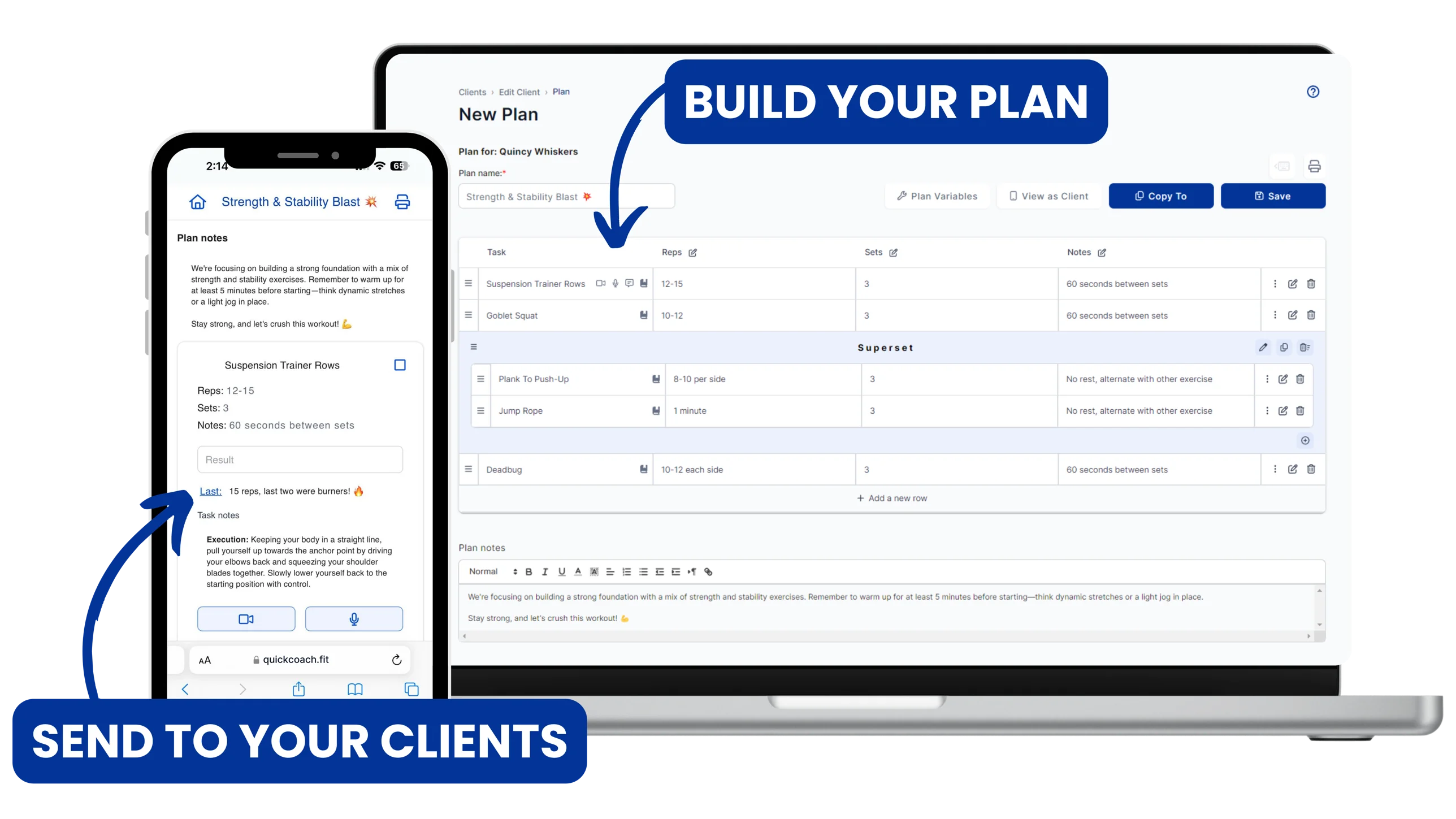
This is the quiet tax on programming by hand. Type a movement fresh each time and you lose the demo video, the cue, and any chance of seeing it the same way twice in your own data. Pull it from a shared exercise library instead and the row a client gets on Monday matches the one they got last block, with the same name and the same instructions, and you skip the retyping. Build a template around the staples once and most of a new client's plan is already done, which is the whole point of learning to build client workout programs faster and to reuse and repeat a program across clients rather than starting from a blank page every time.
Same staples, a fraction of the clicks
If a row, a squat and an RDL are in most of your plans anyway, there is no reason to type them out again for every client. Build the program once, reuse it, and put the saved hours back into coaching.
See how to build programs fasterWhat the rankings tell us about how coaches program
The headline is reassuring rather than surprising, and that is the point. There is no gimmick movement near the top, no trend exercise riding a moment. Rows, squats, presses, hinges and lunges fill the upper end of the list, the work that holds up across goals, ages and equipment. A list led by fads would say something worrying about the profession. This one says coaches are programming the things that work.
Accessories are clearly mainstream, not afterthoughts. The bicep curl lands fourth and tricep work sits inside the top fifteen, comfortable alongside the big lifts. Mobility and warm-up content earns its own place too, with prep routines and stretches programmed often enough to rank, which tells you coaches are scripting the on-ramp to a session, not just the lifting. And underneath the ranked list sits a long tail of thousands of distinct entries, tempo cues, side-specific notes and client-specific labels. That tail is personalisation at work: the same proven staples, shaped to the person in front of the coach.
What this means if you coach clients
If you coach, treat this as cover to keep it simple. The most effective coaches in our data are not reinventing the wheel each week, they are programming a tight set of movements they trust and spending their energy on execution, progression and the relationship. Chasing novelty for its own sake is not what separates good plans from bad ones.
It also points at where your time actually goes. The movements repeat, so the value you add is not in typing them out, it is in how you coach them and how well you keep up with each client. The coaches who protect that time tend to be the ones who systematise the repetitive part and guard against taking on more clients than they can genuinely look after, which we dig into in our look at how many clients an online coach can realistically handle.
This is also one more entry in a pattern we keep finding in our own data: the day-to-day of coaching is more repeatable, and more human, than it looks from outside. We have measured the geographic version in how global online coaching has become, the daily-timing version in when coaches work and when clients actually train, the calendar version in when the coaching year peaks, the structural version in the anatomy of a coaching program, the loading version in the rep ranges coaches actually run on, and the advice version in what coaches tell clients about supplements. The exercise list is the programming version of the same story.
Methodology and limitations
How we got these numbers
Source. Three months of 2026 exercise programming activity across active coaching plans on QuickCoach, a platform used by more than 40,000 coaches and fitness businesses worldwide. Hundreds of thousands of assigned exercises were included. No individual coach, client or plan is identifiable in anything published here.
Definitions. Exercise names are entered as free text, so every spelling, abbreviation and equipment variation of the same movement was grouped into one canonical exercise before counting. Each movement's figure is the share of active programs that include it at least once. A program that uses the same movement several times counts once for that movement. Genuine one-off custom names were left in the long tail rather than forced into a group.
Scope. This is a read of what coaches program, not an endorsement of any exercise or a claim about what clients should do. Pattern and equipment groupings are directional, since many names are generic and do not state the implement. Figures are rounded.
Privacy. Everything is aggregated across the platform. No personal data, client information or individual plan is exposed.
Frequently asked questions
What are the most common exercises online coaches program?
Rows and squats lead. In a 2026 QuickCoach analysis of programming across active coaching plans, a row of some kind appears in about 27% of programs and a squat in about 24%, followed by the push up, bicep curl and shoulder press. The top of the list is foundational strength work rather than anything faddish.
What is the single most-programmed exercise in online coaching?
The row. Once every variant is grouped together (bent over row, single arm row, barbell row and so on), a row of some kind appears in roughly one in four active coaching programs, more than any other movement, with the squat close behind.
Do coaches program barbell lifts or bodyweight and dumbbell work more?
Where the equipment is named, bodyweight and dumbbell movements are far more common than barbell-only work. Many of the most popular names are generic, such as squat, row or shoulder press, which leaves most programming accessible to clients training at home or in a basic gym.
How was this exercise data collected?
It is drawn from three months of aggregated 2026 programming activity across active coaching plans on QuickCoach, hundreds of thousands of assigned exercises in total. Every spelling of the same movement is grouped into one canonical exercise, and each figure is the share of active programs that include that movement. Everything is anonymised, with no individual coach or client identifiable.
Published June 2026. Figures are drawn from aggregated programming activity across QuickCoach's base of 40,000+ coaches and will be refreshed as the dataset grows. We now keep a continuously updated version of this ranking on what coaches actually program, refreshed monthly with the latest month's data. This report is one of eight we have pulled together into the complete picture of online coaching in 2026. For more on turning the repeatable parts of coaching into saved time, see how to build client workout programs faster and the quick way to reuse and repeat a program across clients. Questions about the data? Reach us at support@quickcoach.fit.