
Online coaching looks, from the outside, like a single continuous activity. In practice it runs on two separate clocks. The coach builds the program, reviews check-ins, and adjusts the plan. The client shows up later and does the work. We looked at platform activity data to see exactly how those two schedules line up, and where they diverge.
This report compares session activity from coaches and clients on QuickCoach, each measured in their own local time zone, across a base of more than 40,000 coaches. Client activity alone spans 152 countries. The point was not to guess when coaching happens, but to read it straight off the platform.
The short answer
Coach activity peaks between 8am and 12pm local time. Client activity peaks later, between 4pm and 8pm. The two groups move almost in step overnight and in the early morning, then diverge through the day: coaching activity stays elevated into the afternoon while client activity rises into the evening.
What this is, in one paragraph
This is a short platform study, not an industry survey. We took aggregated session activity from QuickCoach coaches and clients, converted each session to the user's own local time zone, and grouped it into six four-hour windows across the day. Coach figures come from aggregated coach session activity; client figures come from aggregated client session activity recorded across 152 countries. Figures are the share of total sessions falling in each window, unweighted and unadjusted. Everything is aggregated and anonymised, with no individual coach or client identifiable. The full method sits at the foot of the page.
When are online coaches most active?
The short answer
Coach activity peaks between 8am and 12pm local time, the highest single window of the day. This is typically when coaches build programs and review client check-ins ahead of when clients train.
Coach activity peaks sharply in the late morning, between eight o'clock and noon local time, the highest single window of the day. This is when most coaching work actually happens: building programs, reviewing client check-ins from the day before, and getting ahead of what each client will need. By early afternoon it is still elevated, then it tapers steadily into the evening. The morning, not the evening, is the coach's office.
When do clients actually train?
The short answer
Client session activity peaks between 4pm and 8pm local time, the window when most people are finishing work or school. This is several hours after the peak coaching window earlier in the day.
Client activity tells a different story. It builds steadily through the day and peaks in the early evening, between four and eight o'clock local time, the window when most people are out of work or school and heading to train. Where the coach's day front-loads, the client's day back-loads. The single busiest hours for the two groups sit several hours apart.
When coaches work and when clients train
Share of sessions by local time of day, coaches compared with clients (six four-hour windows)
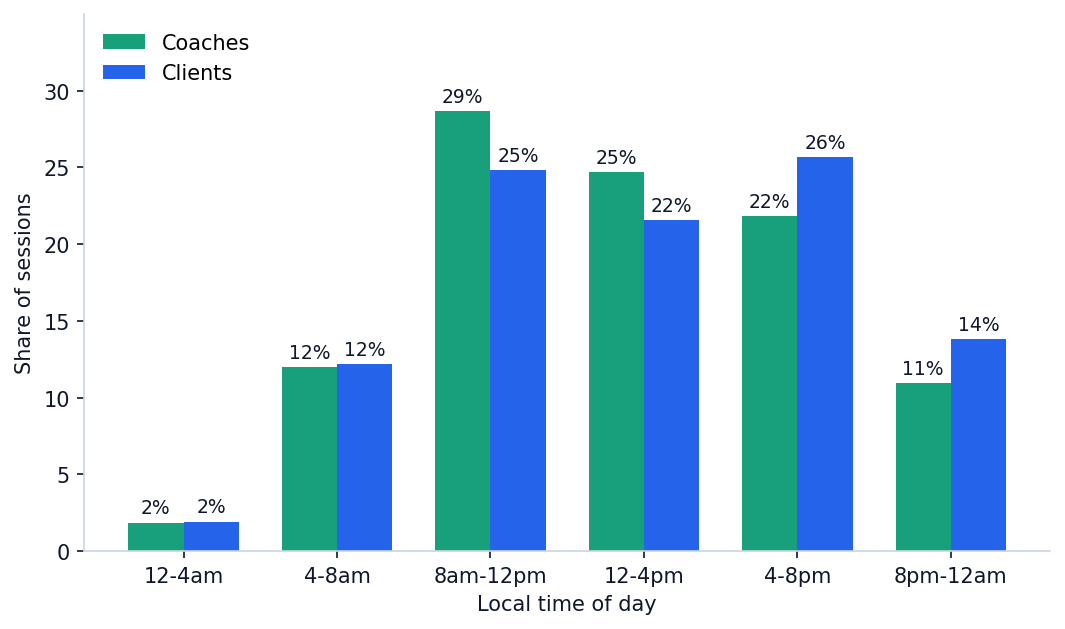
Coach activity peaks at 8am–12pm (29%); client activity peaks at 4pm–8pm (26%). Figures are unweighted shares of each group's sessions in the user's own local time zone.
The mornings overlap. The evenings don't.
Early in the day, coaches and clients move almost in step. Between midnight and eight in the morning the two groups are within a fraction of a percentage point of each other, both quiet overnight, both beginning to stir by sunrise. The split opens up in the second half of the day. Through midday and into the afternoon, coaching activity stays elevated while client activity climbs more slowly. By evening the pattern flips entirely: client activity is highest right as coaching activity is winding down for the day.
Read together, this is the shape of asynchronous coaching at scale. A coach's morning is spent preparing for sessions their clients haven't started yet. By the time a client opens the app to train in the evening, the program is already waiting for them. The handoff, not the meeting, is the unit of work.
Coaching on two schedules. Your time is still the limit.
If the work happens in the gaps between you and each client, the real question is how many of those handoffs you can keep up with before quality slips. It takes a couple of minutes to find out.
See how many clients you can handleWhy this matters
For anyone building tools or content for the fitness industry, this is a useful corrective. Coaching software, support, and communication that assumes coach and client are online at the same moment is solving for a pattern that exists for only part of the day. The more common reality is a relationship that runs on a relay, not a phone call, one person handing off to the other on a schedule that rarely lines up.
It also fits a pattern we keep seeing in our own data. The work of coaching is bigger and more distributed than the live-session image suggests: it crosses borders, time zones, and the hours of the day. We mapped the geographic version of that in how global online coaching has become, looked at the 42 countries with clients but no local coach, zoomed out to the whole calendar in when the coaching year peaks, and covered the advice-channel version in what coaches tell clients about supplements. The timing here is simply one more place that relay shows up.
Methodology and limitations
How we got these numbers
Source. Aggregated platform session activity for QuickCoach coaches and clients, drawn from a platform used by more than 40,000 coaches and fitness businesses worldwide. Each session was converted to the user's own local time zone and grouped into six four-hour windows across the day.
Definitions. A session is a discrete login or activity event. Coach figures are drawn from aggregated coach session activity; client figures are drawn from aggregated client session activity recorded across 152 countries. Figures represent the share of each group's total sessions falling in each window and are not weighted or adjusted.
Scope. This report describes platform usage patterns only. It does not capture activity that happens outside the app, such as in-person sessions or communication on other channels, and the two clocks reflect when people use QuickCoach rather than every minute they spend coaching or training.
Privacy. No individual coach or client is identifiable in anything published here. All figures are aggregated across the group.
Frequently asked questions
When are online coaches most active?
QuickCoach platform data shows coach activity peaks between 8am and 12pm local time, the highest single window of the day. This is typically when coaches build programs and review client check-ins ahead of when clients train.
When do online coaching clients train?
Client session activity peaks between 4pm and 8pm local time, the window when most people are finishing work or school. This is several hours after the peak coaching window earlier in the day.
Do online coaches and clients work at the same time?
Only partially. QuickCoach data shows coach and client activity overlap closely overnight and in the early morning, then diverge through the day. Coaching activity stays elevated into the afternoon while client activity rises later, peaking in the evening.
Is online coaching done in real time?
Mostly not. Session timing data suggests online coaching is largely asynchronous: coaches prepare programs and feedback in the morning, and clients use them later in the day, more like a relay than a live conversation.
Published June 2026. Figures are drawn from aggregated session activity across QuickCoach's coach and client base and will be refreshed as the dataset grows. The two-clock pattern is one piece of everything we have measured about online coaching in 2026. For more from the same data, see how global online coaching has become and how many clients an online coach can handle. Questions about the data? Reach us at support@quickcoach.fit.