Nobody has a good view of online coaching. Coaches see their own roster. Clients see their own plan. The industry commentary tends to be built from anecdote, a few surveys, and whatever a large brand felt like disclosing. The result is that a profession employing hundreds of thousands of people is mostly described by guesswork.
QuickCoach is used by more than 40,000 coaches and fitness businesses worldwide, which puts us in an unusual position: we can measure the ordinary. Not the outliers or the influencers, but the everyday work of coaches quietly training clients in 152 countries. Over the past year we have published that measurement one question at a time. This report puts the pieces together, and the picture that emerges is more global, more consistent and more human than the guesswork suggests.
The short answer
Online coaching in 2026 is global and everyday. On QuickCoach, clients train in 152 countries and coaches work in 110 of them. A typical program runs four sessions a week across an eight-week block, built from rows, squats and presses, with food and habits tracked alongside the training.
What this is, in one paragraph
This is a synthesis, not a new study. Every figure below comes from one of eight QuickCoach platform data reports published between June and July 2026, and each section links to the report it draws from so you can read the full method there. Because the underlying analyses answer different questions, their windows and denominators differ — a geographic share is a share of coaches, an exercise share is a share of programs, a tracking share is a share of tracking items. Those differences are stated as they arise and collected in the methodology at the foot of the page, along with an honest note about which figures are still approximate.
Where is online coaching actually happening?
The first surprise in our own data was how little of online coaching is where you would assume it is. Clients are active in 152 countries. Coaches are active in 110. The gap between those numbers is the story: 42 countries have people being coached and no local coach on the platform at all. Somebody in Kazakhstan or Bangladesh is being trained by somebody who is not in Kazakhstan or Bangladesh.
Coach supply is concentrated. The United States alone accounts for about 36% of coaches, and the four largest English-speaking markets together make up roughly 63%. But that concentration sits on top of a genuinely long tail: more than a hundred other countries share the remaining third.
Where the coaches are
Share of active coaches by country, top eight markets
Shares are the percentage of active coaches in a 90-day 2026 window. The top four markets reach roughly 63% cumulatively; 100+ further countries share the rest. Figures are rounded.
Where clients outnumber local coaches, that imbalance is not small. Seventeen markets run at three or more client sessions per coach session, and those markets account for about 28% of all client activity on the platform. More than a quarter of the coaching happening here is happening in places the supply has not caught up with.
Sources: How global is online coaching? and Coaching has no borders, which ranks the 42 gap markets.
What language does online coaching speak?
If coaching is in 110 countries, it is not being delivered in English everywhere. Using each coach's market as a proxy for their likely working language, English covers about 64% of coaches. Which means roughly a third of online coaching is conducted mainly in something else — Spanish is the largest at about 3.5%, then Italian at 1.8%, India's English-and-Hindi mix at 1.7%, and French at 1.5%, with about 27% spread across a hundred-plus other countries.
The more useful number is what happens when you overlay demand. Of the ten markets with the strongest unmet demand — the biggest imbalance between client and coach activity — nine are not English-first. Costa Rica runs at nearly nine client sessions per coach session. Thailand at eight. Chile at seven and a half. Denmark, Croatia, Israel, Finland and the Netherlands all appear. The growth edge of online coaching is not an English-language edge.
Source: The languages of online coaching. The 64% English figure is a floor rather than a ceiling: the market proxy cannot see a bilingual coach in London working in Portuguese, and the error runs in one direction — it overstates English.
When do coaches work, and when do clients train?
Coaching runs on two clocks that do not overlap. Coach activity peaks in the morning: about 29% of it falls between 8am and noon local time, the single busiest window of the day. Client training peaks in the evening: about 26% of client activity lands between 4pm and 8pm. The work of coaching and the work of training happen at opposite ends of the same day.
When coaches work
Share of coach activity by four-hour window, local time
Share of coach-side activity in each local-time window. Figures are rounded and sum to 101% before rounding adjustments.
When clients train
Share of client activity by four-hour window, local time
Share of client-side activity in each local-time window. Figures are rounded.
This is the asynchronous promise working exactly as advertised. The coach writes the session in the morning while the client is at work; the client runs it that evening while the coach is done for the day. Neither has to be present for the other. It is also the quiet reason online coaching scales at all — if coach and client had to share a clock, a roster would be capped by the hours in an evening.
Source: Coaches work mornings, clients train evenings.
When does the coaching year peak?
The calendar is the most predictable thing in coaching. January is the peak, by a distance nobody in the industry will find surprising. December is the floor, running at well under half of January's pace. What is more interesting is the middle: February through September holds a long, steady plateau rather than collapsing after the New Year rush. October and November sag before the December trough.
Inside the week, Monday is the strongest day and Saturday the quietest. The coaching week is a working week, front-loaded with setup: programs written, check-ins reviewed, the week put in place before it starts.
Source: When the online coaching year peaks. That report deliberately publishes shape rather than volume — no index values, signup counts or absolute totals appear in it or here.
What does a typical online coaching program look like?
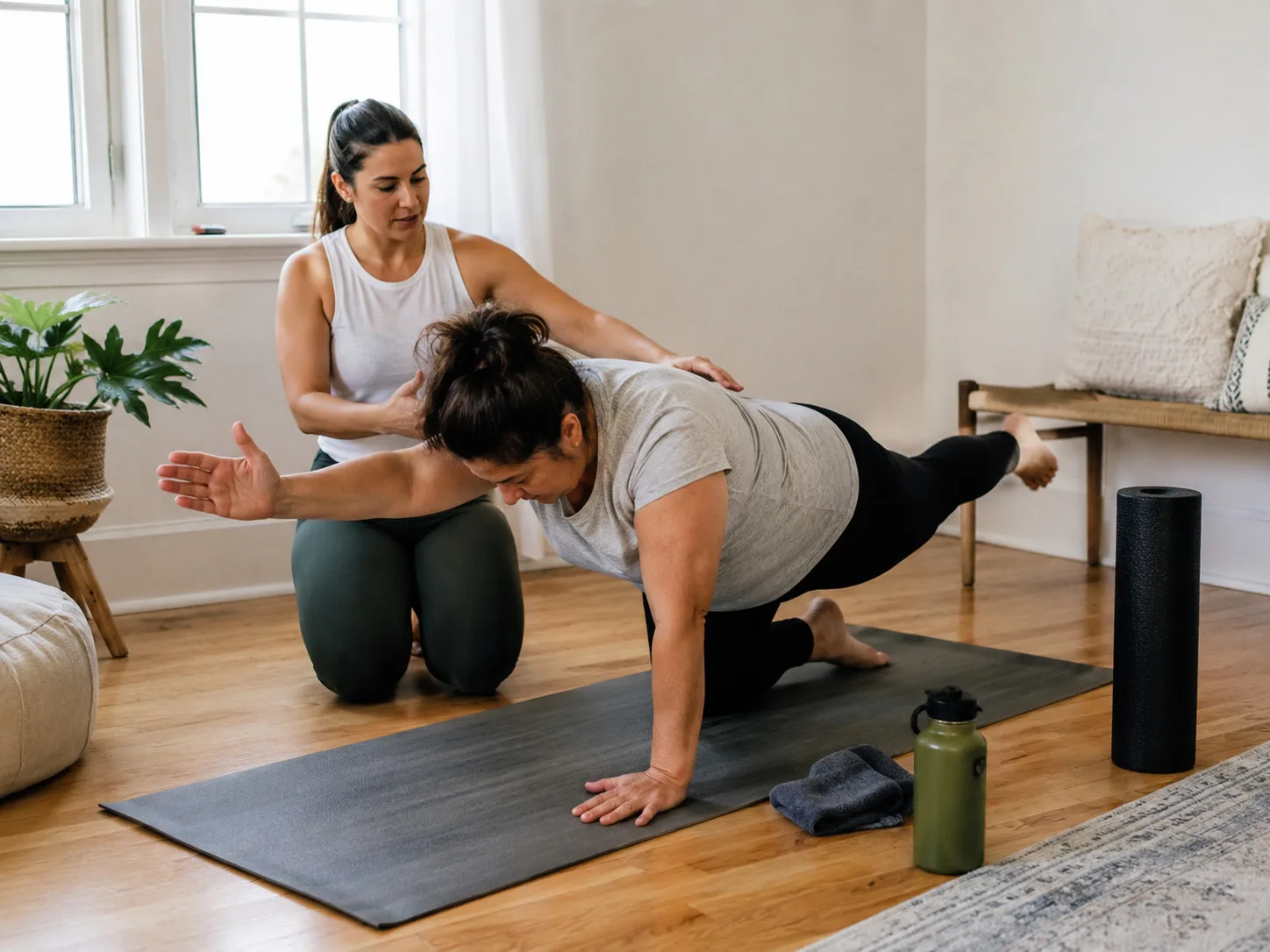
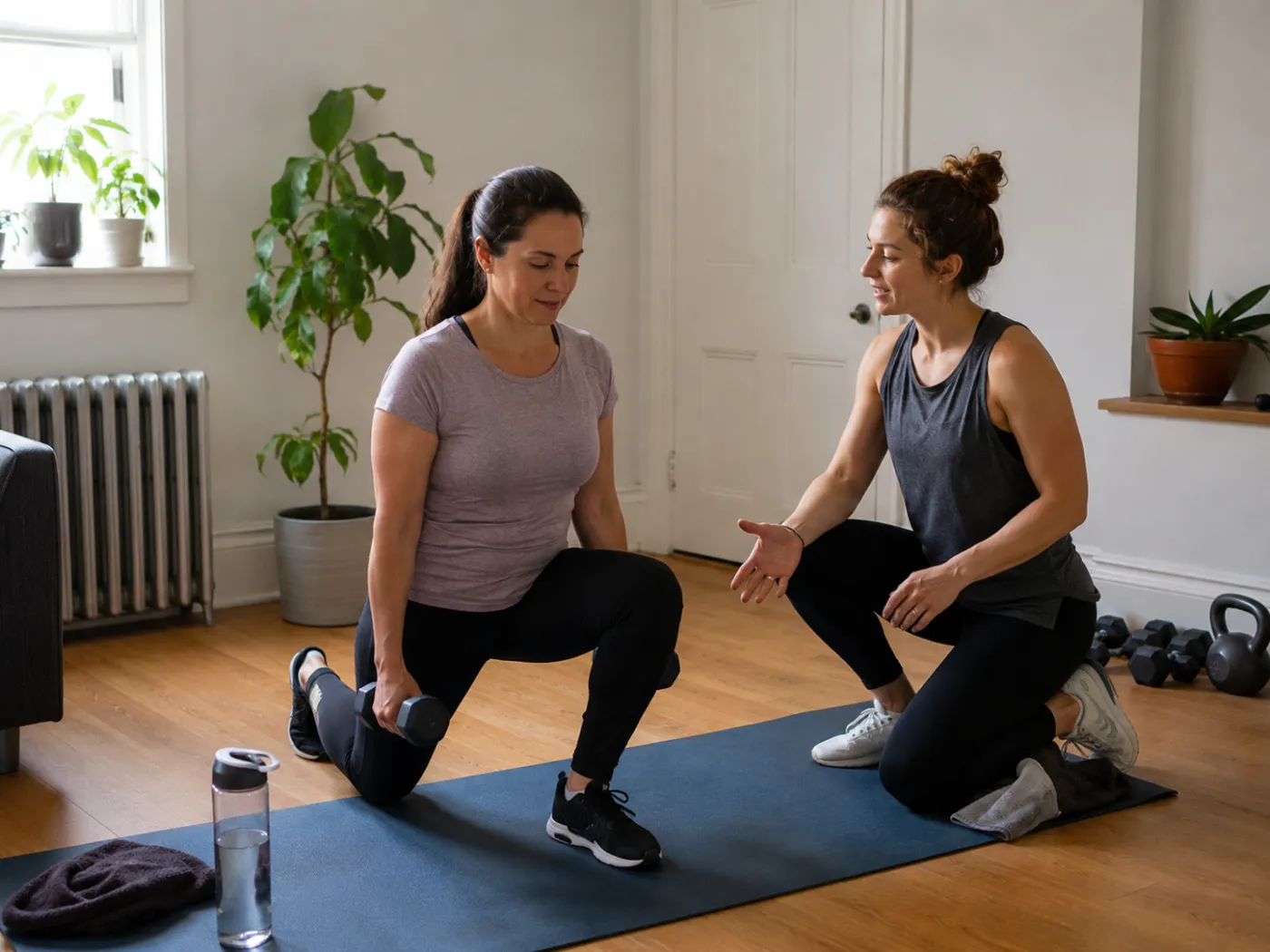
Ask ten coaches to describe their ideal program and you get ten answers. Watch them build one and the same rough shape keeps appearing: four training sessions a week, six exercises a session, three sets an exercise, across an eight-week block. That is roughly twenty-four exercise slots a week and somewhere near seventy working sets. Full-body splits lead at about 34% of programs, upper/lower follows at 27%, push/pull/legs at 18%.
Read the four medians together and the trait they share is restraint. Four days rather than six. Six exercises rather than twelve. Three sets rather than five. Eight weeks rather than an open-ended plan. None is the maximum a body could handle; each is what a real person with a job and a family can actually complete, week after week. Coaches are optimising for consistency, not for what looks impressive on paper.
Source: The anatomy of an online coaching program, where the full distributions for frequency, split and block length sit.
Which exercises do coaches actually program?
The movements are as unglamorous as the structure. A row appears in about 27% of active programs and a squat in about 24%, followed by push ups, bicep curls and shoulder presses. There is no fad at the top of this list. There is barely a fad anywhere in the top fifteen.
The most-programmed movements
Share of active programs including each movement, top ten
Share of active programs that include each movement, with every spelling of the same exercise grouped into one canonical name. Drawn from three months of 2026 programming activity. Figures are rounded.
Grouped by pattern rather than name, the picture is even plainer: squat and knee-dominant work is about 23% of programmed movement, pulling 21%, pushing 19%, hinging 13%. Squat, pull and push together carry roughly six in ten programmed exercises. Mobility and warm-up work takes 12%, core 10%, and loaded carries barely register at 1%.
Where the equipment is named, bodyweight and dumbbell movements far outnumber barbell-only work — and most of the top names are generic anyway. A "row", a "squat", a "shoulder press" specify no implement at all. That is a deliberate choice by coaches writing for clients whose gym might be a full rack or a corner of a bedroom. Counted at the program level, about 61% of active plans could be run with bodyweight, dumbbells and bands alone, which is the headline of the equipment report.
The exercise is only half of what a coach puts on the line. The other half is the note underneath it, and that layer turns out to be just as consistent. A tempo cue in the "control the eccentric" family is written by about 61% of coaches, and roughly one note in seven carries no technical instruction at all, just encouragement. We read the coach's own vocabulary in the words behind the workout.
There is a layer above all of it too, and it is the one the client sees first. Coaches name their programs, and they name them like products rather than files. Goal words lead, a duration marker is the next most common thing to put in a title, and twelve weeks is the length coaches reach for far more than any other. We read the vocabulary on the cover in the naming report, where the figures are deliberately approximate.
Sources: The most-programmed exercises in online coaching, including the full top fifteen and the long tail of thousands of distinct entries, the coaching cues written onto them, and how coaches name their programs. The ranking is now kept current on what coaches actually program, refreshed monthly.
What do coaches track beyond the workout?
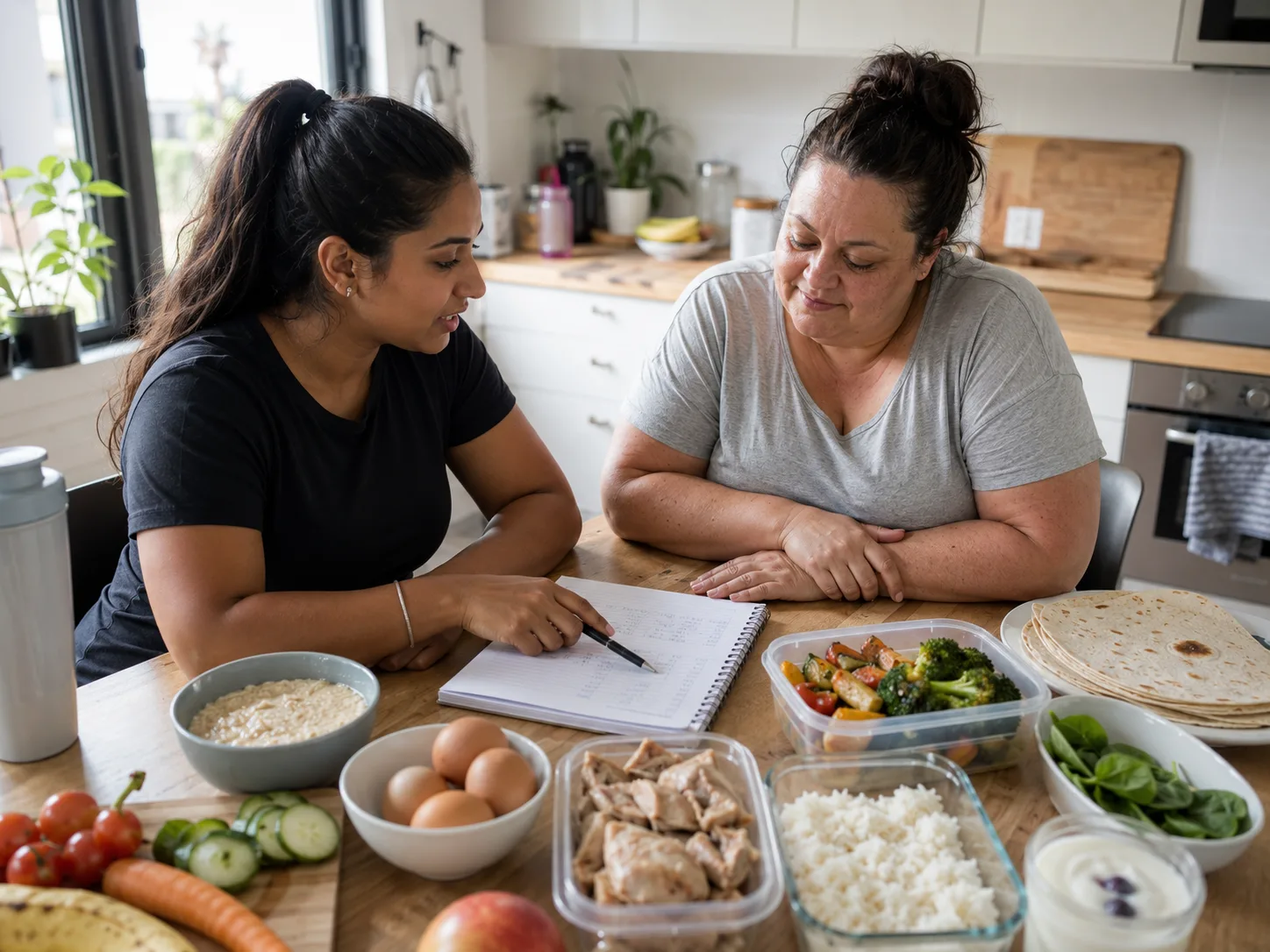
Coaching does not stop at the session, and the tracking coaches build into their plans shows where their attention actually goes. It is not hardware. Meal adherence leads at about 43% of non-exercise tracking items, habits and lifestyle tasks follow at about 37%, nutrition and macros at 31%, sleep at 20%.
What gets tracked beyond the workout
Share of non-exercise tracking items including each theme
The denominator here is non-exercise tracking items, not coaches. A single item can touch more than one theme, so shares overlap and do not sum to 100%. Figures are rounded.
Steps sit under 5%. Progress photos under 3%. Resting heart rate barely registers at all. In an industry that sells wearables hard, coaches are largely ignoring them in favour of things a client can report honestly: what they ate, whether they slept, whether they did the thing they said they would. The same instinct shows up in what coaches recommend — about 68% suggest at least one supplement category, and the recommendations skew toward the boring, well-evidenced basics rather than anything exotic.
Those shares describe the mix of what gets tracked. Counted a different way, by coach rather than by item, about 71% of coaches assign at least one habit or task beyond the training, led by food and logging (58% of coaches), daily movement (44%) and hydration (39%). The typical habit-assigning coach runs three categories, which is a small, deliberate stack rather than a checklist. That read is in the habit assignment report. What a coach does with that month of data at the check-in is the subject of our guide to habit check-ins.
Sources: What online coaches actually track, the habit assignment report and Do online coaches recommend supplements?
What the whole picture says about the craft
Put eight reports side by side and the same trait keeps surfacing from completely different angles. Coaches program four days rather than six. They pick rows and squats rather than novelties. They track what a client can honestly report rather than what a gadget produces. They rewrite the plan every month or two rather than setting it and walking away. They work mornings so their clients can train evenings.
None of that is dramatic, and that is the finding. Online coaching is not the thing its own marketing suggests: it is not a hack, a shortcut, or a screenshot of a transformation. It is unglamorous, repeatable, attentive work, done at a distance, in a hundred and ten countries, in a few dozen languages, mostly before lunch. The consistency across those countries is the part that should be surprising. Nobody coordinated it. Thousands of coaches working alone arrived at similar structures because those structures fit real people with real weeks.
The variation, when it shows up, is not in the skeleton. It is in everything hung on it — the exercise chosen for this client's equipment, the load for their level, the cue for their sticking point, the habit that fits their life. The frame repeats so the coach can spend attention where it counts.
What this means if you coach clients
Three things follow from the picture above, and all of them are practical.
Your structure is probably fine. If your programs run three or four days with a handful of exercises on a full-body or upper/lower split, you are not being unimaginative — you are where the entire platform sits, for good reasons. Building each program from a blank page as though the frame were new every time is wasted effort. Build the skeleton once and clone it, which is the core of building client workout programs faster and reusing a program across clients.
The demand is not where the coaches are. Nine of the ten strongest unmet-demand markets are not English-first, and 42 countries have clients with no local coach at all. If you have a second language, that is not a footnote on your profile — it is a market position. It is worth reading alongside how to get your first online coaching clients.
Coaching is behaviour work. The tracking mix says plainly that what coaches actually manage is food, habits and sleep — the things that happen in the gap between sessions. If your check-ins only ask about training, you are measuring the smaller half of your own job. Our guide to running client check-ins and the reality of retention in online coaching both start from that same premise.
The frame is stable. Your capacity is the variable.
A consistent program shape is what makes a roster manageable, because it caps how long each client takes to set up and each block takes to refresh. Work out how many clients you can genuinely look after at your service level, before you find out the hard way.
Try the capacity calculatorThere is a business layer under all of this. A repeatable frame is what makes the maths of coaching work — it is why how many clients a coach can realistically handle has an answer at all, and why what to charge is a question about your time per client rather than a number pulled from the air. Structure is not just a training decision. It is the business.
Methodology and limitations
How we got these numbers
Source. This report synthesises eight separately published QuickCoach platform data analyses, listed and linked in the sections above. All of them draw on aggregated activity across a base of more than 40,000 coaches and fitness businesses worldwide. Nothing here is a new analysis; each section links to the report that carries the full method for that measure.
Windows differ. The geographic and language analyses use a 90-day 2026 window across a sample of more than 3,200 accounts. The exercise analysis uses three months of 2026 programming activity across hundreds of thousands of assigned exercises. The seasonality analysis pools multiple years and reports shape only, with no index values or absolute totals. The program and tracking analyses read the current state of active plans. These are not one dataset and should not be read as one.
Denominators differ, and it matters. Geographic shares are shares of coaches or of sessions. Program and exercise shares are shares of active programs. Tracking shares are shares of non-exercise tracking items, not of coaches. Each figure above states its denominator where it appears; comparing a percentage from one section against a percentage from another is usually comparing two different things.
Two soft spots, named. The program-structure medians are approximated from established programming norms and our sibling reports, pending a full platform reconciliation. The tracking themes are classified from the free-text language coaches write, so they are directional, and their denominator is items rather than coaches. Both are flagged inline where they appear. Every other figure in this report is a clean aggregate.
Scope. This describes coaches and clients on QuickCoach, not the whole industry. We are a large, global, free-to-start platform, which shapes who shows up here — the base skews toward independent coaches rather than large gym chains. The language figures use each coach's market as a proxy for their working language, which cannot see bilingual coaches and therefore overstates English. Read this as the best available view of a profession that is otherwise measured by anecdote, not as a census.
Privacy. Everything is aggregated across the platform. No personal data, client information, individual coach or individual plan is exposed anywhere in this report or the ones it draws from.
Frequently asked questions
What does online coaching look like in 2026?
Online coaching in 2026 is global and everyday. On QuickCoach, clients train in 152 countries and coaches work in 110 of them. A typical program runs four sessions a week across an eight-week block, built from rows, squats and presses, with food and habits tracked alongside the training.
How many countries is online coaching happening in?
Across QuickCoach, clients are active in 152 countries while coaches work in 110. That leaves 42 countries with people being coached but no local coach on the platform at all. The four largest English-speaking markets account for roughly 63% of coaches, so the long tail is genuinely long.
What language do online coaches work in?
English is the likely working language for about 64% of coaches, which leaves roughly 37% coaching mainly in something else. Spanish is the largest non-English language at about 3.5%, followed by Italian and French. Nine of the ten strongest unmet-demand markets are not English-first.
When do online coaches work and when do clients train?
Coaches and clients run on offset clocks. About 29% of coach activity falls between 8am and noon local time, the single busiest window. Client training peaks later, with about 26% of activity between 4pm and 8pm. The coach's morning builds the plan the client runs that evening.
What does a typical online coaching program look like?
A typical program runs four training sessions a week, six exercises a session and three sets an exercise, across an eight-week block. Full-body and upper/lower splits lead. These program-structure figures are approximated pending a full platform reconciliation, and are labelled as such throughout.
What exercises do online coaches program most?
Rows and squats lead. A row appears in about 27% of active programs and a squat in about 24%, followed by push ups, bicep curls and shoulder presses. The list is a vote for durable basics: pull, squat and press patterns carry roughly six in ten programmed movements.
What do online coaches track besides workouts?
Behaviour, not hardware. Meal adherence appears in about 43% of non-exercise tracking items, habits and lifestyle tasks in about 37%, nutrition in 31% and sleep in 20%. Steps, photos and measurements each sit under 10%, and resting heart rate barely registers.
How was this online coaching data collected?
It synthesises eight separately published QuickCoach analyses of aggregated platform activity across a base of more than 40,000 coaches. Source windows and denominators differ by measure and are stated per section. Everything is aggregated and anonymised, with no individual coach, client or plan identifiable.
Published July 2026. This report synthesises eight QuickCoach platform data reports published between June and July 2026 and will be refreshed as each underlying analysis is updated — the program-structure and tracking sections are next in line for reconciliation. Every section links to the report it draws from. Questions about the data, or want a figure clarified before you cite it? Reach us at support@quickcoach.fit.