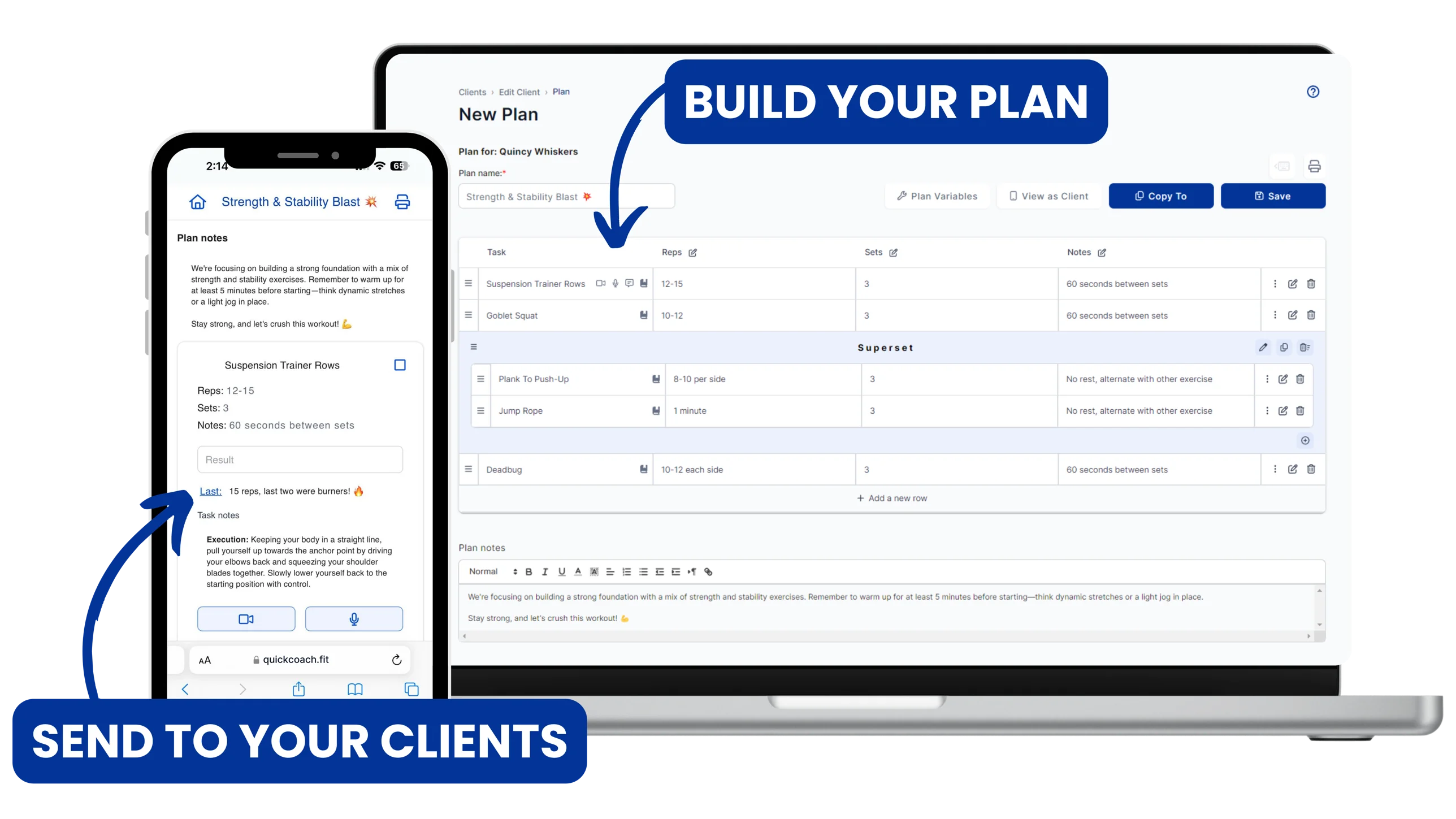
Ask ten coaches to describe their ideal program and you get ten answers. Ask them to build one and something quieter happens. The same rough shape keeps appearing: a handful of sessions a week, a manageable number of exercises in each, a block that runs a month or two before it gets rewritten. No rulebook enforces this. It is thousands of coaches, working alone, arriving at similar structures because those structures fit real clients with real weeks.
QuickCoach is used by more than 40,000 coaches and fitness businesses worldwide, so we can see the shape of a program the way no single coach can. For this report we looked across active coaching plans and measured the frame: sessions per week, exercises per session, sets per exercise, block length and the training split underneath it all. This is the anatomy of an online coaching program, drawn from what coaches build rather than what a textbook prescribes.
The short answer
A typical online coaching program runs four training sessions a week, six exercises a session and three sets an exercise, across an eight-week block. Full-body and upper/lower splits are the most common structures. Most coaches build around a compact, repeatable frame rather than a sprawling one.
What this is, in one paragraph
This is a read of how coaches build, not a survey of opinion. We looked across active, non-template coaching plans on QuickCoach and measured the structure of each: how many sessions a week, how many exercises per session, how many sets, how long the block runs, and the split it follows. Every program is weighted equally, empty and template-only plans are left out, and the figures are medians and distributions. Everything is aggregated and anonymised, with no individual coach, client or plan identifiable. The full method sits at the foot of the page.
What does a typical online coaching program look like?
Put the four medians together and a clear picture forms. Four training days, six exercises a session, three working sets each, running for about eight weeks before the coach rewrites it. That is roughly twenty-four exercise slots across a training week and somewhere near seventy working sets. It is enough to drive progress and light enough that a busy client can actually finish it. The interesting part is not any single number, it is how tightly programs cluster around this frame. Coaches are not scattered across every possible structure. They converge.
None of this is a ceiling. Plenty of programs run heavier or lighter, and the point of a coach is to build for the person in front of them. But the centre of gravity is unmistakable, and it sits exactly where sound training practice would put it: frequent enough to matter, simple enough to sustain.
How many days a week do coaches program?
Training frequency is the first decision in any plan, and coaches answer it in a narrow band. Three and four days a week together account for close to six in ten programs. Five-day plans are common. The extremes, two days at one end and six or more at the other, are where the minority sit.
Training days per week
Share of active coaching programs built around each weekly frequency
Shares are the percentage of active programs built primarily around each weekly training frequency. Figures are rounded.
The three-to-four-day habit is telling. It is the range most general-population clients can hold down for months without the plan quietly falling apart. Coaches are programming for adherence, not just stimulus. A perfect six-day split a client abandons in week three is worth less than a four-day plan they finish, and the distribution suggests coaches know it.
What is the most common training split in online coaching?
The full-body split leads, used in about a third of programs, just ahead of upper/lower, with push/pull/legs a clear third. Frequency decides how often a client trains; the split decides how the week is carved up. The classic body-part split, a different muscle group each day, sits lower than gym folklore would suggest.
How the week is split
Share of active coaching programs following each structure
Splits are inferred from how sessions group muscle work across the week. Hybrid plans that mix structures sit in the last band. Figures are rounded.
The split ranking and the frequency ranking tell the same story from two angles. Full-body and upper/lower are the structures that recover well on three or four days a week, so it makes sense they lead a base of coaches programming in exactly that range. Body-part splits, which really need five or six days to cover everything, are pushed down the list by the same logic. Coaches are not picking splits in a vacuum. They are matching the structure to the number of days a client will actually show up.
How long is a typical online coaching program?
The median block runs about eight weeks, with a strong showing from both shorter four-week cycles and longer twelve-week ones. A program is not permanent: it gets built, run, reviewed and replaced, and the rhythm of that cycle is its own signature. Programs that run sixteen weeks or more without a rewrite are the exception.
Program block length
Share of active coaching programs by how long a block runs before it is rewritten
Block length is the intended run of a program before it is reprogrammed. Figures are rounded and bracket a median near eight weeks.
Four, eight and twelve weeks are the load-bearing numbers, and that is not an accident. They map onto the way coaches actually work: a monthly reprogram, a two-month block, a full quarter. Each is a natural review point, a moment to look at a client's progress and adjust. The distribution is really a picture of how often coaches revisit a plan, and the answer is often. Nobody is setting a program and walking away.
What the anatomy tells us about how coaches program
Read the four measurements together and the same trait shows up in each: restraint. Four days rather than six. Six exercises rather than twelve. Three sets rather than five. Eight weeks rather than an open-ended plan. None of these is the maximum a body could handle. They are the amount a real person, with a job and a family and a finite amount of willpower, can complete week after week. Coaches are optimising for the thing that actually drives results, which is consistency, not for the thing that looks impressive on paper.
It also lines up with what we have found looking at the movements themselves. When we ranked the most-programmed exercises in online coaching, the top of the list was rows, squats, presses and hinges, the durable basics rather than anything faddish. The anatomy here is the structural version of that same instinct. A tight, proven frame of exercises, arranged into a tight, proven weekly structure, run in blocks short enough to keep adjusting. Good coaching is less about novelty than outsiders assume.
What varies, then, is not the skeleton. It is everything hung on it: the exercise choices for this client's equipment, the loads for their level, the cues for their sticking points, the pace for their life. The frame repeats so the coach can spend their attention where it counts.
What this means if you coach clients
If you coach, treat the anatomy as permission to keep your structure simple. The programs working across the platform are not elaborate. They are a sensible number of days, a sensible number of exercises, a block that gets reviewed on a monthly-to-quarterly beat. Building the tenth program from a blank page as if the frame were new every time is wasted effort. The frame is stable. Reuse it.
That is exactly where a template library earns its keep. If most of your programs are four days of six exercises on an upper/lower or full-body structure anyway, you can build that skeleton once and clone it for each new client, then spend your time on the parts that are genuinely individual. It is the core idea behind learning to build client workout programs faster and the quick way to reuse and repeat a program across clients rather than starting cold every time.
Build the frame once, reuse it for every client
Four days, six exercises, an eight-week block. If that shape repeats across most of your roster, there is no reason to rebuild it by hand each time. Set the skeleton up once, clone it, and put the saved hours back into coaching.
See how to build programs fasterThere is a capacity angle here too. A consistent program frame is what makes a roster manageable, because it caps how long each new client takes to set up and each block takes to refresh. When that time creeps up, so does the risk of taking on more clients than you can genuinely look after, which we work through in our look at how many clients an online coach can realistically handle. Structure is not just a training decision. It is a business one.
This is one more entry in a pattern we keep finding in our own data: the day-to-day of coaching is more repeatable, and more human, than it looks from outside. We have measured the geographic version in how global online coaching has become, the daily-timing version in when coaches work and when clients actually train, the calendar version in when the coaching year peaks, the movement version in the most-programmed exercises, and the loading version in the rep ranges coaches actually run on. The anatomy of the program is the blueprint that ties them together, and if you would rather read the whole picture at once, we have gathered every one of those reports into the state of online coaching in 2026.
Methodology and limitations
How we got these numbers
Source. Aggregated programming and workout-builder structure across active, non-template coaching plans on QuickCoach, a platform used by more than 40,000 coaches and fitness businesses worldwide. No individual coach, client or plan is identifiable in anything published here.
Definitions. Sessions per week, exercises per session and sets per exercise are reported as medians across programs, with each program weighted equally regardless of how many clients it is assigned to. Block length is the intended run of a program before it is reprogrammed. Splits are inferred from how each session groups muscle work across the week, and plans that mix structures are grouped as hybrid.
Scope. This is a read of how coaches build, not a prescription for how anyone should train. Split and block-length groupings are directional, since not every program labels its structure explicitly. Figures are rounded and describe the shape of a typical program, not a rule any single plan must follow.
Privacy. Everything is aggregated across the platform. No personal data, client information or individual plan is exposed.
Frequently asked questions
What does a typical online coaching program look like?
A typical online coaching program runs four training sessions a week, six exercises a session and three sets an exercise, across an eight-week block. Full-body and upper/lower splits are the most common structures. Most coaches build around a compact, repeatable frame rather than a sprawling one.
How many days a week do online coaches program?
Three and four days dominate. About 31% of programs are built around four sessions a week and 28% around three, so roughly six in ten sit in the three-to-four-day range. Five-day plans are common too, while two-day and six-plus-day programs are the minority at each end.
What is the most common training split in online coaching?
The full-body split is the single most common, used in about 34% of programs, followed by upper/lower at roughly 27% and push/pull/legs at about 18%. Body-part or bro splits sit lower. Coaches lean toward structures that recover well and fit a three-to-four-day week.
How long is a typical online coaching program or block?
The median block is about eight weeks, with four-week and twelve-week programs both common. Short four-week blocks and longer twelve-week cycles bracket the middle, and programs of sixteen weeks or more are the minority. Coaches tend to reprogram in monthly-to-quarterly cycles rather than leave a plan running indefinitely.
How was this program data collected?
It is drawn from aggregated programming and workout-builder activity across active, non-template coaching plans on QuickCoach, a platform used by more than 40,000 coaches worldwide. Every program is weighted equally, empty and template-only plans are excluded, and figures are reported as medians and distributions. Everything is anonymised, with no individual coach, client or plan identifiable.
Published July 2026. Figures describe the shape of active coaching programs across QuickCoach's base of 40,000+ coaches and will be refreshed as the dataset grows. For more on turning the repeatable parts of coaching into saved time, see how to build client workout programs faster and the quick way to reuse and repeat a program across clients. Questions about the data? Reach us at support@quickcoach.fit.