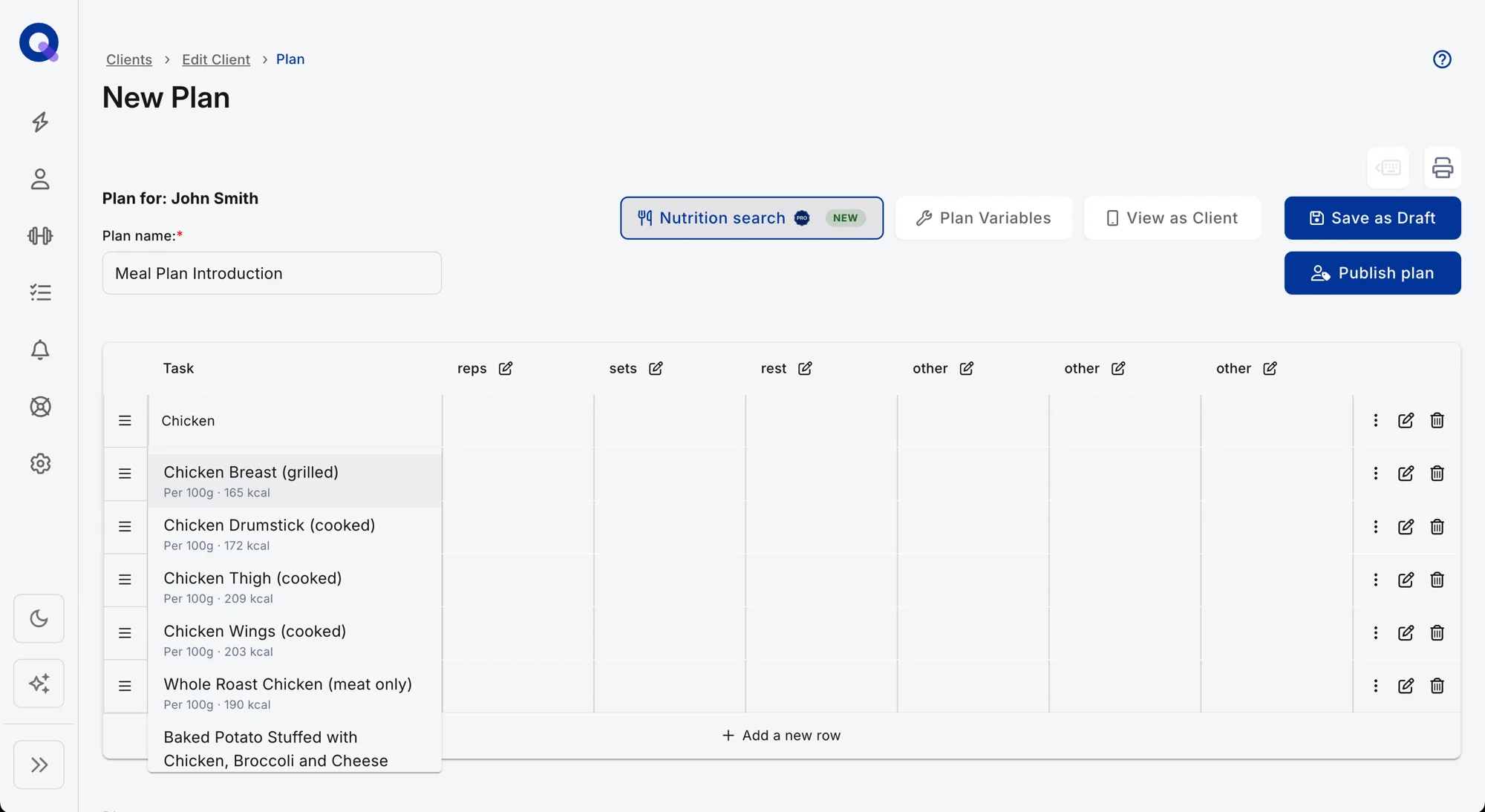
Nutrition coaching software has a pricing problem that the feature lists tend to hide. Every major platform will tell you it does nutrition. Almost none of them tell you, on the same page, what nutrition costs once it is switched on for the roster you actually have. That number is the one worth knowing, and it moves around a lot more than the headline price suggests.
This is not an argument about whether coaches should give nutrition advice. Our own platform data settled that one. When we looked at what online coaches actually track, meal adherence and meal instructions came out as the single most common thing coaches build into a plan outside the workout itself, appearing in 43.0% of non-exercise tracking items, with nutrition and macros close behind at 31.1%. Food is already the main event. The software just bills for it unevenly.
The short answer
At a 30-client roster on monthly billing, nutrition-capable plans run from $39/month on QuickCoach Pro, where nutrition is part of the core subscription, up to $164.98/month on TrueCoach Pro. Trainerize lands at $124/month once its $45 Advanced Nutrition Coaching add-on is added to a Pro 30 plan.
What is nutrition coaching software?
The short answer
Nutrition coaching software lets a coach build food guidance into a client's plan and lets the client log what they eat against a verified food database. The results land back with the coach, next to the training data, rather than in a separate consumer app the coach cannot see.
The distinction that matters is the direction the data flows. A macro tracking app logs food for one person, and that person is not you. If a client uses one, the coach's window into it is whatever the client chooses to screenshot and send. Nutrition coaching software closes that loop: the food log belongs to the coaching relationship, so the coach can look at last week's eating and last week's training on the same screen without asking anyone to export anything.
That is the functional definition. The commercial reality is messier, because platforms draw the line between "included" and "extra" in five different places.
What does nutrition coaching software actually cost?
Sticker prices are close to meaningless here, for two reasons. Most platforms scale by client count, so the plan you need is set by your roster before nutrition enters the conversation. And several of them bill nutrition separately on top. To compare like with like, we priced a coach with 30 active clients who wants nutrition working, on monthly billing, at published rates.
| Platform | Plan needed at 30 clients | Base price | Nutrition cost | Monthly total |
|---|---|---|---|---|
| QuickCoach | Pro (unlimited clients) | $39/mo | Included in Pro | $39/mo |
| Everfit | Pro (35-client slider step) | $75/mo | Food journal and macros included; Meal Plans & Recipe Books +$39/mo | $75/mo, or $114/mo with meal plans |
| Trainerize | Pro 30 | $79/mo | Advanced Nutrition Coaching +$45/mo | $124/mo |
| My PT Hub | Premium | $105/mo | Included in Premium | $105/mo |
| TrueCoach | Pro (up to 50 clients) | $164.98/mo | MyFitnessPal integration, no separate charge | $164.98/mo |
A few things jump out of that table, and one of them cuts against the easy story.
The easy story would be that everyone else nickel-and-dimes you for nutrition. That is not true. My PT Hub bundles nutrition plans into Premium, and TrueCoach has never charged separately for its MyFitnessPal integration. Neither of them is selling you nutrition as an upsell.
What they are selling you is a tier. TrueCoach's $164.98 has nothing to do with food at all: a 30-client roster overshoots the 20-client Standard plan, so you land on Pro and pay for capacity you may not use. My PT Hub's $105 is the price of leaving a 3-client Starter tier. The nutrition is free. The seat is not.
Trainerize is the clearest example of the other model. Pro 30 is competitive at $50, and then Advanced Nutrition Coaching costs $45 on rosters of 30 and above, which nearly doubles the bill. Everfit sits in between: a food journal and macros come with Pro, but structured meal plans and recipe books are a $39 add-on, so what you pay depends on how much of "nutrition" you actually meant.
How we priced this
Scenario. One coach, 30 active clients, monthly billing, regular published rates rather than promotional pricing. Where a platform uses a client-count slider, we took the first step that covers 30 clients, which is Pro 30 on Trainerize and the 35-client step on Everfit.
Sources. Vendor pricing pages, last verified May 2026. QuickCoach pricing was updated in July 2026. Competitor pricing changes without much warning, so check the current figure before you commit to anything on the strength of this table.
Scope. Base plus nutrition only. Payments, video coaching, automation and branded app fees are excluded, which understates the real bill on platforms that charge for those separately.
For the full picture across roster sizes, we priced nutrition coaching software at 10, 20 and 30 clients on a separate cost-by-roster page for nutrition coaches, with each platform's add-on stack made explicit rather than folded into a single headline number.
Why the cheapest plan is rarely the cheapest bill
Look at the base prices in isolation and Trainerize wins at $50. Look at the totals and it is nearly two and a half times QuickCoach. That gap is the whole point.
Add-on pricing is attractive to vendors because it moves cost out of the number a coach compares when shopping and into the number they pay every month afterwards. It is not dishonest, and for a coach who genuinely does not want nutrition it can be cheaper. But most coaches do want it, as our tracking data shows, so the modular price ends up being the real price for the majority of buyers while the marketing keeps quoting the other one.
The same trap runs through client-count scaling. A slider that starts at $19 sounds generous until a roster grows and each step up arrives with a bill attached, whether or not the coaching got any harder. We wrote about the general version of this in our guide to choosing coaching software, and the pattern holds precisely for nutrition: the feature is cheap at the size nobody runs a business at.
If you want the underlying numbers rather than our summary of them, the full breakdowns sit in our Trainerize pricing, Everfit pricing, My PT Hub pricing and TrueCoach pricing guides, each with every tier and add-on listed.
What is core and what is an add-on in QuickCoach Pro
The short answer
Food search across 2.3 million verified items, food photo scanning, calories, macros and the client food log are all part of standard Pro at $39/month. Barcode scanning is the one nutrition feature that is not, and it sits in the optional Nutrition Booster Pack at $12.99/month.
We are not going to pretend our own line is drawn nowhere. It is drawn, just in a different place, and it is worth being specific about where.
Included in QuickCoach Pro at $39/month, or $32.50/month on annual billing: a searchable database of over 2.3 million verified food items with calories and macros on every result, available from the plan editor for you and from the food diary for your clients. Food photo scanning, where a client photographs a meal and gets it identified and logged with estimated calories and macros attached. And a daily food log inside the same app the client already opens for their training. The weekly check-in that reads that log for patterns rather than perfection is the subject of our guide to nutrition coach check-ins.
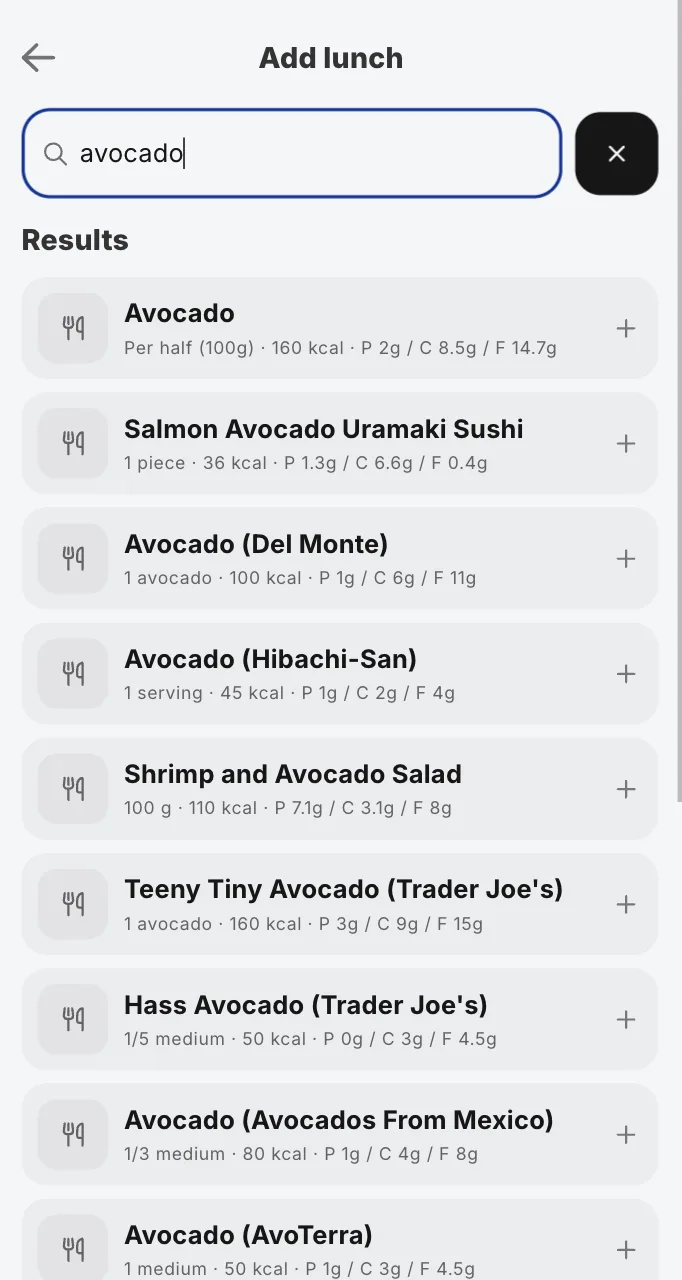
Food search. The verified library on the client's phone, macros on every result.
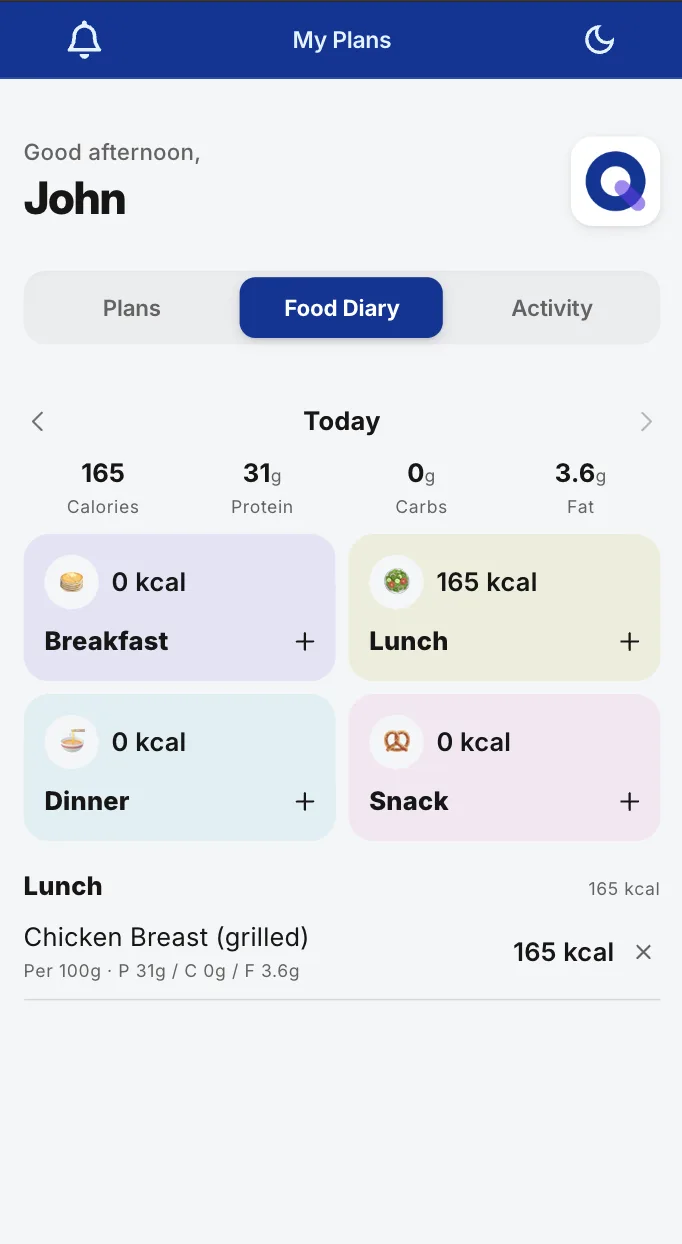
Food diary. The day rolls up by meal, and you see it without asking.
All of it landed in the July 2026 release that brought nutrition and habit tracking into Pro, which walks through the food log, the photo scanning and the habit stacks in detail.
Two honest caveats. Photo scanning returns an estimate, not a label reading, and should be treated as one. And barcode scanning is not in Pro. If your clients live on packaged food and scanning every wrapper would genuinely save them time, that is the Nutrition Booster Pack at $12.99/month, which takes the total to $51.99. Still the lowest number in the table, but it is an extra, and calling it anything else would make this article the same as the marketing it is complaining about.
What to check before you pay for nutrition coaching software
Four questions will tell you more than any feature grid.
- What tier does my current roster force? Work this out first. On most platforms it sets your bill before nutrition is even discussed.
- Is nutrition on that tier, or above it? A feature included on a plan you cannot afford is not included.
- Whose app is the client logging in? If the answer is a third-party tracker, the food data is a screenshot away from you rather than a click.
- What does the coach actually see? A client-side food diary the coach cannot review is a consumer app with extra steps.
That last one catches people out. Nutrition ticks the box on a comparison chart whether it means a real coach-facing log or a link to an app the client downloads separately. Those are very different products at the same price.
Work out what your roster costs you before you pay for it
Client-count pricing punishes growth you have not planned for. Find your honest capacity ceiling first, then price the software against it.
See how many clients you can handleFrequently asked questions
What is nutrition coaching software?
Nutrition coaching software lets a coach build food guidance into a client's plan and lets the client log what they eat against a verified food database. The results land back with the coach, next to the training data, rather than in a separate consumer app the coach cannot see.
How much does nutrition coaching software cost?
At a 30-client roster on monthly billing, nutrition-capable plans run from $39/month on QuickCoach Pro, where nutrition is part of the core subscription, up to $164.98/month on TrueCoach Pro. Trainerize works out to $124/month once the $45 Advanced Nutrition Coaching add-on is added to a Pro 30 plan.
Is nutrition included in QuickCoach Pro or is it an add-on?
Food search across 2.3 million verified items, food photo scanning, calories, macros and the client food log are all part of standard Pro at $39/month. Barcode scanning is the one nutrition feature that is not, and it sits in the optional Nutrition Booster Pack at $12.99/month.
What is the difference between a macro tracking app and nutrition coaching software?
A macro tracking app logs food for one person in isolation. Nutrition coaching software connects that log to the coach, so the food data sits beside the training plan and progress history the coach already manages, with no screenshots or exporting between tools.
Pricing verified July 2026 against published vendor rates and refreshed quarterly. If a figure here no longer matches what a vendor is charging, tell us and we will correct it: support@quickcoach.fit. For the wider picture, see the best free coaching software in 2026 or the evidence that coaches were doing this work all along in our audit of what coaches tell clients about supplements.