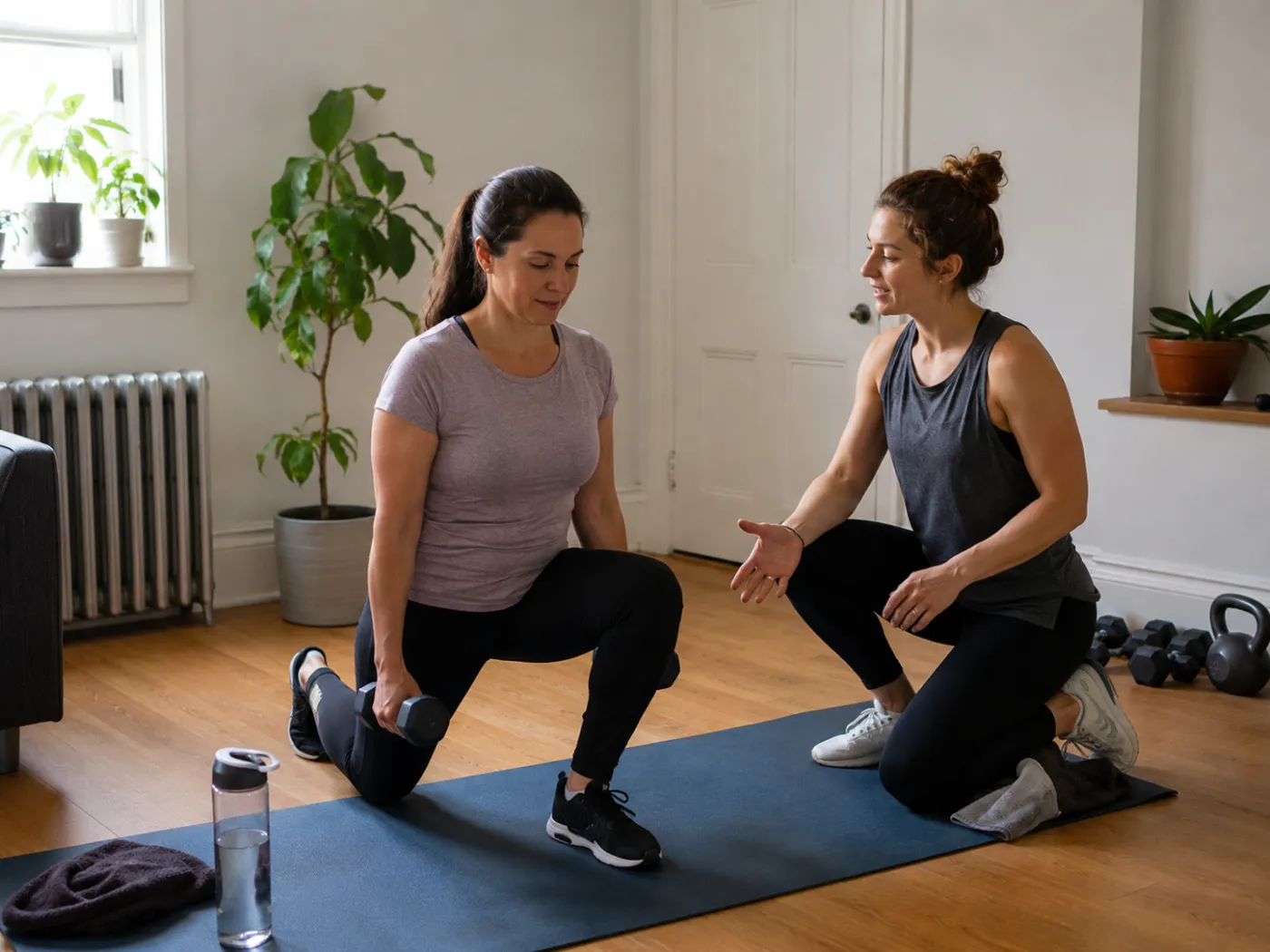
There is a version of personal training that lives in a commercial gym, surrounded by racks and cable stacks and forty kinds of machine. Then there is the version most coaches are actually running, where the client is in a spare bedroom at six in the morning with a mat and whatever they could fit in a cupboard. The second one is winning. What equipment do online coaches program, and how much of it does a client genuinely need to own? We went and counted.
We have published the shape of a program and the movements inside it, but never the kit. QuickCoach is used by more than 40,000 coaches and fitness businesses worldwide, so for this read we took the exercises assigned inside active coaching plans, resolved each one against the exercise library, and sorted whole programs by the heaviest piece of equipment they call for. One rule made the whole thing honest: where an exercise name does not state an implement, we did not guess one. More on that below, because it changes how you should read every number here.
The short answer
About 61% of active coaching programs could be run with minimal equipment, meaning bodyweight, dumbbells and bands alone. Roughly 11% need nothing at all. The remaining 39% name gym-only kit such as a barbell, a rack or cable machines. Most online coaching does not require a gym membership.
What this is, in one paragraph
This measures the equipment a program calls for, not the equipment a client owns. We read the implement named on each assigned exercise, deduplicated it to the program, and placed every program in one of three tiers: bodyweight only, minimal kit, or gym-only kit required. Exercise names that state no implement, and there are plenty of those, are treated as equipment-flexible instead of being assigned a piece of kit by inference. That decision is deliberate and it inherits the scope note from our report on the most-programmed exercises, which found that many popular names are generic. Groupings are directional. The full method sits at the foot of the page.
Can you follow an online coaching program without a gym?
For most programs, yes. Around 61% of active plans could be delivered with bodyweight movements, a pair of dumbbells and a band, which is a kit that fits under a bed and costs less than two months of gym membership. About one program in nine goes further and asks for nothing at all. The rest name something that generally implies a facility.
How much kit a program actually needs
Share of active coaching programs by the heaviest equipment tier they call for
Tiers are mutually exclusive and assigned by the heaviest equipment a program names. Bodyweight only and minimal kit together make the 61% minimal-equipment share. Figures are rounded.
That 61% is the number worth sitting with. It says the majority of remote coaching is not gated behind a facility, a commute or a membership fee, which quietly removes the three excuses that kill the most client relationships in the first month. A coach in Perth can take a client in a village outside Cork, and the plan lands intact because the plan was never leaning on a squat rack. The reach story we told in coaching has no borders has an equipment story sitting underneath it, and this is it.
The 39% that do name gym kit are not an embarrassment either. A powerlifting client needs a bar. A physique competitor wants the cable stack. Those coaches are programming for the room their client is standing in, which is the same judgement call as everyone else's, just with a different answer.
What equipment do online coaches program for most?
Bodyweight leads, and it is not close. Some form of unloaded movement appears in around 83% of active programs, whether that is a push up, a plank or a warm-up drill. Dumbbells come next at roughly 68%. Machines and cables sit in the middle of the pack, and the barbell, the thing most people picture when they picture strength training, turns up in about a third.
Which equipment shows up in a program
Share of active programs with at least one exercise naming each type, counted once per program
A program can appear in several rows, so the shares do not sum to 100%. Specialist kit covers suspension trainers, sleds, medicine balls and similar. Figures are rounded.
Read the top two rows together and you have the working kit of online coaching. Bodyweight and dumbbells are the implements that survive contact with an unpredictable client environment. They scale from a beginner to someone strong, they need no setup, and they do not care whether the session happens in a garage, a hotel room or a gym floor at 6pm on a Tuesday. The coach who programs a goblet squat has written something that works everywhere. The coach who programs a hack squat has written something that works in one building.
A pair of adjustable dumbbells
The single highest-value purchase. Covers presses, rows, squats, hinges, curls and carries, and grows with the client instead of being outgrown in a block.
A mat and two metres of floor
Everything unloaded lives here. Push ups, glute bridges, planks, the mobility and warm-up work that shows up in most sessions.
A band and a bench or chair
The cheap accessories that unlock the rest. Bands fill in the pulling and rehab work, a bench or sturdy chair opens up step ups, split squats and supported rows.
How often does an exercise even name its equipment?
Less than half the time, and that is the finding underneath every other finding on this page. Roughly 46% of assigned exercises carry a name that states no implement at all. Squat. Row. Shoulder press. Chest press. The coach knows what they mean and so does the client, but the entry itself is silent about whether a bar, a dumbbell or a machine is involved.
What the exercise name tells you
Share of assigned exercises by the implement stated in the entry
Shares are of assigned exercises, not programs. Unnamed entries are counted as equipment-flexible and are never inferred to a specific implement. Figures are rounded.
We could have treated that 46% as a guessing game. Assume every bare "squat" means a barbell and the profession suddenly looks far more gym-bound than it is. Assume it means bodyweight and it looks weightless. Both would be inventing data, so we did neither, and counted those entries as what they are: movements a client can run with whatever they have. When the implement is named, the pattern the most-programmed report described qualitatively holds up in numbers. Bodyweight and dumbbell entries together outnumber barbell entries by roughly six to one.
There is a practical read here too. Coaches leave the implement out because they are programming a movement, not a machine. A row is a row. If the client has a bar this week and a band next week, the plan still makes sense, and the coach has quietly built in a substitution without writing one. That flexibility is a feature of how coaches think, and it is why the equipment picture is directional rather than exact.
Why the loading data agrees with all of this
Because the two measurements were made independently and landed in the same place. When we read how coaches prescribe load in the rep ranges report, about 64% of assigned exercises carried no fixed weight at all. The coach set a rep target and let the target imply the load. Only around 22% named a specific weight or percentage.
A rep target is equipment-agnostic by design. Ten hard reps means ten hard reps whether the client is holding 12kg dumbbells or a loaded bar, and the instruction survives a client moving house, travelling for work or switching gyms mid-block. Pin an exact 82.5kg on the line instead and you have written something that only works in one place with one set of plates. Coaches are choosing the portable option roughly two thirds of the time. The equipment tiers on this page and the loading style on that one are the same decision seen from two angles.
Write it once, run it anywhere
If most of your programming already works with dumbbells and a mat, it will work for the next client too. Build the plan once in QuickCoach, reuse it across your roster, and swap the two or three exercises that actually depend on kit.
See how to build programs fasterWhat the equipment footprint says about the job
It says the barrier to being coached has collapsed, and coaches are the ones who collapsed it. Nobody mandated that programming should work in a bedroom. Coaches arrived there one client at a time, by writing a plan, watching a client fail to get to the gym on a Wednesday, and rewriting it around what that person actually had. Do that a few thousand times across 40,000 coaches and you get a profession whose default output runs on a mat and a pair of dumbbells.
It also reframes what a coach sells. If the equipment is not the scarce ingredient, the coaching is. A client can buy dumbbells in an afternoon. What they cannot buy is someone deciding which six movements matter this block, in what order, at what load, and then noticing when week three goes quiet. That is the argument we keep running into from different directions, most recently in the anatomy of a coaching program and across the state of online coaching in 2026.
And it lowers the bar for coaches themselves, which is the part worth saying out loud to anyone still hesitating. You do not need a facility to start. You need a way to deliver a plan and a way to see whether it happened, which is most of what getting your first online coaching clients actually turns on.
What this means if you coach clients
Ask about equipment before you write the first program, not after. The single most avoidable failure in a new client's first fortnight is a plan that assumes a cable machine they have never stood next to. A two-line question during onboarding solves it: what do you own, and where will you train? The answer sorts them into one of the three tiers above and you write accordingly.
Then build your library around the flexible middle. If your staple movements already work with dumbbells, bands and bodyweight, one template can serve most of your roster with two or three swaps at the edges, which is the whole point of learning to reuse and repeat a program across clients. Keep the gym-only exercises for the clients whose environment supports them and whose goals need them.
Name the implement when it matters and leave it out when it does not. "Dumbbell Romanian deadlift" is a different instruction from "Romanian deadlift", and both are correct in the right context. Being deliberate about which one you write is a small habit that saves you a message on Sunday night. It also makes your own exercise library cleaner, which matters more the bigger your roster gets. If you want to work out what roster size you can genuinely handle before setup time eats the week, our free capacity worksheet runs the numbers in four steps.
One more thing worth doing this week. Look at the last five programs you wrote and count how many would survive a client texting to say the gym is closed. If the answer is most of them, your programming is already doing the accessible thing the data describes. If it is none of them, that is not a judgement, but it is a fragility, and it is cheap to fix.
Methodology and limitations
How we got these numbers
Source. Aggregated exercise programming across active coaching plans on QuickCoach, a platform used by more than 40,000 coaches and fitness businesses worldwide. Each assigned exercise was resolved against the exercise library and read for the implement it names. No individual coach, client or plan is identifiable in anything published here.
Definitions. Equipment types are grouped from the implement stated in the exercise entry, with spellings and abbreviations normalised so that the same implement does not split across categories. Program-level figures deduplicate: a program that uses dumbbells in twelve exercises counts once. The three kit tiers are mutually exclusive and assigned by the heaviest equipment a program names. Minimal kit means bodyweight, dumbbells and bands; gym-only means a barbell, rack, cable stack, fixed machine or cardio machine.
The inference rule. Where an exercise name states no implement, and roughly 46% do not, it is counted as equipment-flexible and never assigned an implement by guesswork. This follows the scope note published with our most-programmed exercises report, which found many popular names are generic. It means the minimal-equipment share describes what a program could be run with, not a certainty about how each client performed it. Some flexible entries were certainly intended as barbell work.
Scope. This reads what coaches program, not what clients own, where they train, or whether they completed the session. Equipment groupings are directional for the reason above, and the figures describe coaches on QuickCoach rather than the whole industry. Figures are rounded, and program shares can overlap across equipment types.
Privacy. Everything is aggregated across the platform and reported as shares of programs or exercises. No personal data, client information or individual plan is exposed.
Frequently asked questions
What equipment do online coaches program for?
Mostly light, portable kit. Bodyweight movements appear in around 83% of active coaching programs and dumbbell work in about 68%, while barbell exercises show up in roughly 36%. Machines and cables sit in the middle. The centre of online coaching is a mat and a pair of dumbbells.
Can you follow an online coaching program without a gym?
Usually, yes. About 61% of active coaching programs could be run with bodyweight, dumbbells and bands alone, and roughly 11% need no equipment whatsoever. The remaining 39% name kit that generally means a gym, such as a barbell, a rack or cable machines.
What equipment do I need to start online coaching clients?
Your clients need less than most coaches assume. A pair of adjustable dumbbells, a resistance band, a mat and a bench or sturdy chair covers the movements behind the majority of programs on the platform. As a coach you need software to deliver the plan, not a facility.
Do online coaches program barbell training?
Some do, but it is the minority position. Around 36% of active programs include at least one exercise that names a barbell, and barbell-specific entries account for only about 6% of assigned exercises. Coaches reserve the bar for clients who have one and a goal that needs it.
How was this equipment data collected?
From aggregated exercise programming across active coaching plans on QuickCoach, used by more than 40,000 coaches worldwide. Equipment is read from the canonical exercise entry. Names that state no implement are counted as equipment-flexible rather than guessed, so groupings are directional and all figures are anonymised.
Published July 2026. Figures describe the equipment behind active coaching programs across QuickCoach's base of 40,000+ coaches and will be refreshed as the dataset grows. For the movements themselves see the most-programmed exercises in online coaching or the continuously updated what coaches program index, for the specialist drills beneath the staples see the uncommon exercises report, for how those movements get loaded see the rep ranges report, and for the whole picture read the state of online coaching in 2026. Questions about the data? Reach us at support@quickcoach.fit.