Ranking lists are good at one thing: telling you what everybody does. They're bad at telling you what good coaches do differently. The uncommon exercises in a program, the ones that never crack a top ten, are where a coach's judgement shows up. Nobody programs a Copenhagen plank by accident.
So this report ignores the leaderboard. Our living page on what coaches program already tracks the staples every month. Here we took the same August 2026 read, 204,470 verified assigned exercises across active coaching plans on QuickCoach, and looked only at the long tail. That's the 2,477 movements our classification marked as uncommon or novel, plus the tens of thousands of ways coaches wrote them down. QuickCoach is used by more than 40,000 coaches and fitness businesses worldwide, which makes this a rare look at the part of programming that usually stays inside a coach's head.
The short answer
The uncommon exercises coaches program most are prehab and control drills: the Copenhagen plank (4.4% of clients), world's greatest stretch (4.2%), Cossack squat (3.4%), pogo hop (2.6%) and shoulder external rotation (2.4%). Outside the 100 most common movements sits 42.4% of all assigned work. The long tail isn't a rounding error. It's close to half the job.
What this is, in one paragraph
Coaches type exercise names as free text. We grouped every spelling of the same movement into one of 3,565 canonical movements, tagged each with a movement pattern, and classed each one as common, uncommon or novel. "Uncommon" means a real, recognised exercise that sits well outside the mainstream (a Zercher squat). "Novel" means something close to unique, usually a coach's own named drill or routine. This page reads the uncommon and novel slice. It's a one-off, dated report for August 2026, not the monthly leaderboard. The full method is at the foot of the page.
How much of coaching happens outside the top 100 exercises?
About four exercises in every ten. The ten most common movements account for 17.7% of assigned work. Stretch that to the top 100 and you reach 57.6%. The remaining 42.4% is spread across 3,465 other movements, most of which any one coach might use for a handful of clients.
How fast the leaderboard runs out
Cumulative share of classified assigned work covered by the most common movements, August 2026
Shares are of the 176,946 assigned exercises that could be confidently classified into a canonical movement. Figures are rounded.
Zoom in further and the picture gets more personal. In August, coaches typed 25,900 distinct exercise names into client plans. Around 60% of those names (15,533) were used for exactly one client. Some of that is spelling, which we'll get to. A lot of it is a coach writing something for the person in front of them: a side-specific note, a regression, a drill named after the thing it's fixing.
That changes how you should read any "most popular exercises" list, including ours. The top of the table tells you what the skeleton of a program looks like. The long tail tells you how each program gets fitted to a body.
Which movement patterns hold the most uncommon exercises?
Carries, mobility, core and prehab work. The big pushing and pulling lifts are the most standardised part of programming, with under 9% of that work coming from uncommon entries. Carries sit at the other end: 43% of all carry work was an uncommon variation, such as a waiter carry, an overhead carry or a front rack march, rather than a plain farmer's carry.
Where coaches go off-script
Share of each movement pattern's assigned work that came from uncommon or novel entries
"Isolation and prehab" covers entries that fit no single compound pattern, such as adductor, abductor, rotator cuff and tibialis work. Figures are rounded.
There's a clear logic here. A bench press is a bench press, and there isn't much to gain from reinventing it. But the warm-up, the core slot and the accessory block are where a coach responds to what a client actually needs: a stiff hip, a knee that doesn't like stairs, a shoulder that's been niggling since last winter. Mobility makes up 14% of all assigned work, yet it's 24% of the long tail. Coaches are standard where standard works and specific where it counts.
It also fills in a gap from our own monthly page, which notes that carries are only 1% of assigned work. The carries that do get programmed are unusually varied. Coaches who use carries tend to use them deliberately.
What are the most-programmed uncommon exercises?
The Copenhagen plank, by a distance. It reached 153 clients in August 2026, 4.4% of everyone assigned a program, or about one client in 23. That puts an adductor drill most gym-goers have never heard of in the top 80 movements overall, level with plenty of household names.
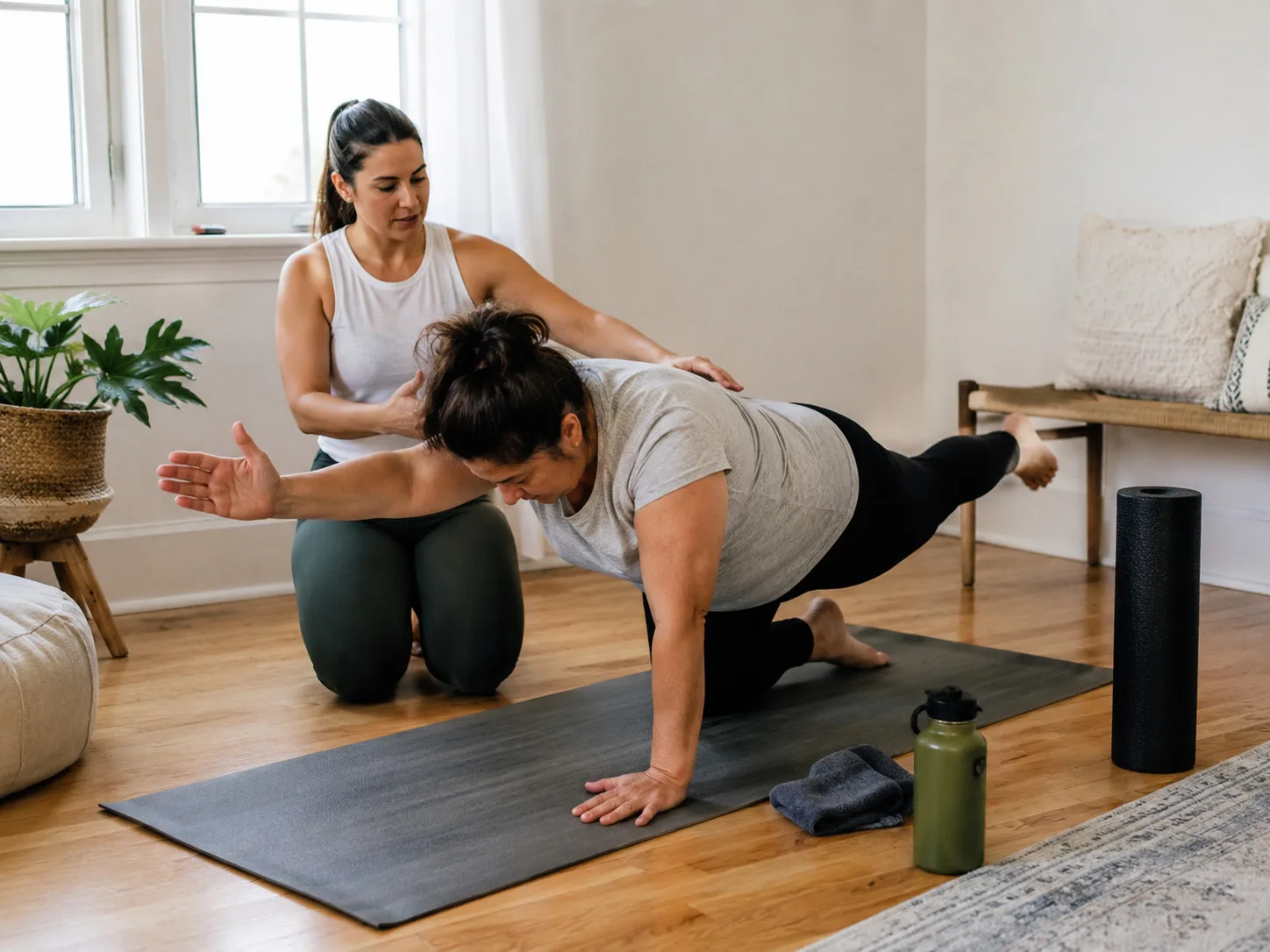
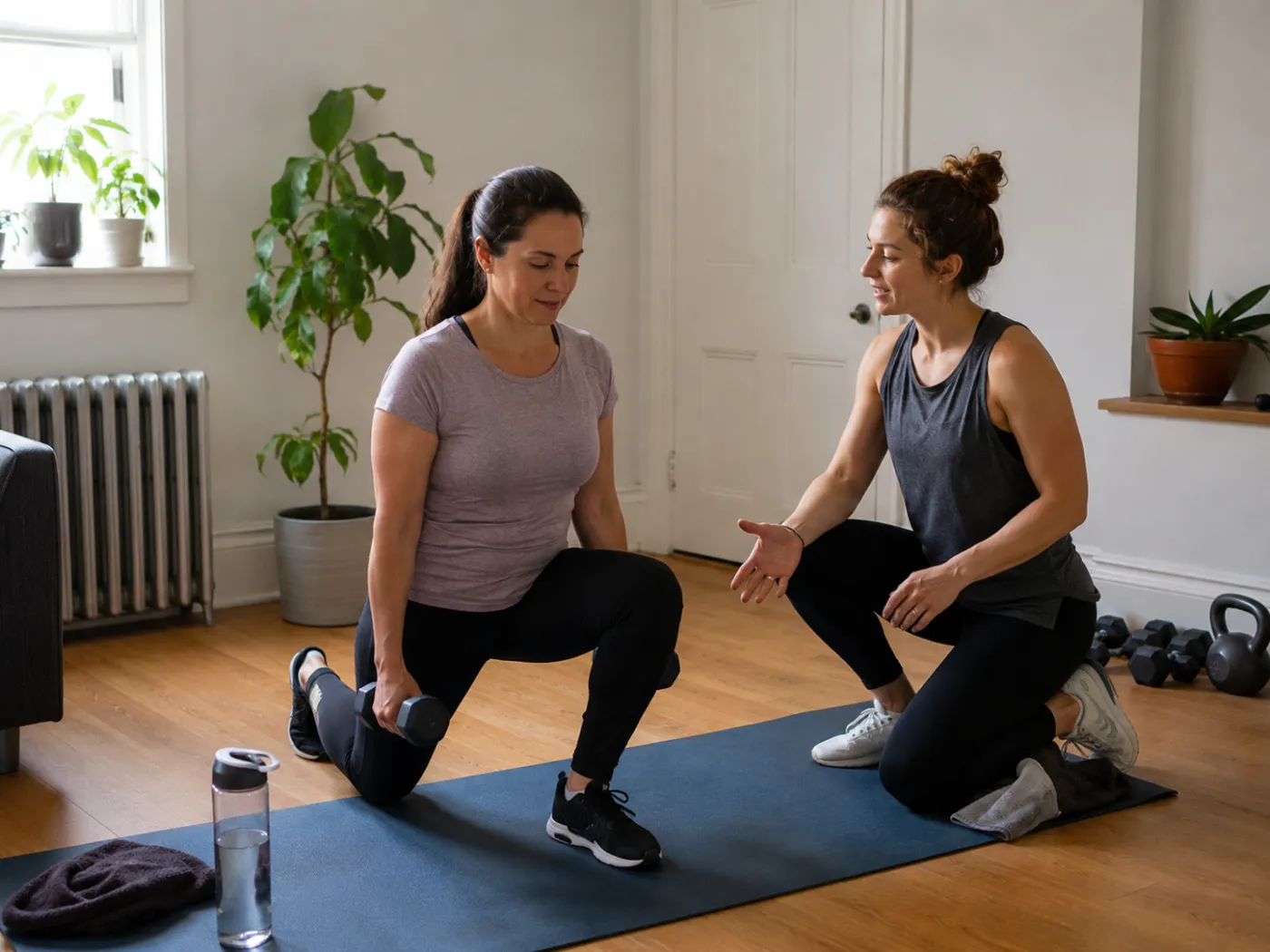
We sorted the uncommon movements that reached the most clients by the job they do. The result reads like a specialist's toolkit, and most of it needs nothing more than a bench, a band or a single dumbbell.
| The job | Uncommon exercises coaches reach for (share of clients) |
|---|---|
| Groin and hips | Copenhagen plank (4.4%), Cossack squat (3.4%), hip airplane (1.4%), 90-90 hip drill (1.3%) |
| Knees, shins and ankles | Pogo hop (2.6%), lateral step down (1.8%), Nordic curl (1.5%), tibialis raise (1.4%), Spanish squat (1.0%) |
| Shoulders | Shoulder external rotation (2.4%), kettlebell halo (1.7%), Y raise (1.4%), Z press (1.3%) |
| Trunk under load | Overhead carry (2.0%), waiter carry (1.6%), front rack march (1.2%), stir the pot (1.0%), suitcase deadlift (0.9%) |
| Warm-up and prep | World's greatest stretch (4.2%) |
| Strength with a twist | Gorilla row (2.3%), Zottman curl (1.9%), sled drag (1.7%), Zercher squat (1.4%), spider curl (1.3%) |
Four of those six rows are about keeping a client healthy enough to keep training. Copenhagen planks and Nordic curls come out of football injury research: a randomised trial in the British Journal of Sports Medicine linked a Copenhagen adduction programme to fewer groin problems, and a 2015 trial with amateur players found the same for Nordic curls and hamstring injuries. Tibialis raises, Spanish squats and lateral step downs are knee and shin work you'd more often expect in a physio clinic than a commercial gym. If you've read our guide on software for rehab and mobility coaches, you'll recognise the overlap. Plenty of general coaches are quietly doing prehab.
The last row is the other side of the long tail: familiar goals, less familiar tools. A Zottman curl still trains the arms and a Zercher squat is still a squat. The coach has just picked a version that loads the body a little differently, often to add variety to a long block or work around an injury.
Is the long tail about specialist equipment?
Mostly not. Specialist implements are a small slice of all assigned work: kettlebells 1.4%, suspension trainers 1.1%, landmines 0.7%, trap bars 0.6%, sleds 0.4%, plates 0.3% and sandbags close to zero. Together that's 4.5%. The long tail is 18.6% of assigned work. So even if every specialist-kit exercise were an uncommon one (they aren't), at least three quarters of uncommon work would still run on ordinary kit or none at all.
That matches what we found when we asked what equipment online coaches program: the centre of online coaching is a mat and a pair of dumbbells. The long tail keeps that footprint. A Copenhagen plank needs a bench. A tibialis raise needs a wall. What makes these exercises uncommon is knowing when to use them, not owning something exotic.
Save the drill once, use it for every client who needs it
An uncommon exercise is only useful if the client knows how to do it. In QuickCoach you can add it to your library once, attach a YouTube or Vimeo demo and your cue, and drop it into any plan. Free for up to 20 active clients.
Start freeHow many ways do coaches write the same exercise?
Plenty. Across the dataset, 1,035 movements had more than one spelling, and between them they were written 12,070 different ways. The row alone turns up 630 ways. That's the common end, and our most-programmed exercises report covers it. The long tail has its own version of the same story, and it's more interesting than a typo count.
Copenhagen plank: 33 ways
Bent knee, modified, deficit, and a Scandinavian "Copenhagen planke". The variations are regressions and progressions, not mistakes.
Cossack squat: 29 ways
Rack supported, foot elevated, alternating, and one written as a combined lateral split squat warm-up.
Shoulder external rotation: 24 ways
Banded, isometric, side-lying with a dumbbell, and a Russian-language entry for a small-loop band version.
Pogo hop: 19 ways
Banded, single-leg side to side off a box, holding dumbbells, and "pogos asistidos con liga" in Spanish.
Two things stand out. First, the spellings are mostly coaching. "Bent knee Copenhagen plank" and "deficit Copenhagen plank" are two ends of a progression, and the coach has written the level into the name. Second, the long tail is multilingual. Nordic curls show up as "curl nordico" and gorilla rows as "remo gorila", which fits what we found about the languages of online coaching. The same specialist ideas are spreading across countries, in whatever language the client reads.
The cost is on the coach's side. If you write a drill fresh every time, you lose the demo video and any consistent record of how the client is doing with it. That's a small tax at five clients and a real one at forty.
What does the long tail say about how coaches program?
It says the leaderboard undersells the profession. Read only the top ten and you'd think coaching is rows, deadlifts and bench press, over and over. Read the long tail and you see 2,016 movements that are uncommon through and through, plus 461 familiar ones that show up in uncommon variations: a single-arm overhead carry instead of a farmer's walk, isometric hip abduction holds instead of the machine. Of those fully uncommon movements, 181 reached ten or more clients in a single month, so these aren't one coach's quirks. And 716 were written for exactly one client, which is about as clear a sign of personalisation as data can give you.
It also says the skill is in the allocation. Coaches keep the main lifts boring on purpose, because boring lifts are easy to progress and easy to track. Then they spend their creativity where it pays, in the warm-up and in the accessory that keeps a knee happy through a twelve-week block. That split matches what we saw in the anatomy of an online coaching program, where the structure stays steady and the details change.
What this means if you coach clients
Keep your staples standard and make your long tail deliberate. The data suggests most coaches already work this way, but it's worth checking your own programs against it. If every exercise in a plan could appear on a top-ten list, there's probably room for one targeted drill that answers something specific about that client. If half the plan is exotic, the main lifts may be getting lost.
Pick your long-tail exercises by job, not novelty. Use the table above as a starting point. A client who plays five-a-side football is a natural fit for Copenhagen planks and Nordic curls. A runner coming back from shin pain suits tibialis raises and pogo hops. A desk worker with a stiff upper back suits halos and Y raises. Ask what the client is trying to protect, then choose the drill.
Name each uncommon drill once and reuse that name. Pick one spelling and attach one demo. If you're not sure what to say for a drill clients rarely see, our guide to writing coaching cues for online clients covers it. Then build it into a template so the next client who needs it gets the same exercise, a job our guide to building client workout programs faster walks through step by step.
One practical test for this week: open your three most recent programs and circle anything that isn't a staple. Can you say, in a sentence, what each one is for? If you can, that's your coaching showing. If you can't, swap it for something you can explain.
Methodology and limitations
How we got these numbers
Source. The same August 2026 read that powers what coaches program: 204,470 verified assigned exercises across active coaching plans on QuickCoach, a platform used by more than 40,000 coaches and fitness businesses worldwide. No individual coach, client or plan is identifiable in anything published here.
Definitions. Exercise names are free text. Every spelling, abbreviation and equipment variation of the same movement was grouped into one of 3,565 canonical movements, each tagged with a movement pattern, an equipment type and a commonality class (common, uncommon or novel). 2,016 movements were classed uncommon or novel in full. A further 461 familiar movements had specific variations classed uncommon (for example a single-arm overhead carry), and only those variations count toward long-tail shares. Pattern, equipment and long-tail shares are of the 176,946 assigned exercises that could be confidently classified. Client reach is the share of clients assigned a movement at least once in the month and counts the whole movement, all variations included.
Distinct names. The 25,900 figure counts raw exercise names as typed in August 2026, before grouping, so the same movement spelled two ways counts twice. The single-client share is the share of those raw names logged for only one client.
Scope. This reads what coaches program, not an endorsement of any exercise or a claim about what a client should do. The commonality class is a judgement about how mainstream an exercise is, made consistently across the dataset but not a perfect science. Entries too ambiguous to identify were excluded from the named examples. Figures describe coaches on QuickCoach rather than the whole industry, and are rounded.
Privacy. Everything is aggregated across the platform and reported as shares or counts. No personal data, client information or individual plan is exposed.
Frequently asked questions
What uncommon exercises do online coaches program most?
The Copenhagen plank leads. It reached 4.4% of clients on QuickCoach in August 2026, about one in 23. Next come the world's greatest stretch (4.2%), the Cossack squat (3.4%), the pogo hop (2.6%), shoulder external rotation (2.4%) and the gorilla row (2.3%). Most are prehab, mobility or carry work.
How much of a coaching program is made of uncommon exercises?
More than most people expect. In August 2026 the 100 most common movements covered 57.6% of assigned work, so 42.4% came from the other 3,465. Entries classed as genuinely uncommon or novel made up 18.6% of everything coaches assigned.
Where do coaches use the most uncommon exercises?
In carries, mobility, core and prehab work. 43% of carry work was an uncommon variation, as was about 32% of mobility and 29% of core work. Pushing and pulling were the most standardised, with under 9% of that work in the long tail.
Should beginners do uncommon exercises?
Usually as accessories, not as the main event. Coaches in this data keep the big lifts familiar and put uncommon work in the warm-up, the prehab slot and the finisher. A tibialis raise or Copenhagen plank can suit a beginner if it answers a clear need, such as protecting a knee or the groin. This is general guidance, not a QuickCoach data figure.
How was this long-tail exercise data collected?
From 204,470 verified assigned exercises across active coaching plans on QuickCoach in August 2026, a platform used by 40,000+ coaches. Free-text names were grouped into 3,565 canonical movements and classed as common, uncommon or novel. Everything is aggregated and anonymised.
Published September 2026. This is a one-off report on the August 2026 data. For the staples, refreshed every month, see what coaches program. For the kit behind all of it, read the equipment report, and if you're weighing how many clients you can program for properly, our free capacity worksheet runs the numbers. Questions about the data? Reach us at support@quickcoach.fit.