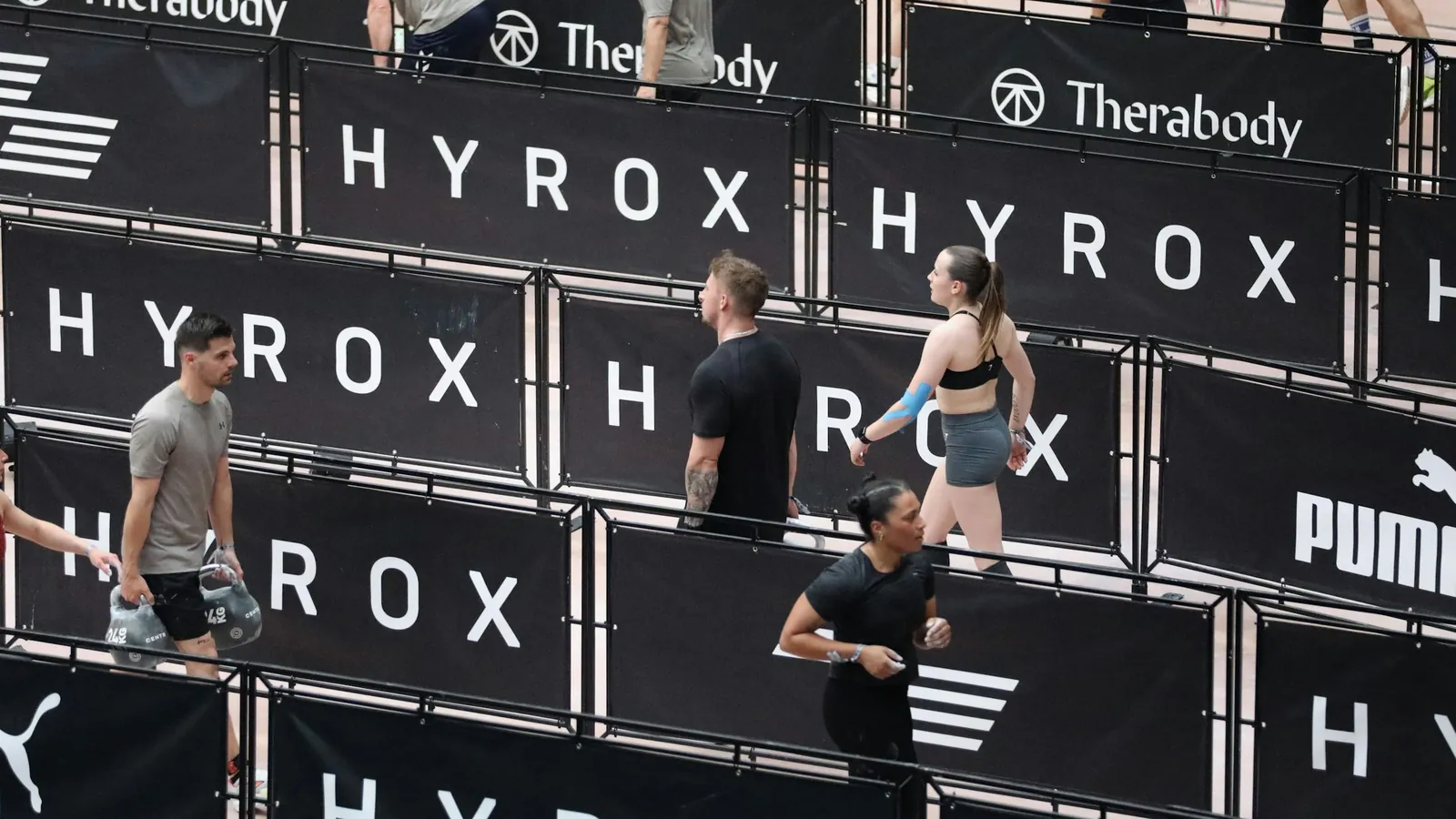
Race day is the one day a HYROX coach's brand is seen by the whole community. The venue is full of athletes, coaches, supporters and photographers, and most of them will be forgotten by Monday. The coaches who planned their presence will not be. That is the difference this page is about.
This is the HYROX race day branding guide, written for coaches and gyms supporting athletes at a race. It covers the support crew, the athlete's visibility, the photo moments and the follow-up that turns the day into a client list. It is not a race-day logistics article. Hydration, pacing and race strategy are someone else's subject. The brand presence is the subject here, and the brand presence is the whole subject.
One thing up front, because it governs everything below. HYROX is a registered trademark of HYROX GmbH. QuickCoach is not affiliated with, endorsed by, or sponsored by HYROX. The branding in this guide is your club's branding, and it never implies otherwise.
What competition-day branding is (and is not)
Quick answer
Competition-day branding is the planned way your club is present at a race: the support crew in club kit, the athletes' visibility, the photo moments, and the follow-up that turns the day into a client list. It is your presence, not the event's, and it implies no affiliation with HYROX.
Competition-day branding is the planned way your club is present at a race. It is the crew in club kit, the athletes in the singlet, the photo moments that get shared and the follow-up that starts the day after. It is a small number of decisions made before the event, and it is the difference between showing up and being seen.
It is also, just as clearly, what it is not. It is not event sponsorship. You are not paying for naming rights, you are not an official partner, and nothing about your presence implies that you are. It is not the event's branding, and it is not the HYROX brand. It is your club's identity, carried into a venue where your whole community happens to be looking.
That distinction changes how you plan. A coach who understands that race-day branding is their own presence plans differently from one who thinks they are buying into the event. The first builds a club. The second builds a misunderstanding, and a misunderstanding is the one thing that can turn a good day into a bad one.
The day itself is the proof. A club that has done the work looks different in the venue: the crew is easy to find, the athletes are easy to spot, the photos are easy to share. A club that has not done the work looks like everyone else, and everyone else is forgotten by Monday.
The support crew: the kit that makes you findable
The support crew is the most underrated branding asset in the sport, and it is the playbook this page is built around. The crew are the people who carry the water, time the splits, hand over the towel at the sled and cheer at the stations. They are also the people who make you findable.
Findable is the word that matters. A race venue is a crowd, and a coach in that crowd is hard to spot. A crew of four or five people in the club's colours is not. The crew is the marker that says your club is here, and it is the reason an athlete can find you between stations and a supporter can find you in the stands.
The kit does the work. One item, the singlet or the tee, in the club's two colours, worn by every crew member. The crew kit is a small number of items that do a large amount of visibility work, and what a club actually wears on race day is covered in our guide to custom merchandise for HYROX teams and training clubs.
The crew also changes what the day means. An athlete who races with a crew in the club's colours is an athlete who races as part of a team, and that belonging is the mechanism the club is built on. The identity stack that the race-day presence carries, the name, the colours and the philosophy, is in our guide to HYROX coach branding.
Assign the roles before the day. One person on the water, one on the splits, one on the finish line, one on the phone. The crew that knows its jobs is the crew that looks organised, and an organised crew is the visible proof that the club is a real operation rather than a hobby.
The crew size scales with the roster. A coach with two athletes races with a crew of two. A gym with twenty athletes at the same event runs a crew of six or eight, split across the stations and the finish. The ratio is not the point. The visibility is.
The athlete's visibility: singlet, bag, warm-up
The athletes you coach are the walking brand, and they are the part of the presence you do not have to organise. They are already at the venue, already in the race, already being watched. The job is to make sure they are recognisable as yours.
The singlet is the first layer. An athlete racing in the club's singlet is the brand in motion, and it is the item the photographers will capture. The bag is the second. The kit bag with the club's name sits in the bag drop and the transition area all day, and it is visible for hours while the singlet is visible for minutes.
The warm-up is the third, and it is the one most clubs miss. The warm-up is the longest stretch of time your athletes are together and visible before the race, and a group warming up in club kit is a photo that gets taken. It is also the calmest moment of the day, which makes it the best one for the team photo and the last briefing.
None of this needs to be expensive. The singlet is the one item the club already prints, the bag is a one-off order, and the warm-up costs nothing beyond showing up in the kit. The athlete's visibility is the cheapest layer of the whole presence, and it is the one that gets photographed most.
The photo moments: where the brand gets remembered
Here is the framing that most race-day branding advice misses. The brand is not remembered in the race. It is remembered in the photos. The finish line, the sled, the team shot, the crew shot. Those are the moments that get photographed, posted and tagged, and they are the moments that last.
So plan for them. Know where the photographers stand, and put the crew there. Keep the kit clean for the finish. Take the team photo in the warm-up, when everyone is together and no one is mid-race. The photos are the content that carries the club's name for months, and they cost nothing to plan.
The photo moments are also the honest record of the day. The athlete who finds a photo of themselves in the club's singlet, tagged by the club, keeps it. That photo is the memory, and the memory is the reason the athlete comes back to the club rather than drifting to the next one.
One practical note on the photos. The club's own phone is the reliable camera, because the official photographers cannot be everywhere and their shots are not yours to use. A crew member with a phone, a list of the athletes and a plan to capture each one at the finish is worth more than any amount of hoping the official gallery comes through.
The photo moments are also the content calendar for the week after. The finish-line shot becomes the post. The team shot becomes the club's cover. The crew shot becomes the thank-you. A day that produces three usable photos is a day that produces a week of content, and the content is what the club's community sees between races.
The post-race follow-up: turning the day into a client
The race ends, and the brand work begins. The follow-up is where the day becomes a client list, and it is the step most coaches skip because the day is exhausting and the instinct is to rest. The coaches who follow up are the ones who turn a good day into a growing roster.
The follow-up has three parts. Tag the athletes in the photos, so the day shows up in their feeds. Thank the crew publicly, so the club's community sees the people who made it happen. And route the contacts into the club, so the interest the day generated has somewhere to land.
The routing is where the branded client app comes in. On QuickCoach, the branded client app is part of Pro at $39 a month, or $32.50 a month effective on annual billing, with unlimited clients. It is the mechanism that turns race day into a client list. The athlete who raced with you gets a message in the app, the recovery plan, the next training block, the invitation to the club. The app is where a race-day contact becomes a client, because it is where the coaching continues.
For the first event, the free tier is the pilot. It holds up to 20 active clients with no time limit, which is more than enough for a first race-day follow-up, and it costs nothing. The full mechanics of turning race-day contacts into paying clients, the messages, the offers and the sequence, are in our guide to getting your first online coaching clients.
The software side of the follow-up, the sessions, the check-ins and the delivery that keep the new client engaged, is covered in the endurance and hybrid pillar, which is our guide to coaching software for endurance and hybrid coaches.
The timing matters too. The follow-up that lands the same evening is the one that gets read. The athlete is still buzzing, still tagged in the photos, still in the race-day mindset. A message in the app that night, with the recovery plan and the next block, is the difference between a contact and a client.
The line you do not cross: no implied sponsorship
Race-day branding is not event sponsorship, and this page says so plainly. You are supporting your athletes, not sponsoring the event. You are not paying for visibility, you are not an official partner, and nothing about your presence should suggest that you are.
The practical line is simple. Your kit is your club's kit, and it carries your club's name and colours. It does not carry the HYROX logo, it does not use the event's branding, and it does not imply affiliation. The club's presence is the club's, and the event's brand is the event's.
What is allowed is describing what you do. Saying your club supports athletes at HYROX races is factual. Saying you are an official partner, or printing the event's marks on your kit, is not. The distinction is the same one that governs the whole identity stack, and it is covered in the FAQ below.
The same discipline applies to the captions and the posts. A photo of the crew in club kit captioned "supporting our athletes at the race" is honest. The same photo captioned "official race partner" is not. The words are part of the presence, and the words follow the same line.
This is the line that protects the club. A club that implies sponsorship it does not have risks the trust of its own members and the attention of the trademark owner. A club that keeps its presence honest has nothing to explain, and the honesty is part of the brand.
Frequently Asked Questions
Can I use the HYROX logo on my crew kit?
No. The HYROX logo is the trademark of HYROX GmbH, and your kit is your club's kit. It must not carry the logo, and it must not imply affiliation with the event. HYROX is a registered trademark of HYROX GmbH. QuickCoach is not affiliated with, endorsed by, or sponsored by HYROX.
Is this event sponsorship?
No. You are supporting your athletes, not sponsoring the event, and this page says so plainly. Race-day branding is your club's presence at a race, not a commercial arrangement with the organiser, and it implies no official status.
What do I do with the photos after?
Run the post-race follow-up: tag the athletes, thank the crew, and route the contacts into the branded app and the club. The photos are the memory of the day, and the follow-up is what turns the memory into a client list.
Published August 2026. This page is part of the HYROX cluster in the coaching guides library, alongside the identity stack and the kit guides. If you are taking a club to its first race, the free tier holds up to 20 clients with no time limit, and the 14-day Pro trial is the honest way to test the branded client app that turns the day into a client list.