Endurance and hybrid coaching cover a wider range of athletes than most niches, from first-time marathoners to multisport racers balancing two goals at once. The questions coaches ask tend to be practical and recurring: how much volume, which intensity marker, how to order sessions, how to peak on a date.
This page collects the questions that come up most often, framed for coaches who already programme training rather than newcomers reading a definition for the first time. Every answer is short, self-contained, and quotable, with a link into the coaching-methods reference where the method gets unpacked in full.
Quick answer
Endurance coaching programmes aerobic capacity and race fitness through volume, intensity, and recovery. Hybrid coaching adds strength work and accepts a slower rate in each quality. Load is tracked, RPE and heart rate set intensity together, and tapering peaks the athlete on race day.
What does an endurance coach actually do, and who do they work with?
An endurance coach plans and supervises training that improves aerobic capacity, fatigue resistance, and race performance across running, cycling, triathlon, and rowing. They work with recreational racers, age-group competitors, and serious athletes, building weekly programmes that balance volume, intensity, and recovery to lift performance without breaking the athlete.
The role sits between writing sessions and reading the data each one produces. Our coaching-methods reference sets out the methods underneath the work.
What is hybrid coaching, and how does it differ from pure endurance or pure strength coaching?
Hybrid coaching programmes strength and endurance in the same plan, so the athlete builds muscle and power alongside aerobic fitness. Pure endurance coaching chases aerobic capacity and race times. Pure strength coaching chases force and muscle. Hybrid coaching pursues both, accepting a slower rate in each to keep both moving.
The trade-off is real. The interference effect limits how much each quality develops at once, so the ordering of sessions matters as much as the volume. Read concurrent training for how to order them.
How do endurance coaches programme training volume without overcooking the athlete?
Volume is set as weekly duration or distance, then split across sessions by intensity. Coaches start from the athlete's current sustainable load, add roughly ten percent per week, and pull back every third or fourth week to absorb the work. Tonnage is tracked, not guessed, so spikes show up before they bite.
See load management for how acute-to-chronic workload ratio keeps a lid on injury risk.
What is concurrent training, and how does the interference effect actually work?
Concurrent training stacks resistance and endurance work in the same programme. The interference effect is the signal conflict where high-volume or high-intensity endurance blunts hypertrophy and power adaptations, strongest when cardio is hard, long, and close to lifting. Coaches separate the sessions by several hours and keep easy days genuinely easy to limit it.
The concurrent training page unpacks session ordering and the cost of stacking them back to back.
How do endurance coaches use RPE and heart rate together to set intensity?
Heart rate gives an objective ceiling for easy and threshold work, while RPE lets the athlete rate how hard a session actually felt on the day. Coaches use heart rate as the target and RPE as the reality check, adjusting when heat, fatigue, or life stress push the same effort higher than it should.
RPE is the autoregulation lever when heart rate drifts off script. The RPE page shows how the 1 to 10 scale is applied.
How do endurance coaches taper for a race without losing the fitness they built?
A taper cuts training volume by 40 to 60 percent over one to three weeks while keeping intensity high, so fatigue clears and the adaptations from the previous block express themselves on race day. Frequency stays roughly normal, with short, sharp sessions replacing long easy ones to keep the athlete firing.
Taper length scales with race distance and the block before it. The tapering page covers the volume-intensity split.
How do endurance coaches manage training load to keep athletes healthy across a season?
Coaches track weekly duration, session RPE, and acute-to-chronic workload ratio, then progress load in small, reviewable steps with recovery weeks built in. Sudden spikes in weekly tonnage or hard sessions are the most common cause of soft-tissue injury, so load is increased only as fast as the athlete's tissues can adapt.
The load management page covers ACWR thresholds and wellness monitoring in detail.
How do endurance coaches programme strength work for runners without killing the running?
Strength work goes on hard days, two to three sessions a week, kept short and focused on heavy compound lifts in the three to six rep range. Coaches lift before hard running when possible, separate lifting from key sessions by several hours, and drop volume rather than intensity in race week.
Rep ranges track the adaptation, and block periodisation sequences the blocks. See the rep ranges and block periodisation pages for how to programme them.
How do endurance coaches run check-ins when their athletes train alone most of the week?
A weekly check-in combines a short readiness questionnaire on sleep, soreness, motivation, and life stress with the session data already logged, then the coach adjusts the next block on trends rather than one bad session. Heart rate, RPE, and completed versus planned sessions are reviewed together so the loop stays tight.
Our online coaching check-ins guide sets out the questions and the cadence.
What software do endurance coaches actually use to deliver sessions and track the data?
Most use a coaching platform that holds the session library, delivers sessions to a client app, collects heart rate, RPE, and completion feedback, and rolls that into a dashboard for review. Spreadsheet-only delivery works for one or two athletes but breaks down once a roster grows past single figures.
See how to choose coaching software in 2026 for the decision factors that matter for an endurance roster.
Do endurance coaches assign nutrition and fueling plans, or is that someone else's job?
Most endurance coaches give general fueling guidance, carbohydrate intake targets for long sessions, and hydration and race-day fueling strategies, but stop short of clinical meal plans for conditions like diabetes or eating disorders. Those require a dietitian. Habits around sleep, fueling, and recovery are fair game and fit naturally into check-in workflows.
See whether online coaches assign habits and how nutrition coaching software supports the non-clinical side.
What credential should an endurance coach hold before taking on athletes?
A recognised exercise science credential is the baseline, with ACSM certified exercise physiologist or NSCA-CSCS the most widely accepted for coaches working with competitive endurance athletes. Run-specific coaches often pair that with a federation coaching award from UKA, Athletics Australia, or USATF. Without one, coaches should stay with general fitness clients.
The NSCA and ACSM pages set out what each exam covers and where each is recognised.
What is polarised training, and why do so many endurance programmes use it?
Polarised training splits volume into roughly 80 percent easy and 20 percent hard, with little time in the middle. Easy work builds aerobic base cheaply and recoverably, hard work lifts threshold and VO2max. The middle intensity, often called zone 3, gives moderate fitness gains at a high fatigue cost, so coaches use it sparingly.
How do endurance coaches programme VO2max intervals without frying the athlete?
VO2max work goes in short blocks of three to four weeks, two sessions a week at most, using intervals of three to five minutes at the velocity that elicits VO2max with equal or short recoveries. Coaches cap the block when session RPE climbs or heart rate stops responding, then move on.
Block periodisation sets when VO2max work sits in the year. The block periodisation page covers block lengths.
How long should an endurance macrocycle be, and how do coaches plan back from race day?
A macrocycle usually runs the full season or the build to one key race, split into base, build, peak, and taper phases of three to eight weeks each. Coaches plan backwards from the race date so each phase feeds the next and the peak lands on the right week, not before or after.
How do endurance coaches test athletes without disrupting the training week?
Testing is folded into normal sessions where possible, using routine time trials, hill repeats, or the last interval of a set as a benchmark rather than running a separate test day. Dedicated test weeks happen at block boundaries two to four times a year to set training zones and check progress.
How does an endurance coach change the plan between off-season and in-season?
Off-season is base building, mostly easy volume with a little strength work and one or two harder sessions to keep sharp. In-season drops total volume, keeps intensity high to preserve race fitness, and prioritises recovery around the race calendar. Strength work shifts to maintenance, one short session a week.
What does a first session with a new endurance client actually look like?
The first session covers history, goals, and recent training, a conservative benchmark such as an easy run or a short time trial, and agreement on how training and check-in feedback will flow. Coaches do not hammer a new athlete on day one. The aim is to set baselines, build trust, and leave room to progress.
Can a hybrid athlete genuinely improve at both strength and endurance at the same time?
Yes, but slower than if they chased one. Coaches keep strength and endurance sessions separated by at least six hours, place the priority session first in the day, and accept roughly 60 to 70 percent of the rate of gain in each. Concurrent beginners adapt fastest, advanced athletes feel the interference most.
The concurrent training page sets out the separation rules and the cost of stacking.
How does tapering for a marathon differ from tapering for a 5k?
A marathon taper runs two to three weeks, cuts volume by 50 to 60 percent, and keeps a short race-pace session to stay sharp. A 5k taper is five to ten days, drops volume by 30 to 40 percent, and keeps one or two short, fast intervals to preserve leg speed and turnover.
The tapering page covers taper length by event distance.
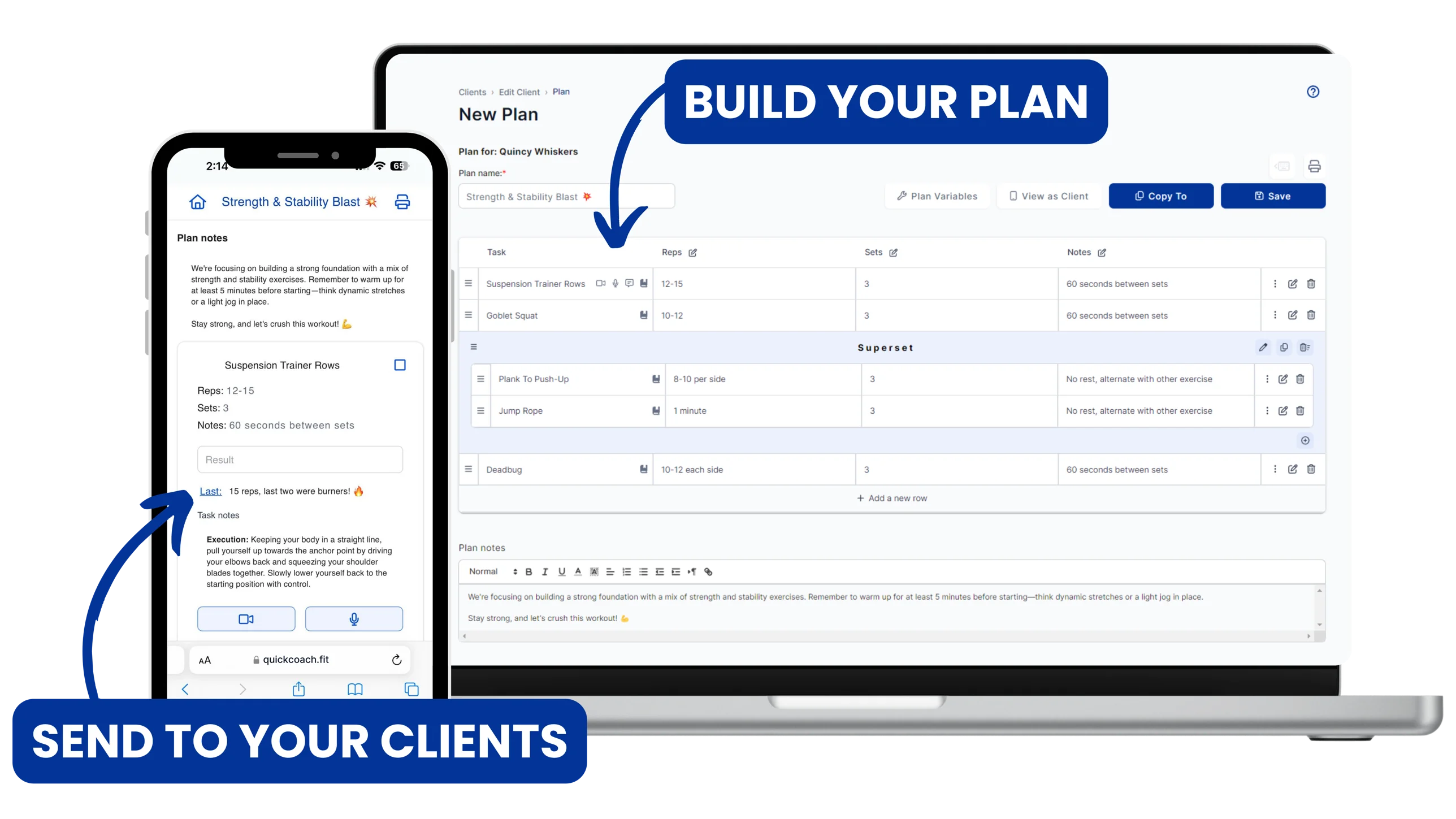
Want to put these methods into a programme without building spreadsheets? QuickCoach holds the session library, delivers sessions to a client app, and rolls completion and RPE feedback into a dashboard, with up to 20 clients free. Start free at quickcoach.fit, or read more on the QuickCoach blog.