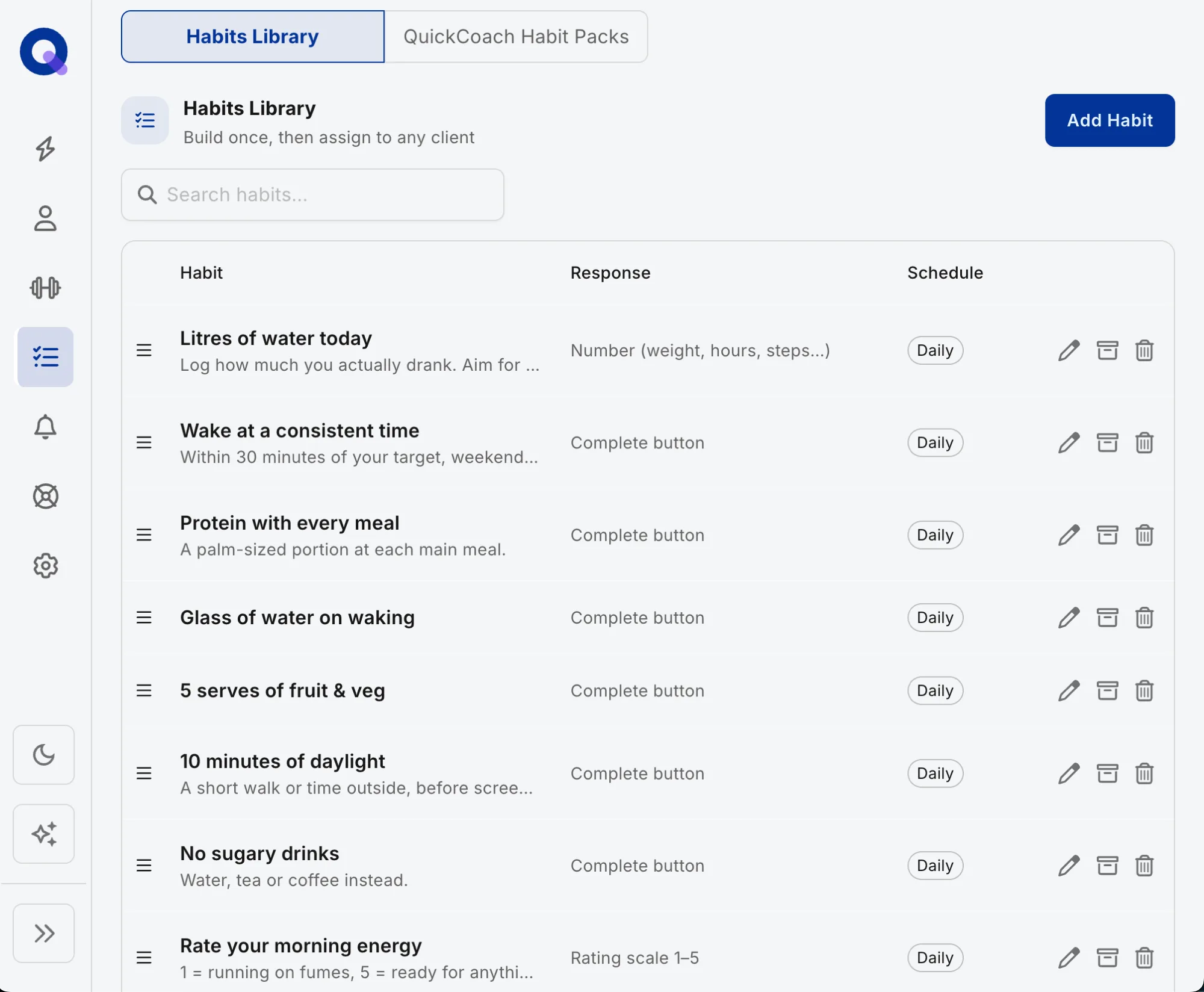
Ask a coach what they do and most will describe a program. Watch what they actually build and something else shows up alongside it: drink this much water, walk after lunch, get to bed before eleven, photograph one meal a day. None of that is training. All of it is coaching. The question we wanted answered was simple and, until now, unanswerable from the outside. Do online coaches assign habits, and how many of them think that work belongs to them?
We have written about the tracking layer before, but that report answered a different question. It measured the mix, which themes make up the tracking coaches add to plans. This one changes the denominator and counts coaches instead of items. QuickCoach is used by more than 40,000 coaches and fitness businesses worldwide, so for this read we looked across active coaching plans, separated the assigned tasks and habits from the exercise programming, and counted each coach once per category. A coach who sets a hydration habit for forty clients counts the same as a coach who sets it for one.
The short answer
About 71% of online coaches assign at least one habit or task outside the training itself. Food and logging leads at 58% of coaches, then daily movement (44%), hydration (39%) and sleep or recovery (34%). The typical coach who assigns habits runs three categories, not one.
What this is, in one paragraph
This report counts coaches, not tasks. We took the assigned tasks and habits that sit alongside the training in active coaching plans on QuickCoach, sorted them into categories, and asked one question of each category: how many coaches use it at all? A coach is counted once per category no matter how often they assign it, so a busy coach cannot outweigh a quiet one. Every figure below is a share of coaches. If you want the mix of what gets tracked instead, that is a different measure and it lives in our report on what online coaches track. The full method sits at the foot of the page.
Do online coaches actually assign habits?
Yes, and by a wide margin. Roughly seven in ten coaches assign at least one thing a client has to do away from the gym. That number reframes habit work. It is not a niche practised by lifestyle specialists while everyone else writes sets and reps. It is the default behaviour of the profession, chosen by most coaches on the platform without anyone requiring it of them.
The other three in ten are worth defending rather than scolding. A strength coach hired to add fifteen kilos to a squat has no business auditing anyone's water intake, and a client who wants a program and nothing else is entitled to buy exactly that. Habit assignment is a choice about scope, and a clear scope beats a bloated one. What the data shows is which way that choice usually falls when a coach is free to make it.
What habits do online coaches give their clients?
Food is the first place coaches reach. Nearly six in ten assign something around eating or logging, which puts it well ahead of everything else. Movement outside training comes next, then hydration, then sleep. The pattern is not exotic. These are the four levers that decide whether a training block does anything, and coaches go after them in roughly the order a nutritionist would.
What coaches assign beyond the workout
Share of coaches who assign each category at least once
Each figure is the share of coaches who assign that category at least once, counted once per coach. Coaches assign in several categories, so the shares do not sum to 100%. Figures are rounded.
Look at the middle of the list and you find the part that surprised us. Hydration sits third. It is the least glamorous instruction in coaching, it costs a client nothing, and roughly two in five coaches still bother to write it down and ask for it back. Nobody assigns a water target because it is impressive. They assign it because it is the easiest win available to a client who is currently getting nothing right, and a coach who can bank one easy win in week one has a client who believes the rest is possible.
The anchor habit
One thing, daily, hard to fail. Water, a short walk, protein at breakfast. It exists to build the tick, not the outcome.
The visibility habit
A meal photo, a weekly rating, a logged food day. It gives the coach something to read before the next check-in.
The recovery habit
A bedtime, a screens-off time, a rest-day stretch. Usually assigned second, once training volume starts to bite.
Why does this look different from what coaches track?
Because a common habit and a common tracking item are not the same thing, and the gap between them is the most useful finding here. Steps are a good example. In the tracking mix, step and movement items sit near the bottom of the list. Counted by coach, a daily movement target is the second most widely assigned habit on the platform. Both readings are correct. They answer different questions.
The reason is frequency. A food log fires every day and generates a stream of items, so it dominates any count of items. A step target is set once and sits there quietly, producing almost nothing to count while still shaping what a client does every afternoon. Weighted by items, the loud habits win. Weighted by coaches, you see how many people made the decision at all, which is the number that tells you what the craft looks like. Our earlier read of what online coaches actually track mapped the mix and said in its own limitations that it could not speak to adoption. This report is the other half of that sentence.
It is the same trick we used when reading the cues coaches write onto exercises, where ranking phrases by the number of distinct coaches who use them turned a pile of text into a picture of a shared vocabulary. Counting people rather than records is the difference between knowing what a platform is full of and knowing what coaches believe.
How many habits does one coach assign?
Not many, and that restraint is deliberate. Among coaches who assign anything at all, the median is three categories. A quarter use a single one. About a fifth run five or more, which is a genuine lifestyle-coaching practice rather than a training service with extras bolted on.
How broad a coach goes
Share of habit-assigning coaches by number of categories used
Shares are of coaches who assign at least one non-training task, not of all coaches. Median is three categories. Figures are rounded.
Three is a very human number. It is roughly what a person can hold in their head on a bad Tuesday, and it maps almost exactly onto the top of the category list: one food habit, one movement habit, one recovery habit. Coaches did not read that off a chart. They arrived at it the way everyone arrives at working practice, by assigning six things, watching four of them quietly die, and keeping the ones that survived contact with a real client's week.
The same restraint keeps showing up wherever we look at our own data. Programs land on four sessions a week rather than six. Cues stay short. Habit stacks stay at three. Coaches are running a constant, unglamorous trade between what would be ideal and what will actually get done, and the platform-wide answer is nearly always the smaller number.
What habit assignment says about how coaches coach
Seven in ten coaches choosing to reach past the training tells you what they think they are selling. Not a program. A change in how someone lives, of which the program is one part. That is a much harder product to deliver and a much easier one to justify charging for, because a spreadsheet of sets is free on the internet and a person who notices whether you ate breakfast is not.
It also explains where the relationship gets built. A habit is a small, daily promise between two people. The client makes it, the coach sees it, and the two of them talk about it a week later. That loop is why habit-led coaching and staying power are so closely linked, something we unpacked in our guide to why coaching clients leave and what fixes each cause. Clients rarely quit because the programming was wrong. They quit when nothing outside the gym changed and the coaching stopped feeling like it was about them.
None of this is a verdict on how well clients complete what they are given. We did not measure that here, deliberately. This report is about the coach's decision, which is the part of the craft that is genuinely theirs to make. If you want the wider picture of how those decisions stack up, from geography to program shape, it is collected in the state of online coaching in 2026.
What this means if you coach clients
If you already assign habits, the useful takeaway is that your instinct to keep the list short is shared by most of your peers, and the three-category shape is a sensible default rather than a compromise. One food habit, one movement habit, one recovery habit will cover more ground than a fifteen-item checklist that gets abandoned in week two.
Not assigning anything yet? Start with one. Pick the habit that fixes the thing your client complains about most, make it small enough to be embarrassing, and put it in front of them daily instead of mentioning it once on a call. The mechanics matter more than the choice: a habit a client can tick in the app is a habit you can see, and a habit you can see is something to talk about at the check-in. That is the shape habit tracking in QuickCoach is built around, and the first month is where it pays best, which is the argument running through how to structure the first 90 days with a client.
Then close the loop. An assigned habit with no follow-up is a suggestion, and clients treat it like one. Reviewing the ticks alongside the training is the whole point of a decent check-in cadence, which we lay out in our system for check-ins that keep clients, with a ready-made set of check-in questions you can copy straight in. When the check-in is about food, the log gives you the evidence and the questions give you the story, which is what our guide to nutrition coach check-ins walks through. The follow-ups that come out of those check-ins are worth writing down somewhere they will be seen, which is what the coach-side to-do list is for. And a month of ticks is where that follow-up gets its material, which is the subject of our guide to habit check-ins: turning a month of ticks into a coaching decision.
Assign the habit, then actually see it
Habits are on every QuickCoach plan, including Free. Set a daily task, let the client tick it in their app, and read the week beside their training instead of asking how it went. Pro adds multiple habits per client, richer responses than a yes or no, and ready-made packs.
See how habit tracking worksOne last note on why we bothered to run this the slow way. The obvious version of this report counts tasks, which is easy and rewards whoever assigns the most. Counting coaches is harder and produces a smaller, more honest set of numbers about what the job looks like. It also told us something we acted on: habit work is not a fringe feature request, which is why habit tracking and nutrition now ship in QuickCoach Pro rather than sitting behind an add-on.
Methodology and limitations
How we got these numbers
Source. Aggregated task and habit activity across active coaching plans on QuickCoach, a platform used by more than 40,000 coaches and fitness businesses worldwide. We separated assigned non-training tasks, the habits, logging prompts and to-dos coaches build in alongside the training, from the exercise programming itself. No individual coach, client or plan is identifiable in anything published here.
Denominator. Every figure is coach-weighted. A category's share is the number of coaches who assign it at least once, divided by the coaches running active plans in the same window. Each coach is counted once per category regardless of how many clients or plans they assign it in, so volume cannot distort the picture. This is a different measure from the item-weighted shares published in our tracking report, and the two are not interchangeable.
Definitions. Categories are assigned from the task and habit language coaches write, which is partly free text, so the grouping is directional. A single task can touch two categories (a hydration and steps combination, say) and is counted in both, which is why the shares do not sum to 100%. The breadth figures are shares of coaches who assign at least one non-training task, not of all coaches.
Scope. This reads what coaches choose to assign, not whether clients completed it, and it is not a measure of coaching quality. Coaches who assign nothing beyond training are running a legitimate model, not a deficient one. Figures describe coaches on QuickCoach rather than the whole industry, and are rounded.
Privacy. Everything is aggregated across the platform and reported as shares of coaches. No personal data, client information or individual plan is exposed.
Frequently asked questions
Do online coaches assign habits to clients?
Most do. About 71% of coaches assign at least one habit or task outside the training itself, and the typical coach who does uses three categories rather than one. Habit assignment is standard practice in online coaching, not a specialist add-on.
What habits do coaches give their clients most often?
Food first. About 58% of coaches assign a nutrition or food-logging habit, 44% assign a daily steps or movement target, 39% assign hydration and 34% assign something around sleep or recovery. Mobility, journaling and photo or form-check uploads follow further down the list.
How many habits should a coach assign a client?
Platform practice points to a small stack. The median habit-assigning coach uses three categories, about a fifth use five or more, and roughly a quarter run a single one. Three is the shape most coaches converge on: one food habit, one movement habit, one recovery habit.
Is habit coaching part of online personal training?
For most coaches, yes. Roughly seven in ten assign something a client does away from the gym, which makes lifestyle work a defining behaviour of online coaching rather than an optional extra. The rest run a training-only remit, which is a legitimate model and often the right one.
How was this habit assignment data collected?
From aggregated task and habit activity across active coaching plans on QuickCoach, used by more than 40,000 coaches worldwide. Every figure is coach-weighted, meaning the share of coaches who assign a category at least once, counted once per coach no matter how often they assign it. All figures are anonymised and platform-wide.
Published July 2026. Figures describe habit assignment across QuickCoach's base of 40,000+ coaches and will be refreshed as the dataset grows. For the companion measure, the mix of what gets tracked rather than the share of coaches assigning it, see what online coaches actually track, and for the whole picture read the state of online coaching in 2026. To put habits to work with your own clients, start with our system for check-ins that keep clients. Questions about the data? Reach us at support@quickcoach.fit.