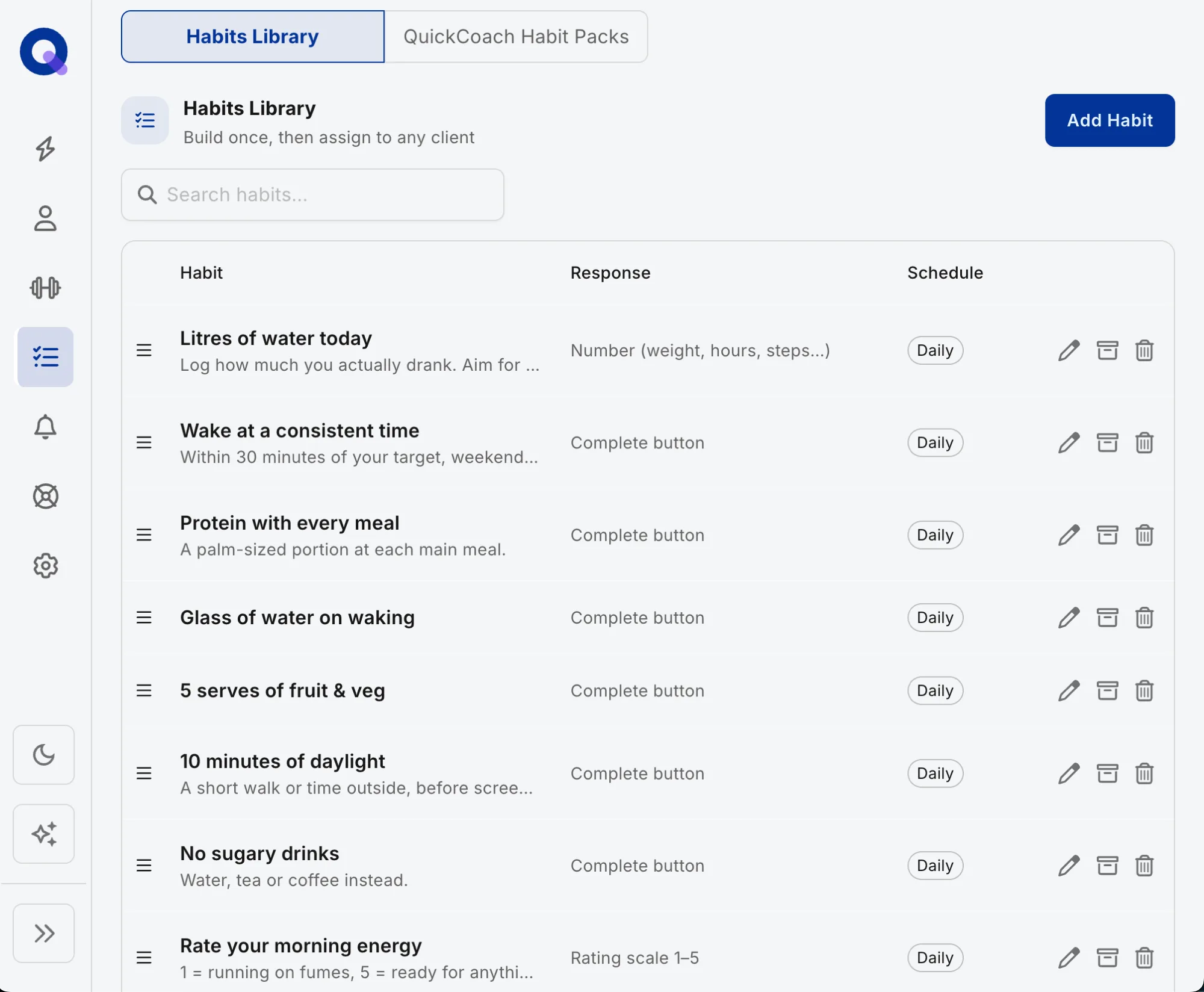
A habit check-in is not a tracker. The tracker records the ticks. The check-in reads them. Most coaches already run something close to one, because the weekly check-in has always carried a habit question inside it. What most of them do not do is look back at a month of ticks on purpose, and that is the difference between noticing a pattern and responding to it.
The short answer
A habit check-in is a short, regular review of how a client's habits are actually landing. It is not the tracker itself. The tracker records the ticks; the check-in reads them, spots the pattern, and decides whether the habit, the plan or the coaching needs to change.
What a habit check-in is, and how it differs from a habit tracker
A tracker answers what happened. A habit check-in answers so what. The tracker records whether the client drank the water, walked the steps, hit the protein. The check-in takes that record and turns it into a coaching decision: keep the habit as it is, shrink it, swap it, or drop it.
The check-in sits inside a wider system, which we lay out in our guide to client check-ins that keep clients. If you want the questions before the system, the copy-paste set of check-in questions is the place to start. The habit layer has its own shape, and it is worth understanding before you ask a client to report on it. Where habits sit in the wider tracking picture is in what online coaches actually track, and how coaches assign them in the first place is the subject of the habit assignment report.
Read the shape, not the streak
The streak is a scoreboard. The shape is the information. Three shapes show up over and over, and each one points at a different coaching move.
The steady line. Ticks land most days, a miss here and there, no long gaps. The habit is anchored. Keep it, and only raise the standard when the client asks for it. This is the shape you protect rather than improve.
The fading line. A strong first week, then the gaps grow and the ticks thin out. The motivation was the fuel and the habit has no routine underneath it. Fix the trigger, not the willpower. The habit-stacking method, where the new behaviour is anchored to something the client already does, is exactly this move, covered in the habit stacking reference.
The all-or-nothing line. Bursts of ticks, then nothing, then a burst again. The habit is too big, or a miss reads as failure and the client quits until they can restart cleanly. Shrink it until a miss is almost impossible, and the client stops treating a gap as a reason to stop.
None of these are visible in the streak. All three can sit behind a string of green ticks, because the streak hides the gaps that matter. The month view is where the shape shows up, which is why the check-in needs the history rather than the count.
The four questions to ask about a habit that slipped
When a habit slips, the temptation is to ask the client to try harder. Try these four questions first, in order, and most of the time one of them finds the real problem.
- Was it realistic this week? A habit set at the height of a busy week was a planning failure, not an effort failure. Reduce the load before you ask for more effort.
- Did it have a trigger? A habit without a cue is a hope. If there is no moment attached to it, the missing piece is the trigger, not the habit.
- Did they choose not to, or did they forget? One is motivation, the other is systems. Forgetting gets a reminder. Choosing not to gets a conversation about whether the habit still fits.
- Did the behaviour happen without the tick? Sometimes the client did the thing and missed the box, and the habit is actually landing. The tick is a proxy for the behaviour, not the behaviour itself.
Ask them as a conversation, not an interrogation. Each of the four has a different fix, and the point of the questions is to find out which one failed before you prescribe anything.
Copy and paste: a five-line habit check-in
The whole habit review fits in five lines. Send this once a month, after a month of ticks has built up, and the reply tells you what to change next month. Copy it and make it yours.
Copy-paste habit check-in
Habit check-in for [month]: 1) Which habit held up best this month? 2) Which one slipped, and how often? 3) What was in the way of the slipped one? 4) Did the habits change how you felt, or just what you ticked? 5) What should we keep, cut or swap for next month?
CopiedFive lines, and each one earns its place. The first finds the winner, which is where you build. The second and third find the failure and its cause. The fourth is the quiet one: it catches the tick-without-behaviour pattern before it becomes a month of theatre. The fifth hands the client the decision, which is the whole point, because a habit the client helps choose is a habit they keep.
Keep the history, and the review has context
Habit data is only useful at the check-in if it is still attached to the client when you get there. QuickCoach keeps each client's habit history beside the training, so a month of ticks is a page you can open, not a spreadsheet you have to remember. Free for up to 20 active clients, with no time limit.
Start freeWhen to change the habit instead of pushing the client
Sometimes the habit has become the problem. The signs are specific: a miss streak that keeps growing, a client who starts dreading the tick, a habit that takes more emotional energy than it returns. When the signs are there, change the habit, not the client. Shrink it to something slightly embarrassing. Swap the trigger for a better one. Or drop it and let the client choose the replacement, because a habit that survives a month of honesty beats one that was imposed in week one.
The habit is a means. The behaviour change is the end. If a habit is not producing behaviour change, it has no job, and it should not keep the client's attention. That judgement, deciding whether the plan, the habit or the coaching needs to change, is the same one the check-in system asks of you every week. The habit layer just gives you the data to make it honestly.
Why three habits beats ten
Attention is the real constraint. A client has a limited amount of it, and every habit added to the list competes with the training for a share. Ten habits mean ten daily boxes, and a client who misses three of them is already behind on Tuesday. Three habits, one food, one movement, one recovery, cover the ground that matters and still fit inside a five-line check-in.
A short list also keeps the check-in short, which is what makes a check-in cadence sustainable over months rather than weeks. And in the first 90 days, when the habit layer is being set for the first time, the discipline matters most: that window, and what to establish in it, is covered in our guide to structuring the first 90 days with a client. The habit tracking itself, including ready-made packs and rich response types, shipped with the nutrition and habit tracking release.
Frequently asked questions
How many habits should a client have?
Three is a sensible ceiling for most clients: one food habit, one movement habit, one recovery habit. A short list covers the ground that matters and still fits inside a weekly check-in, where a long checklist competes with the training for the client's attention. Most coaches already keep the stack small, and the habit assignment report has the full shape of how they do it.
Should habit check-ins be weekly or daily?
The tick is daily and the review is weekly. A client ticks habits in the app as they do them, and the coach reads the week's shape at the check-in. Reviewing every habit every day turns the check-in into admin and wears the client out on the habit. Weekly is where a month of ticks becomes a decision.
What if a client ticks the box but nothing changes?
That is the pattern where compliance and outcome disagree, and it is one of the most useful signals in habit coaching. The tick says the behaviour happened; the unchanged outcome says the behaviour is not doing its job. Change the habit, not the client: shrink it, swap the trigger, or replace it with something closer to the goal.
Can you do habit check-ins on a free plan?
Yes for the assignment layer. The QuickCoach free tier gives you unlimited tasks, so you can set a habit, have the client tick it in the app, and review it in a check-in, for up to 20 active clients with no time limit. Multi-habit tracking with rich response types, ready-made packs and full history is Pro, at $39/month or $32.50/month on annual billing, with the Nutrition Booster Pack as a separate optional add-on.
Published August 2026. This is the review half of the habit layer: the assignment data lives in the habit assignment report, the feature is documented in the nutrition and habit tracking release, and the method behind stacking habits is in the coaching methods reference. Every guide lives on the coaching guides hub. Questions about reading your own clients' habit data? Reach us at support@quickcoach.fit.