The welcome email is the first piece of evidence a new client has about what kind of operator they have just hired. They make a quiet judgement about your business based on what lands in their inbox in those first few minutes. Most of them never realise they have made it.
Most coaches do not think about this either. The focus goes to the program, the check-in, the first call. The welcome email is something that gets sent automatically and never gets a second thought.
It should. The welcome email, and every system-generated email that follows it, is doing real work on how clients perceive your business. The question is whether it is doing that work for you or against you.
That first email is also the opening move of the window that decides retention. The two weeks after a client says yes set the pattern for everything that follows, a sequence we've since mapped day by day in our guide to client onboarding for online coaches. The welcome email is day zero of that timeline.
Quick answer
Branded client emails put your logo, colours, and identity on every system-generated email QuickCoach sends your clients, from welcome messages to check-in reminders. They are included with QuickCoach Pro ($39/mo, or $32.50/mo on annual billing), so the software stays invisible and your brand stays front and centre.
Two Versions of the Same Welcome Email
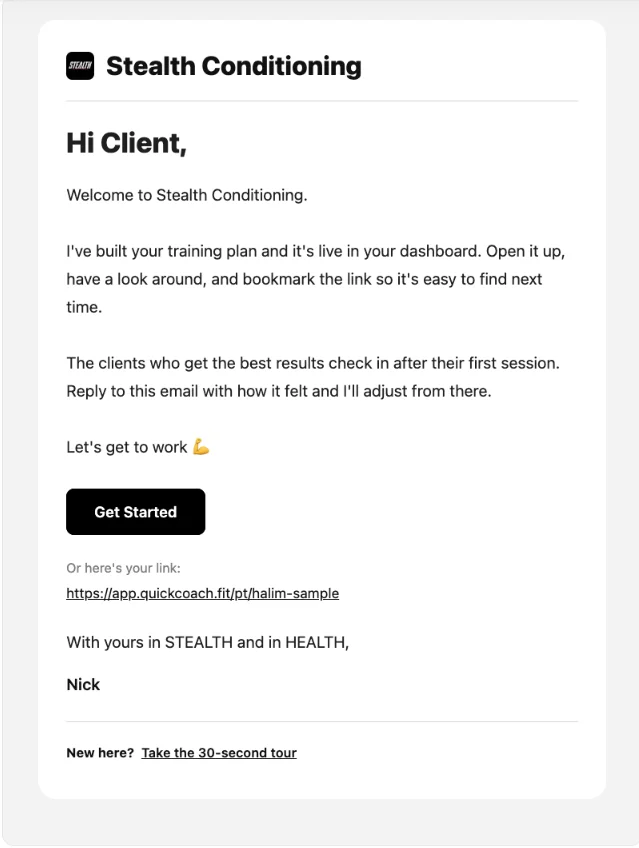
Here is a welcome email from a coach running QuickCoach Pro with custom branding switched on. The logo, colours, and voice all belong to the coach's business.
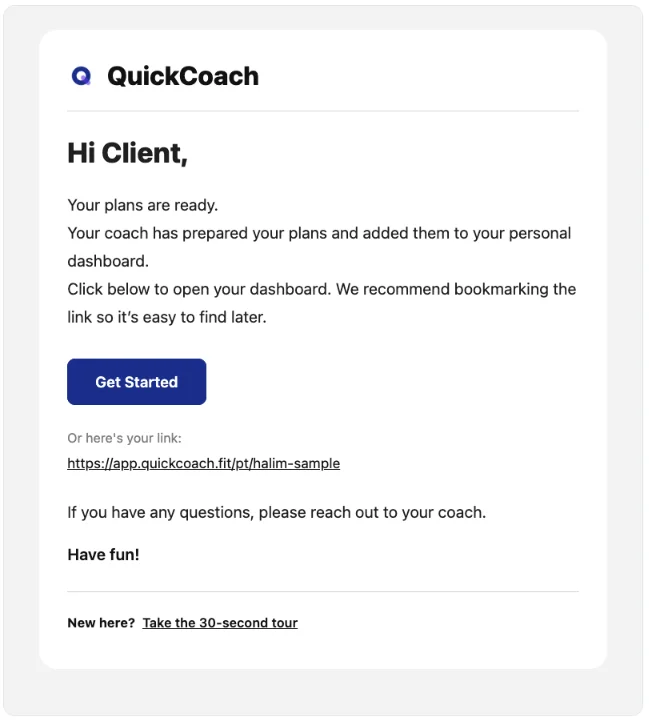
And for comparison, here is the default QuickCoach welcome email a new client receives on the free tier. Clean, functional, gets the job done. The brand on the page is QuickCoach's, not the coach's.
Same platform underneath. Two completely different impressions left with the client.
The default email tells the client they have signed up for a service that uses QuickCoach. The branded email tells the client they are working with the coach's business, and that business happens to use software in the background. That difference matters more than most coaches realise.
What the Default Email Signals
The default email is fine. It is well-designed and it delivers the right information. For coaches at the early stage of building a practice, it is more than enough.
But it does signal something the coach probably does not want to signal. The client receiving the default email forms an immediate impression that they are working through a platform rather than with a coach. The QuickCoach logo at the top is the brand the client sees first. The coach's name appears in the body, but the brand identity of the email belongs to the software.
For a coach starting out, with a handful of clients and no real brand to speak of yet, this is completely fine. The platform doing the branding work is one less thing to worry about. The client is paying for the coaching, not the wrapper.
For a coach building toward something more serious, the default email starts to work against the positioning. It tells the client, quietly and consistently, that the coach is a user of a platform rather than the operator of a business.
What the Branded Email Signals
The branded version signals something else. The client opens the email and sees the coach's brand. The coach's logo. The coach's colours. The coach's voice. The link they click through to carries the coach's identity, not QuickCoach's.
Every one of those small details is a piece of evidence to the client that they are working with a real, established business. The software is invisible. The coach is the operator. The brand holds together across every touch point.
This sounds like a small thing. It is not. The client's impression of how serious and professional your business is forms in seconds, often without any conscious thought, and once that impression is formed it is very hard to change. A branded email at the start of the relationship tilts the impression in the right direction. A generic email tilts it the other way.
Why This Matters More as Your Business Grows
In the early stages, the welcome email is not the thing making or breaking your business. As the roster grows, it starts to matter. Coaches who have moved from in-person work to online coaching tend to notice this earliest, because the digital touch points now carry weight that face-to-face contact used to absorb. By the time the business is producing referrals, it matters a lot, because the people landing in your funnel are arriving with expectations set by the friends who referred them.
A referred client lands with two questions in their head. Is this person legitimate, and is the experience going to be polished? The welcome email is one of the first concrete answers they get. A branded, professional-looking email reinforces the warm referral. A generic platform email creates a small, often subconscious gap between what they were told and what they are seeing.
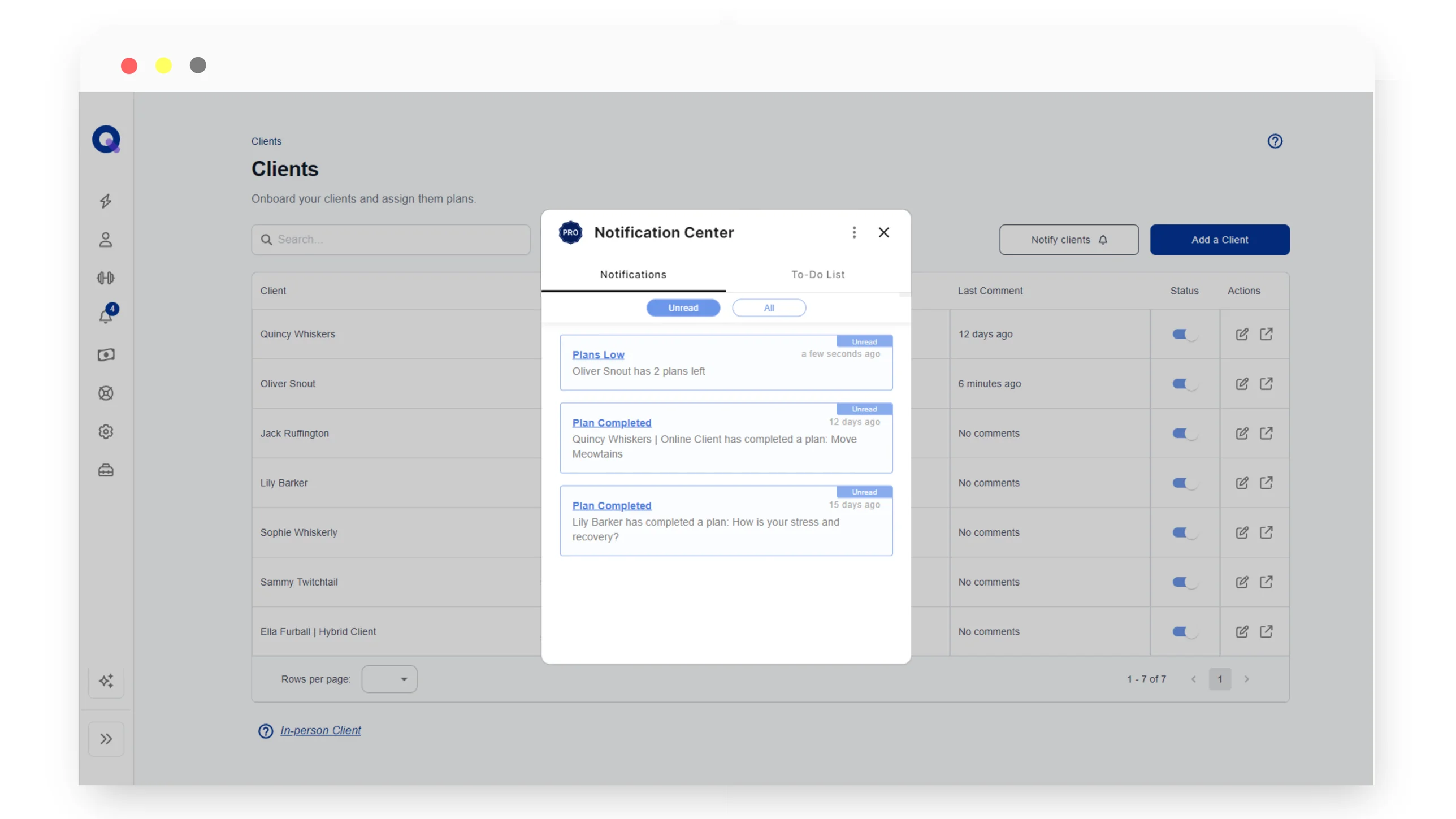
Multiply that across every system-generated email a client receives over the course of a coaching relationship and the impact compounds. Welcome emails. Plan ready notifications. Check-in reminders. Renewal emails. Every one of them is either reinforcing the coach's brand or quietly substituting it with the platform's. This is the same pattern we kept seeing across the patterns in what we have learned from the online coaching community: the operational layer is doing more brand work than coaches give it credit for.
What QuickCoach Pro Actually Changes
When a coach upgrades to Pro, every email QuickCoach sends to their clients automatically switches to the coach's branding. The coach uploads their logo and sets their brand colours once. From that point on:
- Welcome emails go out under the coach's brand, not QuickCoach's.
- Plan ready notifications carry the coach's logo and identity.
- Check-in reminders feel like they are coming from the coach's business, not from a third-party app.
- All other system-generated client emails inherit the same branded treatment.
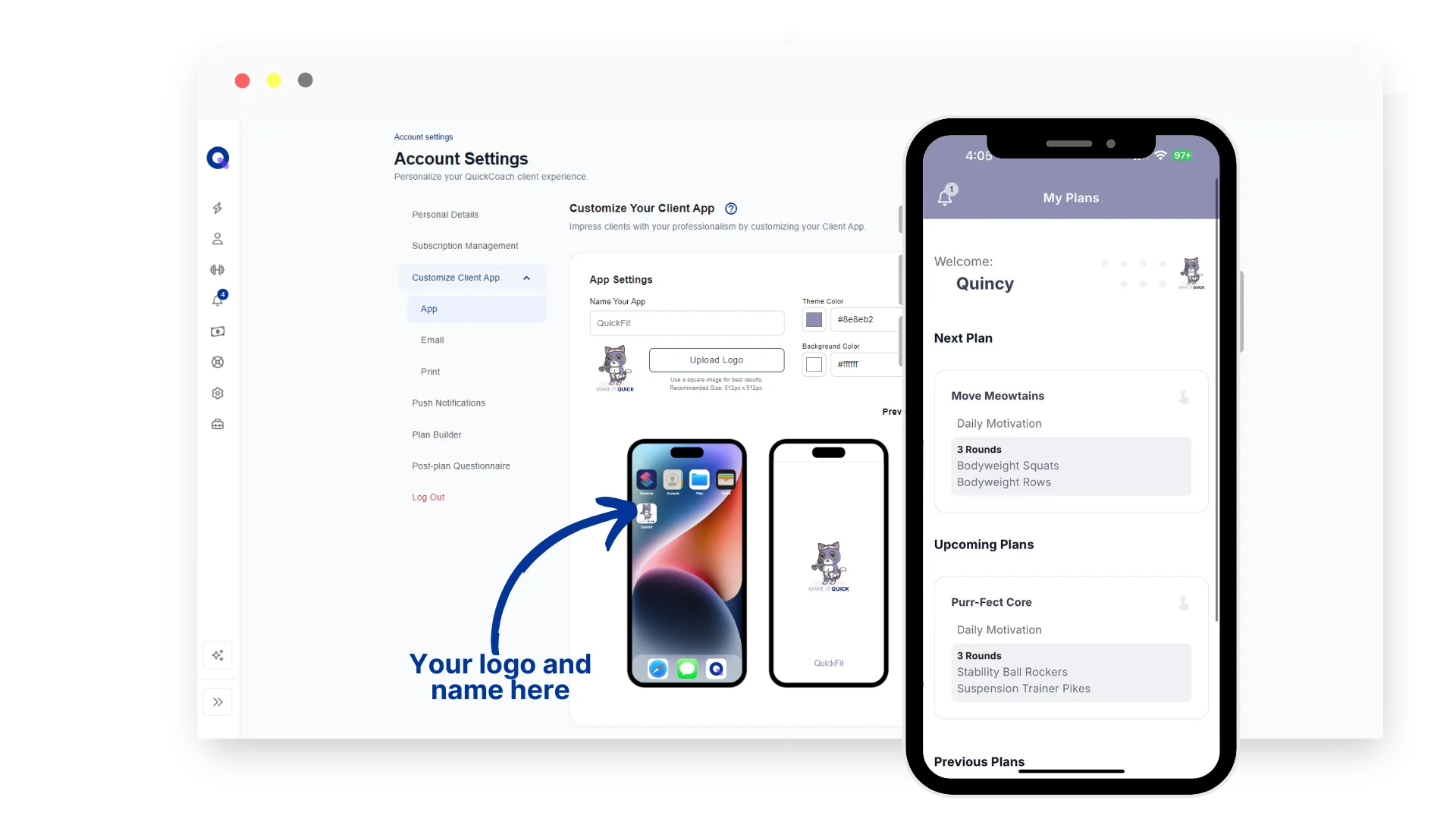
The same treatment also applies to the custom branded client app, which carries the coach's name, logo, and colours, and to printed plans, which clients can download with the coach's branding on them rather than QuickCoach's. The whole client-facing experience becomes the coach's, not the platform's. The full Pro feature breakdown covers the rest, including branded workout shares and the built-in coach to-do list.
Who This Feature Is Actually For
Pro is not for every coach. The free tier serves coaches at the early stages of building a practice well, and we have written about why we keep it that way in why QuickCoach is a sustainable free coaching platform. There is no reason to upgrade until the upgrade genuinely helps. The branded emails feature, specifically, becomes worth it when a coach has reached the point where their brand is part of how they sell, how they retain, and how they want to be perceived.
Signals that branded emails are worth turning on:
- You have a logo, a brand name, and a website that you actively use to market your coaching.
- Your clients are referring people to you, and the referrals arrive with expectations of professionalism.
- You charge premium prices and the price needs the experience to match it.
- You have noticed that the operational layer around your coaching is starting to feel important to how clients perceive you.
- You are working toward a long-term business, not a side hustle.
Coaches who tick most of those boxes are leaving real value on the table by running on the default platform branding. Coaches who do not yet tick them are completely fine on the free tier and should focus on the coaching itself rather than the wrapper around it.
The Quiet Compounding Effect
Branded emails do not feel like much in isolation. One email looks slightly more professional. Big deal.
The deal is bigger than it looks because of compounding. Every client who receives a branded email from you instead of a generic one is forming a slightly more positive impression of your business. Every referral they make lands a prospect with slightly higher expectations. Every renewal they consider is being weighed against slightly stronger evidence that they are working with a real operator. This is the same logic behind the investment we are making across the platform after the Hale Health acquisition, with the client-facing experience as the priority.
None of these effects is dramatic in any single moment. All of them compound over months and years into a meaningfully different business. The coaches who get this right end up with stronger brands, better retention, more referrals, and easier pricing conversations. The coaches who do not end up wondering why their growth feels stuck despite the coaching itself being excellent. The full framework for what to brand first, and the order of operations, is in our guide to personal branding for fitness coaches. For the physical side of the identity, the utility test that decides what to print and what to skip is in our guide to branded fitness merchandise.
The software you run on is one of the most consistent pieces of evidence your clients ever see about what kind of business you are running. A branded experience reinforces what you want them to see. A generic experience quietly contradicts it. Once a coaching practice is past the early stage, that contradiction starts to cost real money.
Frequently Asked Questions
Are branded client emails included on QuickCoach Pro?
Yes. Branded client emails are included in every QuickCoach Pro subscription at no extra cost. Once you upload your logo and set your brand colours, every system-generated email QuickCoach sends to your clients switches over automatically.
Which client emails get branded when I upgrade to Pro?
Every system-generated email QuickCoach sends to your clients carries your branding once Pro is active. That includes welcome emails, plan ready notifications, check-in reminders, and the other transactional emails clients receive during a coaching relationship.
Do I need design skills to set up branded client emails?
No. You upload your logo once and pick your brand colours. QuickCoach handles the layout, formatting, and delivery for every client email automatically. Most coaches finish the setup in under five minutes.
Will branded emails really affect client retention?
Branded emails are not a retention silver bullet on their own, but they are a consistent piece of evidence your clients see about how serious your business is. Coaches who pair branded emails with a strong coaching experience tend to retain better than coaches running premium pricing on a generic platform wrapper.
To switch branded client emails on, upgrade to QuickCoach Pro, upload your logo and brand colours in your account settings, and every system-generated email switches over from your next send. More coaching guides on the QuickCoach blog. Questions: support@quickcoach.fit.