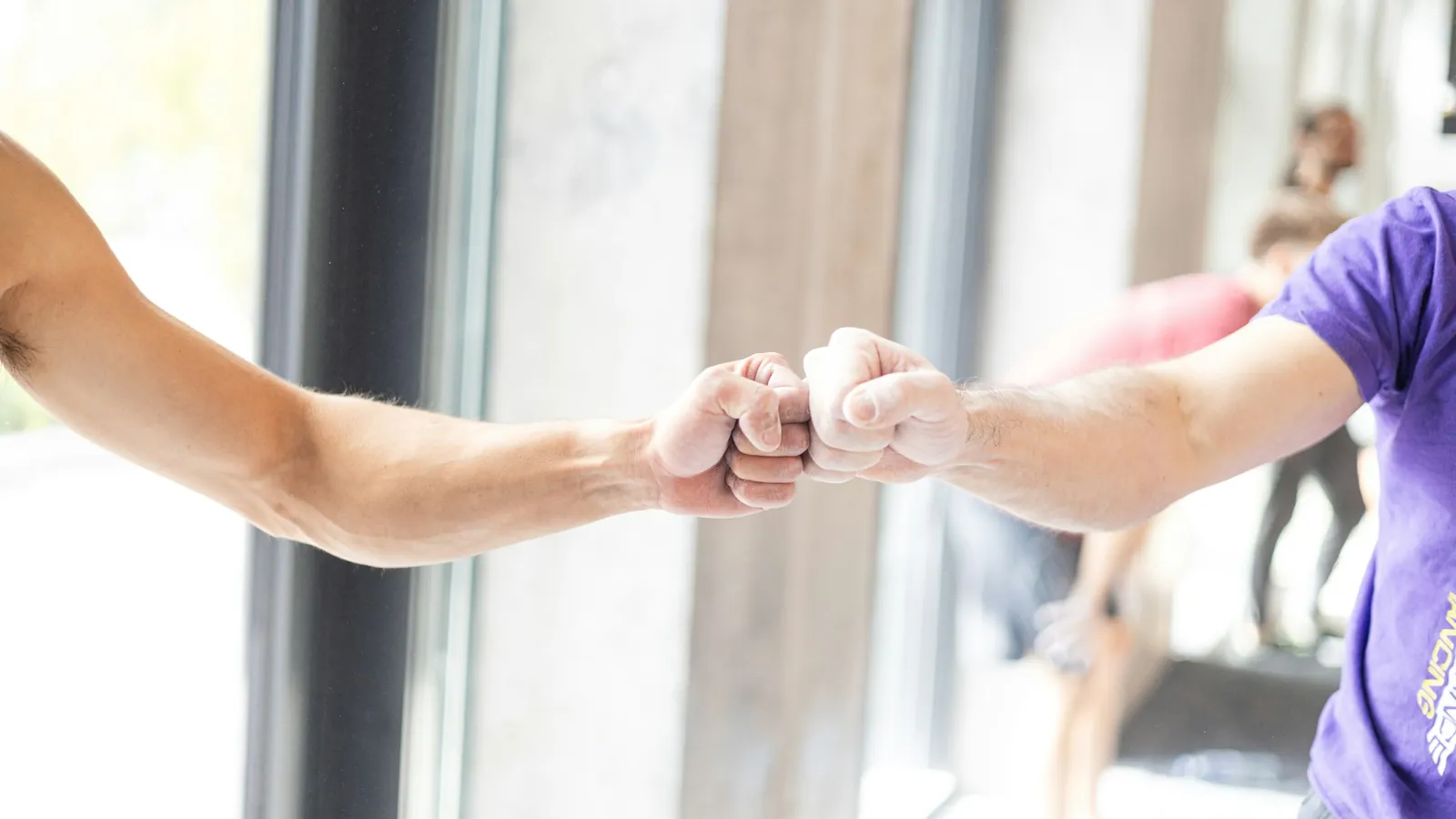
Every fitness community has a moment when it stops being a group of people who train at the same time and becomes something members belong to. The moment is rarely announced. It shows up in small ways: a member wearing the gym's singlet to a session, a group photo that looks like a team, a new member who says a friend brought them along.
This page is about the role branded products play in that moment. It is written for gym owners, studio owners and club owners who want a stronger community and are wondering whether merchandise is part of the answer. The short version is that products help, but only when they carry a belonging signal, and only when the community underneath is real. The honest version is the whole page.
Why communities need a visible identity
Quick answer
Branded products build fitness community by carrying a belonging signal into the member's week. The kit, the towel, the bottle and the branded app make membership visible, and visible members stay, train together and refer. The products amplify the community; the people and the coaching build it.
A community needs to be seen before it can be joined. People cannot feel part of something they cannot identify, and they cannot identify a group with no visible markers. The markers are the identity: the name, the colours, the kit, the app. They are how a member recognises their own group and how an outsider recognises it too.
Think about how a new member arrives. They do not join an invisible club. They see the group, the colours, the way members greet each other, and they decide they want in. The visible identity is the front door. Without it, the community exists only in the coach's head and the group chat.
The identity also does quiet work for the members who are already there. A member who can point to their group, name it and show it is a member who can explain why they stay. That explanation is the seed of every referral, and it needs something visible to point at.
The identity also needs to be consistent to work. A community that changes its name, its colours or its look every few months never becomes recognisable, because members and outsiders have nothing stable to hold onto. The strongest communities are the ones where the identity has been the same for years, and the products carry it the same way every time.
The belonging signal: what members actually wear and use
The belonging signal is the item a member wears or uses that says "I am part of this group". It is not decoration. It is the physical proof of membership, and it works because it is visible to the member and to everyone around them.
The items that carry the signal best are the ones members already use. The kit, the towel, the bottle. The full list, and the utility test that decides what to brand, is in our guide to branded merchandise for fitness businesses. The short version: brand what members use weekly, and skip what they would not.
The signal compounds. One member in the gym's singlet is a statement. Three members in the same singlet is a team. The group photo, the shared kit, the colours on the floor. Each one makes the next member's decision to belong a little easier.
The skip list matters as much as the list that passes. Tote bags, keyrings, mugs and pens fail the weekly test, and they dilute the signal when they appear. One item members actually use beats a range of items they do not, and the range is how a community's identity gets lost.
The same logic applies to the digital side. The app is the belonging signal that travels, and it is the one members touch most. Physical products are optional for an online community; the app is not.
The branded app as the community hub
The strongest belonging signal a fitness business can put its name on is the one members open between sessions. The branded client app carries the community's identity onto the surface members use most: the program, the check-ins, the messages. It is the hub the community gathers in when it is not in the room.
On QuickCoach, the branded client app is part of Pro at $39 a month, or $32.50 a month effective on annual billing, with unlimited clients. The setup takes minutes rather than a print run, and it is covered in our guide to creating the branded client app.
For a small community, the free tier is the pilot. It holds up to 20 active clients with no time limit, which is enough to run a real community and see whether the app becomes the hub members actually use. The 14-day Pro trial is the honest way to test the branded version.
The app also does something physical products cannot. It is the place the community's shared experience lives: the program everyone follows, the check-ins that show progress, the messages that keep members connected. A community with a hub has a reason to come back between sessions, and coming back is what makes it a community.
For an online community, the app is not one option among several. It is the room. Members who never meet in person still gather in the app, follow the same program and answer the same check-ins, and that shared routine is what makes them a community rather than a mailing list.
Retention: why a member with the kit stays
Membership is easier to leave when it is invisible. A member who pays and trains but owns nothing and opens nothing has no daily reminder of why they joined. A member with the kit, the app and the colours has a reminder every time they train.
The retention argument is simple: invested members stay. The kit is an investment the member made, and people hold onto things they have invested in. The app is a daily touchpoint that keeps the community present between sessions. Both make the cost of leaving feel higher and the value of staying feel visible.
The leaving moment is usually quiet. A member misses a week, then two, then stops replying to check-ins. The kit and the app do not prevent that drift on their own, but they slow it, because they keep the community present in the member's week. A member who sees the colours and opens the hub is a member who is harder to lose.
The mechanics of keeping clients, the churn causes and the fixes, are covered in our guide to client retention for online coaches. The branded products are one lever in that work, and they are the lever that makes the other levers visible.
Referrals: why a visible community refers
People refer what they can show. A member who can point to their gym, name it, show the kit and open the app has a concrete thing to offer a friend. A member of an invisible community has only a description, and descriptions do not convert.
The referral program is the mechanism that turns that visibility into growth. QuickCoach's Free with Friends program rewards Pro subscribers with $10 in monthly credit for every coach they bring to the platform, with no cap. The full details are on the Free with Friends referral program page.
The order matters. The community comes first, the visibility makes it referable, and the program rewards the referral. A branded community refers because its members have something to point at, and the program is how the coach gets paid for the word of mouth they were already earning.
The referral is also earned, not manufactured. A member refers because the community is worth sharing, and the visibility just makes the sharing possible. The program rewards the referral after it happens; it does not create the reason for it. That is the honest order, and it is why the community work comes first.
The honest version: products do not build community, people do
Here is the concession this page owes you. Products do not build community, people do. A singlet does not make a group of strangers into a team, and an app does not replace a coach who shows up. The products amplify a community that already exists; they cannot create one from nothing.
The order of operations matters. The coach builds the community with coaching, consistency and shared experience. The products then make that community visible, and visibility is what turns it into something members stay in and refer. Brand the community you have built, not the one you hope merchandise will build for you.
None of this means the products do nothing. They do real work: they make the community visible, they give members something to point at, they keep the identity present between sessions. The distinction is that they work on a community that exists. They are the amplifier, not the source.
This is why the honest version is the useful version. A gym owner who knows the products are amplifiers rather than builders spends money on the right things: the coaching first, the belonging signals second, and the app as the hub that holds it together.
Frequently Asked Questions
Do I need merch to build a community?
No. The identity signals help, but the community is built on people, coaching and shared experience. Merchandise makes the community visible and easier to join, and it supports retention and referrals, but it is not the foundation. Build the community first, then brand it.
What if my community is online?
The branded app is the online hub. It carries the community's identity onto the surface members use between sessions, and it works whether members ever meet in person. Physical products are optional for an online community; the app is the belonging signal that travels.
How do I start?
Start with the belonging signal members already use. If they train in person, that is the kit or the towel. If they train online, it is the app. The free tier holds up to 20 active clients with no time limit, which is the pilot for a small community, and the 14-day Pro trial tests the branded app.
Published September 2026. This page is part of the community cluster in the coaching guides library, and it sits alongside the merchandise pillar and the referral program. If you are building a community from scratch, the free tier is the pilot: 20 clients, no time limit, and the branded app is one 14-day Pro trial away.