Most online coaches run check-ins. Fewer run a review. The difference is the difference between collecting data and using it. A client who answers a weekly check-in for three months and never hears the trend read back to them does not feel progress. They feel paperwork.
The client progress review is the meeting that closes that gap. It is a scheduled conversation, once a month, where you read the month's check-in history and turn it into decisions about the program and the coaching. Software does not run it for you. What software does is give you the history, the habit streaks and the response quality to review in ten minutes. This page is the meeting itself: the agenda, the reading of the data, and what to do when the review reveals a problem.
Quick answer
A client progress review is a monthly meeting where you read a month of check-in data and turn it into coaching decisions. It is not a check-in, not a sales call and not a lecture. The four-section agenda covers the data, the client's read, the program and agreement, and the meeting runs in twenty minutes.
Why check-ins alone do not retain clients
Check-ins are a collection mechanism. They surface problems, but they do not resolve them. A client who reports a sore shoulder every week for a month is telling you something the check-in cannot fix on its own. The fix is a conversation where the pattern gets named and the program changes.
The retention problem is subtler than that. Clients do not leave because they are unhappy with the training. They leave because they stop feeling progress, and progress is a story, not a spreadsheet. The weekly check-in records the chapters. The monthly review reads them back. A client who hears "you have trained 14 of your 16 sessions this month, your squat is up, and your sleep score has climbed" is a client who knows the service is working. That knowledge is what survives a plateau, a busy fortnight or a bad week.
None of this is a knock on check-ins. The weekly pulse is the raw material, and the full system for running it is laid out in our guide to client check-ins that keep clients. The point is that the check-in is the input and the review is the output. Most coaches build the first and skip the second, which is why the data they collect never quite pays for itself.
What a progress review is (and is not)
A client progress review is a scheduled meeting, usually monthly, where you and the client look at the month's data together and agree what changes next. It has a start time, an agenda and an outcome. It is the one meeting in the coaching relationship that exists purely to look at progress.
It is not a check-in. The check-in is the weekly pulse, short and frequent, and it belongs to the cadence system. It is not a sales call. The review is not the place to pitch a renewal, and a client who smells a pitch stops being honest about the month. It is not a lecture. If the review is mostly you talking, the client is not in it, and the data reading becomes a report instead of a conversation.
The distinction matters because the review fails the moment it becomes any of those three things. Keep it as the one meeting that is purely about the client's progress, and it stays the meeting they do not want to skip.
The monthly review agenda: four sections
Here is the agenda. It is designed to run in about twenty minutes, with ten minutes of prep spent reading the data before the meeting. Copy it, adapt the wording to your voice, and keep the four sections in order.
Section 1: The data (five minutes)
Open the month's history and read it out loud. Adherence first: how many sessions were completed against how many were programmed. Then the check-in response rate, the habit streaks, and any notes the client left. The client hears their own month summarised, which is often the first time they see the shape of it.
Section 2: The client's read (five minutes)
Ask what is working, what is hard, and what they would change. This is the section that keeps the review a conversation. The data says what happened. The client says what it felt like, and the two rarely disagree by accident. When they do, that gap is the most useful thing in the meeting.
Section 3: The program (five minutes)
Decide what changes next month. A progression, a deload, a new focus area, a habit swap. The review is where the program stops being a template and becomes a response to this client's month. Name the changes out loud so the client leaves knowing what is different.
Section 4: The agreement (two minutes)
Close with commitments. What the client commits to for the next month, and what you commit to. Write them down. The agreement is what makes the review a decision rather than a chat, and it gives next month's review something concrete to check against.
That is the whole meeting. Twenty minutes, four sections, one outcome: a client who knows where they are, what changes, and what they are working towards. If you are building the check-in side of this system from scratch, the client check-in questions template gives you the weekly pulse that feeds this review.
How to read a month of check-in history in ten minutes
The prep is where most coaches stall, so make it mechanical. Ten minutes, three passes, in this order.
Pass one: the response rate. Scroll the month's check-ins and count the gaps. A client who answered every week is engaged. A client who missed two of the last four is telling you something before the review starts, and our guide to what to do when a client stops replying to check-ins covers the quiet-client pattern in detail. Note the gaps, but do not open the conversation with them. Let the client raise the month first.
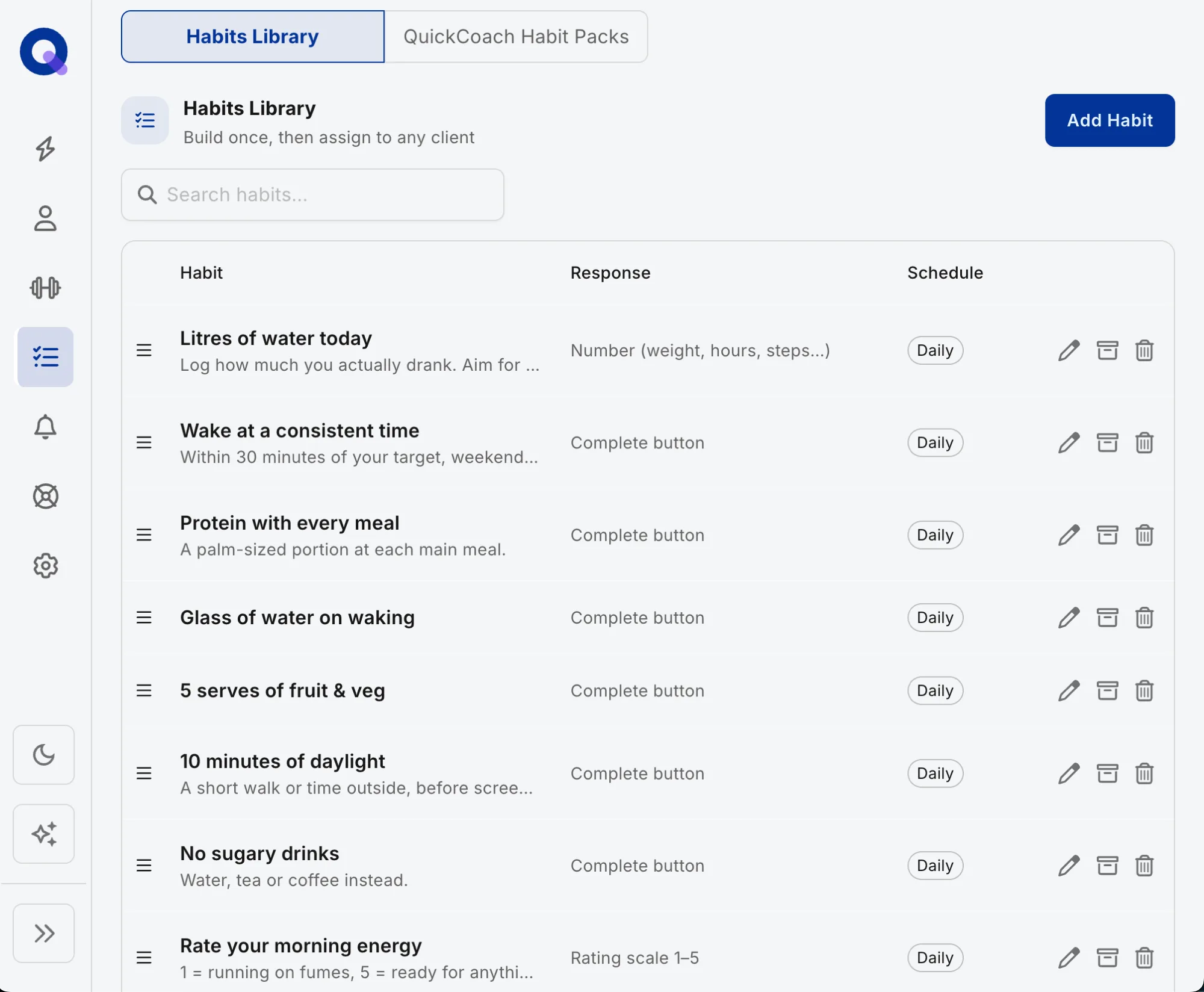
Pass two: the habit history. Look at the shape of the month, not the streak. A habit that faded from daily to twice a week is a different problem from a habit that stopped dead, and the coaching move is different for each. The full reading of habit shapes lives in our guide to habit check-ins and turning a month of ticks into a decision.
Pass three: the training volume. Sessions completed, weights moved, the trend across the month. On QuickCoach, Training Insights on Pro pulls the progress recap together so this pass takes a minute rather than ten. The point of all three passes is the same: walk into the meeting already knowing the month, so the conversation can be about the client instead of the spreadsheet.
The numbers that matter: adherence, habit streaks, response quality
Not every number deserves a place in the review. Three do.
Adherence. Sessions completed against sessions programmed. This is the headline number, and it is the one clients understand instantly. A month at 80 percent adherence is a good month. A month at 50 percent is a conversation about the plan, not a lecture about effort.
Habit streaks. The shape of the habit data matters more than the streak itself. A steady line, a fading line and an all-or-nothing line each need a different coaching move, and reading them correctly is what separates a habit review from a habit report.
Response quality. One-word answers and engaged answers are different signals. A client who writes three sentences about their week is a client who is in the process. A client who answers "fine" for a month is a client who is going through the motions, and that is worth naming in the review before it hardens into a cancellation.
Those three numbers are the review's raw material. Everything else, the sleep score, the mood rating, the notes, supports them. If you only have time to read three things before the meeting, read those.
What to do when the review reveals a problem
The review will surface problems. That is its job. The useful move is to sort the problem before you try to fix it, because the fix depends on the cause.
Most problems fall into one of four buckets. A results plateau, where the early wins have stopped and the client cannot see the next one. Attention drop-off, where your replies have thinned as the roster grew and the client feels processed. A life event, where the training simply does not fit the current week. And price-value drift, where the service has become routine and the fee no longer feels justified. Each cause has a different fix, and the full mapping lives in our guide to client retention for online coaches.
The review is where you catch these early, which is the whole point. A plateau caught in month three is a program change. The same plateau caught in month nine is a cancellation. A life event caught in the review becomes a downshift to a maintenance block. The same event caught in a cancellation email becomes a lost client. The review does not prevent problems. It moves them from the exit door to the meeting room, where you can still do something about them.
When the problem is the program, change the program. When the problem is the coaching, change the coaching. When the problem is the client's life, change the plan to fit the life. The review gives you the information to tell the three apart, and that is the entire value of the meeting.
The quarterly review: bigger picture, program change
The monthly review keeps the engine running. The quarterly review decides where the car is going. Run both, and the monthly feeds the quarterly.
The quarterly review is the bigger-picture version: the last three months of data, the goal progress, the program direction, and the honest conversation about whether the current approach is still the right one. It is the natural place for a program overhaul, a goal reset, or a pricing conversation, because it has the evidence to support those decisions.
It also maps cleanly onto the relationship arc. The 60-day conversation in our guide to structuring the first 90 days with a client is a quarterly review arriving early, and the same structure scales to every quarter after that. A client who has a quarterly review on the calendar is a client who can see the next phase, and clients who can see where they are going stay longer.
Frequently Asked Questions
How long should a client progress review take?
Plan for 20 to 30 minutes once a month, with about ten minutes of prep spent reading the check-in and habit history before the meeting. The four-section agenda keeps the meeting itself to half an hour even when the month was messy.
Do I charge for progress reviews?
Most online coaches include the monthly review in the coaching fee, because the review is what keeps clients past the first few months and a client who stays is worth more than a review fee. Coaches on fixed packages sometimes bill a quarterly review as a separate session. Either way, state it in the agreement so the client knows what the review is.
What if a client skips the review?
Reschedule once, then treat a second skip as a signal rather than a scheduling problem. A client who avoids the review is usually avoiding a conversation about progress, and that is worth naming directly. The review is part of the service, not an optional extra.
Can I automate the progress review summary?
The data reading can be automated: check-in history, habit streaks and training volume are already summarised in the software, and Training Insights on Pro gives a progress recap. The conversation cannot be automated, and it should not be. Coach Workflows is a separate add-on at $14.99 a month that can generate automated check-in summaries, but it is not included in the Pro price.
Published August 2026. The progress review is the retention mechanism that check-ins feed, and it sits in the engagement cluster of the coaching guides hub alongside the check-in system, the retention guide and the habit check-in guide. If you are building the review habit with a small roster, QuickCoach's free tier holds up to 20 clients with no time limit, and the full Pro breakdown, including Training Insights and the check-in history that makes the ten-minute prep possible, is on our Pro features and pricing page.