A check-in goes out on Sunday. Monday passes with nothing back. By Tuesday you are looking at a client who stopped replying to check-ins. Another automated reminder is the easiest thing to send, and the least likely to work. A client who has gone quiet has usually hit something they do not want to type into a form. The fix is not a louder nudge. It is a smaller door.
Software does not make a client answer. That is the honest limit of every coaching app, including QuickCoach. What software can still do is narrow the problem: tell you the silence started, cut the effort of following up down to one message, and keep a client from drifting for three weeks before you notice.
The short answer
Treat the silence as information, not proof. Send one low-effort message that makes replying easy, shorten the ask, and check whether the plan has become too hard to face. Escalate slowly. Software can surface the silence, but it cannot make a client answer.
Why coaching clients go quiet
Most coaches read silence as a verdict on their coaching. Usually it is not. In many cases the client is not rejecting you, they are avoiding a conversation they think will be uncomfortable, and the check-in has become the place where that discomfort shows up. Shame is the quietest cause: a client who planned to train three times and managed once will rather say nothing than explain the gap. Overwhelm works the same way. When the week is already too full, one more thing falls off the pile.
The check-in itself can be the problem. A form that has grown to ten questions takes real effort to answer, and clients quietly stop paying that price. So can the program: four sessions when the client can honestly manage two, or a plan that no longer fits their week after a new job or a new child. Personal disruption lands a lot of clients here. Where the check-in sits matters too. A form that lives one step away from the program, inside a stack of spreadsheets, PDFs and chat threads, quietly raises the cost of every reply, which is the case we make for moving coaching off spreadsheets and WhatsApp.
And sometimes it is simple disengagement. The goal changed, or the motivation left, and the client stopped believing the coaching is worth the money. That is the one outcome a kind message will not fix. The full map of why clients leave, and what fixes each cause, lives in our guide to client retention for online coaches. But silence is information, not proof. The first message is how you find out which cause this is.
What to send in the first 72 hours
Send something within the first few days, while the miss is still a normal part of coaching and not a silence that has gathered weight. One message, and short. Importantly, a message that does not ask for the thing they are avoiding. Copy this and make it yours.
Copy-paste message for the first 72 hours
Hey [Name], no need to complete the full check-in right now. Just reply with one number from 1 to 10 for how manageable the plan felt this week. We can work from there.
CopiedThis works where "just checking in" does not. One number carries the whole answer, so no explanation is needed. There is nothing to justify, so it is emotionally safer to reply to. A 3 and a 7 lead to very different conversations. And it does not pretend nothing has happened, the way "just checking in" quietly does.
Send it, then make the follow-up visible
The message takes two minutes. The follow-up is where it counts, so log it where you will actually see it, and let the platform tell you when a client goes quiet instead of finding out weeks later. QuickCoach is free for up to 20 active clients, with no time limit.
Start freeUse an escalation ladder
Think of the follow-up as a ladder, and climb one rung at a time. Most quiet clients respond at the bottom.
- Shorten the ask. The 1-to-10 message is this rung. Keep cutting until the answer is easy: one number, one question, one line.
- Change the channel. After a silent week, move off the platform to a channel the client already agreed to, usually SMS or email. One message in one new place, not the same text across every app.
- Change the program. If the client answers, or if the silence lines up with an unrealistic plan, reduce the load. Two sessions instead of four, a lighter check-in.
- Call the client. A deliberate escalation, not the automatic first response. Some clients who cannot face a form will happily talk for five minutes. If they do not pick up, leave one message and stop.
Each rung lowers a different cost: effort, the platform's formality, the load, then the medium. You are looking for the cheapest way to make a reply possible, not the loudest way to demand one.
Fix the plan, not the reminder
Some silences are not about the relationship. They are about the program. When a client is consistently behind, the reminder was never the problem. The plan was. The signs are specific: the plan asks for more sessions than the client can currently complete, the client falls behind on the same two or three tasks each week, the check-in has become a report on failure nobody wants to open, or the plan no longer fits their schedule after a change at work or at home. Some clients do not know what "good enough" looks like, so anything short of perfect counts as a miss.
When the signs point this way, change the plan, not the cadence. Shorten the check-in until it takes under two minutes. Cut the program back to what fits the current week, even if it feels too small. In many cases a client who would not answer a ten-question form will answer one question about a plan they can actually follow. Reminder frequency does the opposite: more reminders treat the symptom, and a client who is ashamed of falling behind responds by feeling more ashamed. Hand them a smaller thing to fail at instead.
This is not a guide to building a check-in system from scratch. That is a bigger job, covered properly in our working system for client check-ins that keep clients, with a copy-paste set of check-in questions you can shorten to fit.
How to spot a quiet client before the check-in is missed
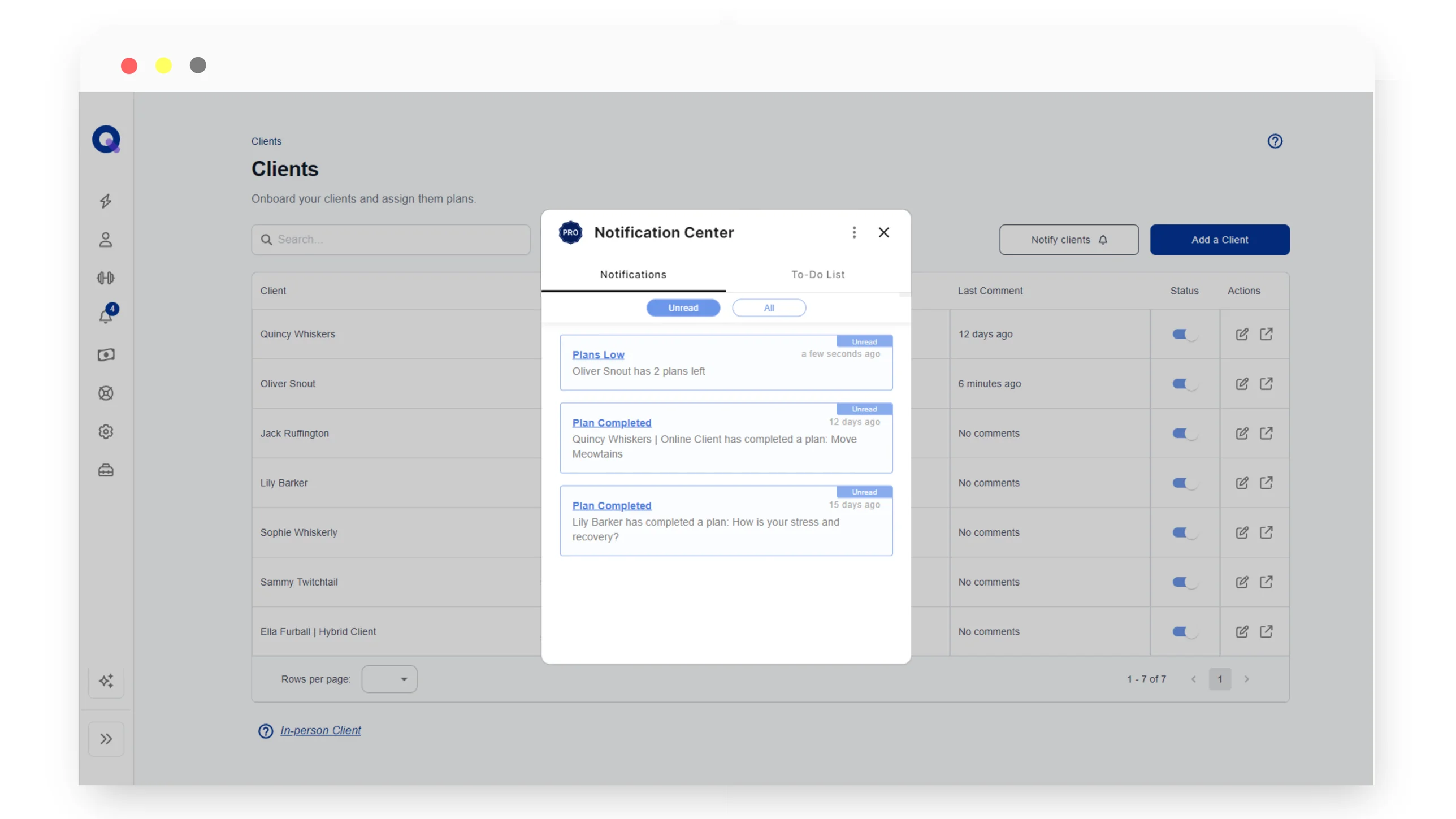
The goal is to see the silence start, not to discover it after a month. QuickCoach notifies you on Pro when a client completes a plan, skips a plan, or is running low on programming. A client who has stopped opening plans stops generating completions, and the gap in the feed is the warning sign. The client list also shows how long ago each client completed a plan and left a comment, so a quiet stretch is visible at a glance.
The coach to-do list, also on Pro, is where the follow-up lives. Our guide to the QuickCoach to-do list covers the habit properly, but the short version is this: when a client goes quiet, log a task to follow up. It stops being a thing you will remember and becomes a thing on a list. On Free, a single daily task can act as a minimum accountability layer. None of this makes a client reply, but it surfaces the warning signs. The reply is still earned the old way, with a message that makes it easy.
When to let a client go
Some clients come back after the first message. Some answer after the call. A few never do, and at some point the silence stops being a coaching problem and becomes an admin one. You cannot coach a client who is not there, and a client who has not replied in weeks is not receiving the service you are billing for. Keeping them on the roster quietly turns the arrangement into a fiction.
Before you make any decision, document. Write down each attempt to reach the client, the date, and the channel. If the client later disputes what happened, you have the record, and it protects both of you. Then follow the terms you agreed at the start. Your written cancellation and payment policy exists for exactly this moment. If it says a client who stops replying for a set number of weeks is considered cancelled, apply it. If it says payments continue until the client cancels, follow that.
Do not let the silence become indefinite unpaid or undefined support. A client who has stopped replying is not a client you owe unbounded time to, and most coaches end up resenting a relationship they were too polite to end. End it without hostility, to close the loop cleanly rather than punish anyone. Something like this works:
I have not been able to reach you, so I am going to pause our active coaching work from [date]. You are welcome to get back in touch when you are ready, and we can discuss what restarting would look like.
The message is honest and leaves the door open. Most clients who are coming back will reply to it. The ones who do not were already gone.
Frequently asked questions
How long should I wait before following up?
No universal cadence exists. Send the first low-pressure follow-up within a few days. If that gets no reply, change the channel after roughly another week. If that goes unanswered, move to your written pause or cancellation process. The order matters more than the exact days.
Should I keep charging a client who has stopped replying?
That depends on the coaching contract you agreed, your cancellation policy, and whether the service remains available. This is not legal advice. Tell the client clearly what happens to billing and service while they are unresponsive, so neither of you is guessing.
Do automated reminders work?
They prevent accidental misses and cut admin, and for a client who simply forgot, they work well. They do not resolve shame, disengagement, or a plan that has become unrealistic. A reminder assumes the client wants to complete the check-in. A quiet client has usually stopped wanting to.
What if the client replies but says nothing useful?
Ask one bounded question instead of opening the full conversation: "Was the main issue time, motivation or the plan itself?" or "Should we keep, reduce or pause this week's plan?" A single bounded question is easier to answer than a list.
Published August 2026. This is the practical follow-up to our working system for client check-ins that keep clients, inside the wider picture of why coaching clients leave and what fixes each cause. The proactive counterpart, the touches that keep a client engaged before the silence starts, is covered in our guide to keeping online clients engaged. Questions about your own quiet client? Reach us at support@quickcoach.fit.