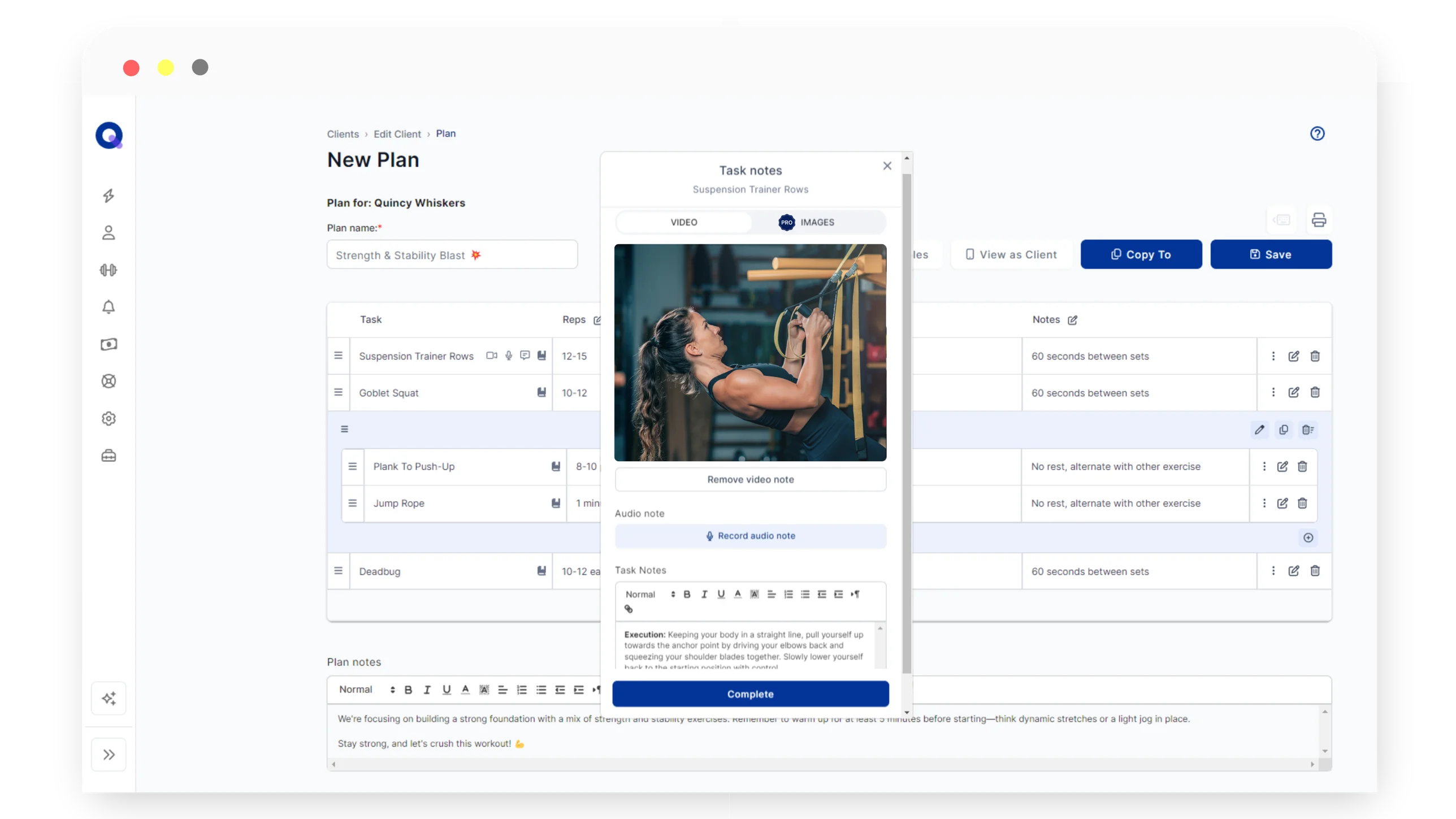
The pilates client app question is a between-session question, not a feature question. Your clients see the studio in class, the class is excellent, and then they spend six days with no studio at all. The reformer work is precise, the cues are specific, and the client leaves with nothing but a memory of it. The app is the surface that carries the work between sessions, and it is the reason the relationship survives the week.
This page is the branded client app for Pilates instructors. It walks the branded-app workflow for an instructor, names what the app carries and what it costs, and states plainly what it does not do. If you teach Pilates and you are deciding on software, this is the delivery half of that decision.
Quick answer
A pilates client app should carry the programming half of your coaching: the mat and home flows, the homework between sessions, the check-ins, in a branded app clients open between classes. It does not run class bookings or studio scheduling. QuickCoach Pro includes the branded client app at $39 a month, with a 14-day trial.
Why a Pilates instructor needs a client app at all
In most coaching, the program is the product. A coach writes a program, the client follows it, and the quality of the program is the reason the client stays. Pilates works the other way around. The client comes for the class, the class is the product, and the relationship between classes is where the client is won or lost. A client who only experiences the studio in class is a client whose relationship with the studio is a booking, not a membership.
That is the gap the app closes. The client needs one place where the flow shows up, gets done and gets reported back, and without that place the coaching fragments into screenshots in a chat thread, a memory of what was prescribed and when. A client app collects the delivery into a single surface, and for an instructor whose clients train between sessions, that surface is where the week actually happens.
The software decision for a Pilates instructor is therefore not about features. It is about whether the between-session surface exists at all, and whether it carries your name when the client opens it. The questions a Pilates instructor actually asks about software, from credentials to online delivery, are answered in the pilates coaching questions hub.
What the branded app carries: flows, homework, check-ins
Three things make up the between-session work for a Pilates instructor, and the branded app carries all three.
Flows. The mat and home sessions written out, delivered to the client app and ticked off as they are done. The program builder that writes those sessions is free, with unlimited programs and tasks, and templates and cloning are free too, which matters when the same flow repeats across a client group. Save the flow once, clone it for the next client, reassign.
Homework. The between-session work that keeps the client in the method: the mobility drill, the breath work, the short mat sequence. In the app, homework is just another session, assigned and ticked off like the rest, and it is the work that keeps a client moving between classes.
Check-ins. The weekly questions that keep the instructor in the loop between classes. They are free on the free tier, and Pro adds the richer habit tracking with ready-made packs and full history. The check-in is the moment a week of home work becomes visible to the instructor, and it is the delivery layer that keeps a remote roster honest.
The branded experience: your studio in their pocket
The app is the surface your clients touch between sessions, so it is where your identity does its daily work. A branded client app carries your name, your colours and your logo. Clients install your app, not the vendor's, and the daily repetition of your name is the branding that no post and no email can match.
The identity framework that decides what to brand first, and in what order, is in our guide to pilates studio branding. This page is the delivery half of that stack: the app itself, what goes in it, and what it costs. The two sit together, and neither restates the other.
Setup is minutes rather than days. The app is a Progressive Web App, so clients install it from the browser with no store review, and your branded version is live the moment you set it up. The step-by-step walkthrough is in our custom branded coaching app guide.
The honest limits: no booking, no class scheduling
The line is worth stating plainly, because the category blurs it. QuickCoach does not run class bookings, studio scheduling or the waitlist for a reformer slot. It does not deliver video. It is the programming and client-management half: the flows, the homework, the check-ins, and nothing more.
A Pilates instructor's software stack is therefore usually two tools, not one. The class side lives in the booking tool the studio already uses, and the app carries the programming and the client relationship around it. That is the honest division of labour, and it is the reason the app pairs with a scheduler rather than competing with it.
The same honesty applies to the branded app itself. The branded client app does not turn you into a software company, and it does not promise a store listing of your own. It is the branded version of the delivery surface your clients already use, and the distinction between that and a full white-label app is covered in our guide to branded versus white-label apps.
The between-session gap, closed
Here is what the app actually changes. A client who opens the studio's app between classes is a client who is still in the relationship. The flow is there, the homework is there, the check-in is there, and the studio's name is on all of it. The between-session gap, which is where most studios lose the thread, stops being a gap at all.
The cost question is the one that decides it. The branded client app is part of QuickCoach Pro at $39 a month, or $32.50 a month effective on annual billing. The free tier holds 20 clients with no time limit and includes the program builder and the client app, which is enough to run a mat block and see whether the delivery holds. Pro carries a 14-day free trial, which is the honest way to test the branded app before committing.
The honest read on what the software costs at a typical Pilates roster, across six platforms, is in our cost breakdown for Pilates instructors, and the full Pro breakdown, including the branded client app and the flat $39 a month price, is on our Pro features and pricing page.
Frequently Asked Questions
Can I deliver reformer work in the app?
Yes, as written programming. You can deliver reformer work the same way you deliver any written plan, with the exercises, sets and notes written out in the app. What the app does not do is deliver video or track the session. The plan is the delivery half, and the reformer work happens in the studio or on the client's own equipment.
Does it replace booking software?
No, and it is not meant to. QuickCoach is the programming and client-management half of a Pilates instructor's stack, and a booking tool is the class side. They pair rather than compete: the scheduler runs the classes, and the app owns the flows, the homework and the check-ins between them.
What does the branded app cost?
The branded client app is part of QuickCoach Pro at $39 a month, or $32.50 a month effective on annual billing. The free tier holds 20 clients with no time limit and includes the program builder and the client app. Pro carries a 14-day free trial, which is the honest way to test the branded app before committing.
Published August 2026. The between-session gap is the Pilates application of the touchpoint ladder in the coaching guides index, and it sits alongside the pilates questions hub and the pilates cost page. If you are building the client experience between sessions, the free tier is the honest pilot, and Pro is the branding layer when the app becomes the point.