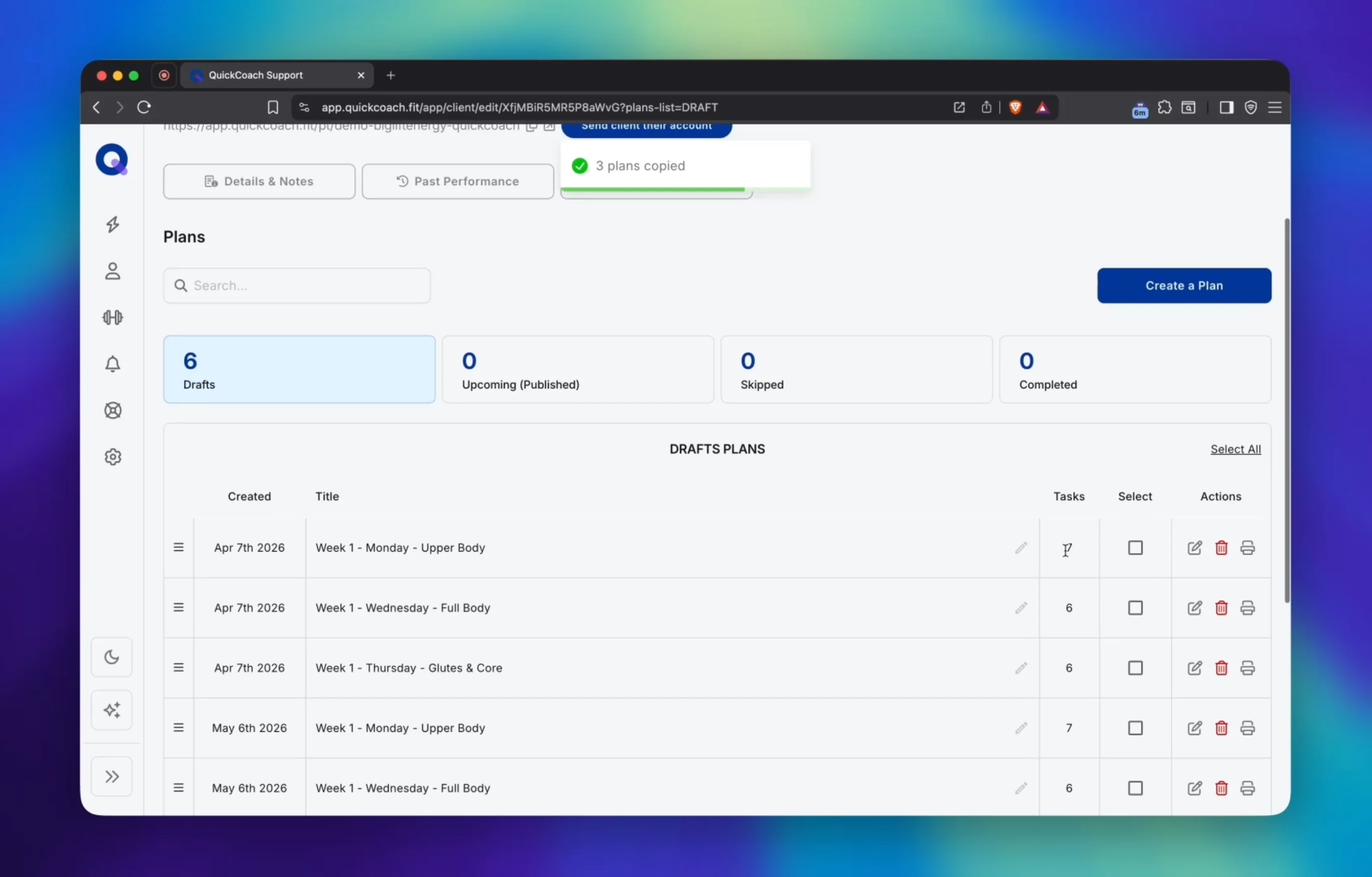
A program title is the smallest piece of work a coach does, and one of the few a client sees every single day. It sits at the top of the app, above the sets and the notes and the check-in reminder. Call it "Program 3" and the client opens a spreadsheet. Call it "Foundations: Weeks 1-6" and they open a plan with a beginning and an end. Same training either way. Different feeling entirely.
We have mapped the exercises, the loading, the habits and the words coaches write inside a workout. This is the lightest read of the set, and the most fun: the language on the cover. QuickCoach is used by more than 40,000 coaches and fitness businesses worldwide, so for this one we took the titles coaches give their programs, broke them into word families, and counted which ones recur across many different coaches. No individual title appears anywhere on this page, and none needs to. The patterns are the story.
The short answer
Coaches name programs like products, not files. Roughly a third of titles lead with a goal word such as strength, build or foundations. About a quarter carry a duration, and twelve weeks is the runaway favourite. Phase and season words come next, and only a small remainder are left as a default.
What this is, in one paragraph
This is a read of vocabulary, not of anyone's program. We took the titles attached to active coaching programs, lower-cased and tokenised them, stripped personal names, and counted word families by the number of distinct coaches who use each. Nothing is reported unless many separate coaches write it. Because this is a light culture piece rather than a precision audit, every figure here is deliberately published as an approximation, a ranking or a rough share rather than a decimal. The full method sits at the foot of the page.
How do online coaches name their programs?
Sort the titles by what they are mainly doing and a clear hierarchy falls out. Goal words lead. Duration comes second, usually a week count sitting at the front of the name. Phase and season language follows, borrowed almost intact from athletic periodisation. A smaller group names a person or a group, and a genuinely tiny remainder never got named at all.
What a program name is doing
Approximate share of titles by their dominant pattern
Each title is counted once, by the job its strongest word is doing. Shares are approximate and rounded to the nearest simple ratio, and plenty of titles do two jobs at once.
The bottom row is the one that surprised us. Naming things is optional. The software will happily accept whatever appears by default, and on a busy afternoon that is the path of least resistance. Almost nobody takes it. Coaches stop and write something, which is a small unpaid act of care repeated thousands of times a day across the platform, and it tells you how these people think about the work. A program is a thing they made. Things you make get names.
What words do coaches use most in program names?
Rank the word families by how many separate coaches use them and the shared vocabulary of the industry appears. Strength sits at the top. Week is everywhere once you count the duration markers. Then the outcome words, the phase words, and the entry-level words coaches use to signal "this one is for beginners" without saying it.
- StrengthThe most-used goal word by a comfortable margin. Broad enough for almost any client, specific enough to mean something.
- Week / WeeksRarely alone. Almost always attached to a number at the front of the title, marking where the block starts and stops.
- BuildThe growth word. Used for muscle, for base fitness, and as a general "we are adding something" signal.
- FoundationsAlso Fundamentals and Basics. The universal name for a first block, and the friendliest word in the whole list.
- Phase / BlockBorrowed from periodisation. Signals that this program is one chapter of a longer plan, not the whole book.
- Fat loss / LeanIncludes Shred and Cut. Common, and noticeably more common in titles written for a January or pre-summer start.
- Off-seasonAlongside Prep and In-season. Athletic calendar language, used well beyond athletes.
- MobilityUsually a supporting block rather than a main one, and often paired with a body part or a recovery word.
- Beginner / StarterThe onboarding block, named so a nervous client can see themselves in it before they open it.
- Hybrid / AthleteThe identity words. These name the person the client wants to become rather than the training they are about to do.
Read that list top to bottom and it is a decent summary of what people actually want from coaching. Get stronger, build something, start from the basics, work in chapters, lose some fat, move better. The vocabulary of the industry is short, plain and almost entirely free of jargon, which is a quiet argument against the idea that coaches overcomplicate things. The words on the cover are the ones a client would use.
Two of them are doing more work than they look. "Foundations" reframes a beginner block as a base rather than a remedial course, and nobody feels patronised opening it. "Hybrid" names an identity, and the client who buys a program called Hybrid Athlete is buying who they get to be, not the sets. Coaches worked that out on their own, one title at a time. It is the same instinct we found in the notes they write inside the workout, mapped in our read of the coaching cues behind the workout, where the language is short, concrete and pointed at the person rather than the spreadsheet.
Why is everything twelve weeks?
Because twelve weeks works, commercially and physiologically. Of the titles that name a length, twelve is the clear leader, roughly twice as common as its nearest rival. Eight weeks is second. Six and four fill the shorter slots, usually for a starter block or a bridge between two bigger phases, and anything past sixteen is rare enough to count as a specialist choice.
How long a program says it runs
Approximate share of the titles that name a duration
Shares are of titles that state a length, not of all titles. Approximate and rounded to the nearest simple ratio.
Twelve weeks is a season. It is long enough for a client to see their photos change and their top set move, short enough that committing to it does not feel like a life sentence, and it lines up neatly with a quarterly billing rhythm. There is also an honest bit of theatre in it. A named end date creates a finish line, and a finish line is the thing that gets someone through week seven, when the novelty has gone and the results have not fully arrived yet. Coaches are not naming a duration. They are naming a commitment, and the number is how they make it feel finite.
That end date is doing retention work too. A block that finishes is a block that gets renewed, reviewed or replaced, which is a natural conversation rather than an awkward one. We looked at what keeps those conversations going in our guide to retention in online coaching, and the arc of a named twelve-week program is one of the simplest versions of it.
Do coaches name programs after the client?
Some do. Around one title in eight is personalised to a person or a group, and you can see the logic. It looks bespoke, it is easy to find in a list, and it tells the client this was built for them specifically. The cost shows up later. A program called after one person cannot be handed to anyone else without an edit, so the coach who names that way is quietly rebuilding the same block every time a new client needs it.
The coaches who scale past a handful of clients tend to solve this differently. The program keeps a reusable name, and the personalisation lives inside it, in the loading, the swaps and the notes. That is the difference between a library and a filing cabinet. It is also why the repeating and reusing programs workflow matters more than it sounds: name the block once for what it does, then reuse it for every client it fits.
We do not publish personalised titles, obviously. They are counted as a category and never reproduced, which is the same de-identification rule we apply to any coach-written free text on this site.
The four naming formulas that keep coming back
Strip the titles down to their structure and most of them are one of four shapes. If you have ever stared at an empty name field, this is the useful part of the report.
[Duration] + [Goal]
12-Week Strength Build
The workhorse. States what the client gets and when it ends, in four words. Hardest to get wrong.
[Phase] + [Number]
Off-Season Block 2
For clients on a long arc. Signals continuity, and makes the next block feel inevitable rather than optional.
[Identity]
Hybrid Athlete
Names who the client becomes. The most brandable shape, and the one that survives being sold as a product.
[Level] + [Focus]
Beginner Barbell
Sets expectations before the first session. Good for onboarding, good for anyone nervous about starting.
Those example titles are illustrative constructions built from high-frequency word families, not any coach's actual program name. That distinction is the reason a report like this can exist at all: we can show you the shape of the naming culture without exposing anybody's work.
If you want a rule of thumb from all of it, name the block for the client's outcome and the calendar, not for your admin. "Phase 2 v3 FINAL" is a file name. "8-Week Foundations" is a promise. The first one is for you, and the client is the one who has to look at it.
What a program name is really doing
Here is the thing the data keeps pointing at. Coaches are not labelling files. They are packaging a service, and the title is the label on the box. A well-named block sets the expectation before the first rep, gives the client a finish line to aim at, and makes the coach look like a professional running a considered process rather than someone improvising each week.
That effect compounds when the whole experience carries the same voice. The name at the top of the plan, the cues inside it, the logo on the app the client opens: all of it is one impression, and coaches on Pro can make that impression theirs with a custom-branded coaching app. A program called Hybrid Athlete lands differently in an app with your name on it than in a generic one. Same words, different weight.
It is also the most portable part of a coach's work. Programs get shared, resold and handed to new clients years after they were written, and the name travels with them. When you share a workout or a program from a branded template, the title is doing marketing for you in an inbox you will never see.
What this means if you coach clients
Three practical takeaways, and none of them take longer than a minute.
Name for the client, not the folder. Put the outcome and the timeframe in the title and you have answered the two questions every client asks on day one. Keep the naming consistent across your library, so a client moving from their second block to their third sees an obvious sequence rather than a new invention. And treat your best-named blocks as products: build them once, name them properly, then reuse them for every client they suit instead of starting from a blank page. That is the same discipline behind writing client programs faster, and naming is the free half of it.
New coaches, take the naming seriously from the first client. It is one of the cheapest ways to look established before you are, and it sets the tone for everything after it. Our guide to onboarding online coaching clients covers the rest of that first impression.
Name it once, use it for years
Your best block deserves a better name than "Program 4". Build it in QuickCoach, name it for what it delivers, then reuse it for every client it fits. Free for up to 20 active clients, with no time limit.
See how program reuse worksThis is the light one in a series of heavier reads. If you want the numbers underneath the names, start with the anatomy of an online coaching program and the rep ranges coaches actually run, or take the whole picture at once in the state of online coaching in 2026.
Methodology and limitations
How we got these findings
Source. A de-identified read of coach-authored program titles across active coaching programs on QuickCoach, a platform used by more than 40,000 coaches and fitness businesses worldwide. We analysed vocabulary and structure, not programs. No individual coach, client or title is identifiable in anything published here.
Method. Titles were lower-cased and tokenised, with personal names and stray identifiers stripped out. Words and short phrases were grouped into families (all the ways of saying the same thing) and counted by the number of distinct coaches who use each. Only high-frequency families are reported. Anything rare enough to point back to one coach or client was suppressed, and the top lists were reviewed by hand for anything that still read as one person's wording.
Precision. This is a culture piece, not a precision audit, and it is written that way on purpose. Figures are published as approximate shares, simple ratios and rankings rather than exact values, because the interesting finding here is the pattern and the ordering, not a decimal place. Do not quote these as precise platform statistics.
Definitions. Pattern shares are of titles, each counted once by the job its strongest word does. Word-family ranks are by distinct coaches, not by how often a word appears. Duration shares are of the titles that name a length, not of all titles. Example titles shown in the body are illustrative constructions from common word families, never verbatim program names.
Scope. This reads what coaches call their programs, not how clients responded to the names or whether the naming changed anything. Sorting free text into patterns is directional by nature, and many titles do two jobs at once. Figures describe the centre of the platform, not a rule any coach should follow.
Privacy. Everything is aggregated across the platform and reported as counts of coaches or approximate shares of titles. No personal data, client information, individual program or verbatim title is exposed.
Frequently asked questions
How do online coaches name their programs?
Around a third of titles lead with a goal word such as strength, build or foundations. About a quarter carry a duration, roughly one in six names a phase or season, and a smaller group is personalised to the client. Very few programs are left with a default name.
What is the most common word in a workout program name?
Strength leads the goal words, and week leads everything once duration markers are counted, because so many titles open with a number. Build, foundations, phase, block, off-season and prep follow close behind. The vocabulary is strikingly consistent across coaches who have never spoken to each other.
Why are so many coaching programs 12 weeks?
Because twelve weeks is long enough to show real change and short enough for a client to commit to. Of the titles that name a length, twelve weeks is the clear leader, with eight weeks second and six or four weeks the shorter options used for starter blocks and bridges.
Should you put the client's name in the program title?
Some coaches do, and roughly one title in eight is personalised to a person or group. It reads as bespoke, but it makes the program awkward to reuse. The better pattern is a reusable named block, with the client's context living in the loading and the notes instead of the title.
How was this program-naming data collected?
It is a de-identified read of program titles across active plans on QuickCoach, used by more than 40,000 coaches worldwide. Titles were tokenised into word families and patterns, then ranked by the number of distinct coaches using each. No individual title is reproduced, and figures are published as approximations.
Published August 2026. Findings describe the naming vocabulary across active programs on QuickCoach's base of 40,000+ coaches, reported as approximations by design, and will be refreshed as the dataset grows. For the training underneath the titles, see the most-programmed exercises in online coaching and the habit assignment report. Questions about the data? Reach us at support@quickcoach.fit.